Session Continuity and Identity Coherence for Agents Operating Across Multi-Step Scraping Workflows
Web scraping for agents fails at the infrastructure layer, not the reasoning layer.
A web scraping API for AI agents and LLM pipelines should deliver usable content. Session continuity and identity coherence are fetch-layer infrastructure problems. The practical default is a scraping API for reads and a managed browser for actions, with explicit control over credentials, persistent state, and request identity.
Why multi-step scraping workflows break at the fetch layer, not the reasoning layer
An agent receives an anti-bot interstitial and treats it as page content. Its tool call reports success, so the planner tries to extract product data from a CAPTCHA screen. Scrapfly describes this failure sequence in its agent scraping guide. The request succeeded only in the narrowest sense. The agent never received the page it needed.
That distinction changes where the fault belongs. An agent follows an observe, plan, act loop, and a failed observation leaves the planner reasoning from the wrong input. Scrapfly calls the dependency on the fetch tool “invisible until it breaks,” when every other layer looks broken too. A more capable model does not restore a discarded session cookie or turn a challenge page into product data.
The specific ways fetch-layer failures compound across a multi-step workflow
Scrapfly describes an agent logging in on step one, then reaching step five after its cookie expires or its proxy IP moves. The site sees a fresh visitor. Reauthentication trips a fraud check, and the agent gives up. The original decision to authenticate was sound, but the infrastructure failed to preserve the state that made later steps possible.
Blocking creates a different problem because it can masquerade as success. The tool returns a bot-detection page without telling the planner that retrieval failed. Intelligent navigation can make LLM-driven browsing more detectable to fingerprinting systems than human behavior through direct jumps to target elements, irregular timing, and missing scroll events.
A client-side rendered page can arrive as an empty shell, leading the agent to infer that the requested data does not exist. A guessed CSS path can drift as the DOM changes and produce zero results with high confidence. Neither needs to raise an obvious error. Repeated attempts then consume tokens without improving the input, a pattern Scrapfly calls “the single biggest cost driver in agent runs.”
Geography adds a quieter data-integrity failure. A datacenter request from one country can receive localized prices when the user expects another country's prices. The extraction may be accurate while the answer is wrong. These failures accumulate across a workflow, but they are not interchangeable. State loss, blocking, rendering gaps, selector drift, and localization each require a response at the layer responsible.
Why session persistence, credential state, and request identity must be treated as first-class architectural concerns
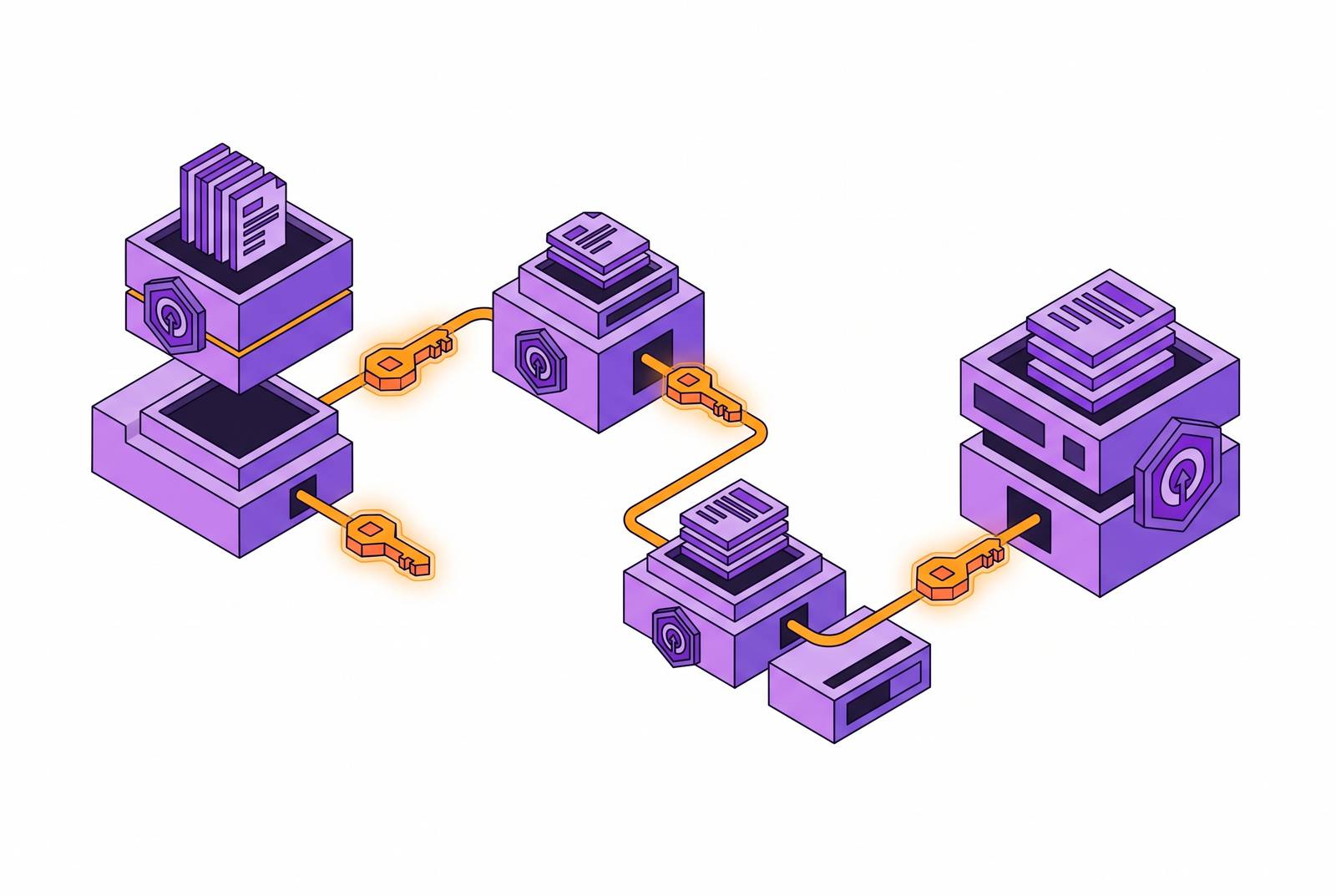
Session persistence is a contract between steps and runs. Cookies, localStorage, and authentication tokens must survive for as long as the workflow depends on them, including across separate agent invocations. A stateless call cannot provide that contract by itself. Without explicit persistence, an agent that successfully enters a gated dashboard has no dependable basis for resuming there later.
Credential state also needs its own storage and trust model. The practitioner approach treats browser cookies and localStorage as persistent, encrypted, per-account objects replayed on each connection. This allows a later run to resume without repeating login. But encrypting that state does not decide who should hold it. Developers who cannot accept a managed vendor's encryption and isolation boundary self-host, which requires an architectural fork.
Request identity extends beyond the proxy IP. It includes the TLS fingerprint, user-agent string, IP reputation, locale, timezone, and browser behavior signals. Those signals must agree with one another. A UK session that sends Europe/London, en-GB, and the correct timezone offset has signals that agree, while one that sends UTC and en-US is a datacenter proxy wearing a label.
The observe, plan, act loop does not handle these needs on its own. Nor does a well-designed MCP integration remove them. Tool discovery can expose a fetch capability without preserving its credentials or propagating its identity. These decisions belong below the planner because every later observation depends on them.
The four-layer model of agent web access and where each failure lives
Scrapfly names four layers of agent web access, which are fetching, observation, sessions, and tool integration. Each answers a different question about the same workflow. Fetching retrieves the page through HTTP or a browser. Anti-bot blocks, TLS mismatches, poor IP reputation, geographic mismatch, and rendering gaps belong here. A status code alone does not describe retrieval quality.
Observation turns the retrieved page into something the model can use. Raw HTML wastes tokens, changes to DOM structures break selectors, and an empty client-side rendering shell gives the model no content to work with. Fetching and observation can fail at the same boundary. Retrieving a document successfully does not mean the document contains the content needed for the task.
Sessions preserve identity and state across steps. Cookie expiry, proxy changes that break authentication, and credential loss between invocations belong at this layer. Their symptoms often look like bad reasoning. The agent may produce a wrong answer rather than report a session error because the page it sees no longer represents the authenticated user.
Tool integration governs how the agent discovers and calls these capabilities. It needs to distinguish a block from a 404 or a session expiry, propagate identity, and support adaptive tool budgeting. MCP improves discovery but does not yet standardize those production-scale primitives. The model provides a practical diagnostic map. A tool should be chosen for the failing layer.
Scraping API or managed browser for AI agents and LLM pipelines — when is each right?
Scrapfly states the default plainly, recommending a scraping API for reads and promotion to a managed browser when the agent must act. Read-only research, QA, and RAG ingestion need content. Stateless retrieval may still require anti-bot handling. It may also need structured JSON output so that fetching and extraction happen in one call, eliminating a separate DOM parsing step.
A managed browser fits multi-step authenticated work, including login, pagination through a gated dashboard, and form submission. The agent reads through the DOM, accessibility tree, or a screenshot, plans an action, executes it, and checks the result. That loop needs state between actions. Scrapfly's Cloud Browser API calls the feature that keeps state across invocations Session Resume, which lets the agent return without authenticating on every run.
Playwright provides the free, deterministic base with full control, while anti-bot handling, proxy rotation, and session management remain the developer's responsibility. Browser Use is another way to self-host for developers who cannot accept the managed trust boundary.
For buyers seeking LLM-ready content rather than raw HTML, output format is a separate criterion from runtime choice. Markdown removes the need for a separate parsing step, while developer-defined JSON schemas specify the shape of extracted data. Neither format shows that authenticated state is kept between calls. The choice turns on whether the workflow needs to act, whether it must keep the same identity across steps, and whether it must keep that identity across invocations.
What session continuity looks like in practice across three agent workflow patterns
RAG ingestion can use stateless page reads while preserving state in the pipeline. LinkedIn's agentic RAG paper describes an ETL pipeline with a snapshot pointer, so each refresh scopes retrieval to the latest snapshot without deleting prior content. The pipeline resumes from a known content state, and its identity concern is freshness.
Scheduled monitoring tends to be semi-stateful. Each cycle opens the target, waits for a relevant marker, reads the field, and closes the session. The browser session is deliberately short-lived. When a value crosses a threshold, the agent sends a notification, writes a record, or starts a downstream workflow. Consistency across cycles is the requirement, because a localized or personalized variant can undermine change detection even when every individual extraction succeeds.
Brand intelligence shifts the problem to entity identity. Tastelabs' Brand API separates extraction into an Extractor that turns a rendered page into a design system and source artifacts, a Search component that finds brands from plain-language descriptions, and a Verifier that compares pages for brand compliance. Brandfetch's Brand API returns known brands from its index, crawls unknown brands live on first request, and caches them. Stored entity state becomes the continuity mechanism. The agent needs two fetches of the same brand URL to point to the same entity, even when the page that appears is CDN-localized or A/B-tested.
How the emerging identity and trust layer changes what fetch infrastructure must do
Request identity is becoming a protocol concern as well as an infrastructure concern. The 2026 AI user-agent landscape includes at least five functionally distinct categories of AI traffic. A site can over-block and disappear from AI answers, or under-block and feed training pipelines its operator never intended to support. Fetch identity therefore has to show more than a browser request that looks trustworthy.
MCP's adoption does not mean this work is finished. As of early 2026, it does not yet standardize identity propagation, adaptive tool budgeting, or structured error semantics at production scale. MCP moved to the Linux Foundation's Agentic AI Foundation in December 2025, shifting its development from single-vendor control to open governance. Applications still need infrastructure that can surface failures clearly to the planner.
Amazon Bedrock AgentCore illustrates a related shift toward platform-level controls. It reached general availability in October 2025, and its Policy component reached general availability on March 3, 2026. Policy supplies deterministic, Cedar-based authorization for agent-to-tool calls at the Gateway. Authorization is distinct from session persistence. A policy layer decides whether a tool call is allowed, but that does not make it a runtime for browser state.
Signed Agent Cards give A2A cryptographically verifiable provenance in 2026. Web Bot Auth points in a similar direction for web requests. Coverage remains partial. The implication for teams building now is to use fetch infrastructure that can be upgraded to transmit signed identity claims as standards stabilize. Well-designed managed infrastructure positions teams to adopt those changes without maintaining every part of a bespoke scraper themselves.
What it means to treat the fetch layer as infrastructure rather than an afterthought
A fragmented stack creates more places for identity to drift. A scraper, crawler, proxy rotation service, and structured data vendor each introduce handoffs where session state can be lost. Consolidation can remove those handoffs. A well-designed API that handles fetching, rendering, anti-bot bypass, persistence, extraction, and crawling can maintain one consistent model of a session. Using fewer vendors helps only when they share that model.
Choosing whether to build or buy therefore involves more than what the infrastructure costs. In-house session management, fingerprint rotation, and proxy infrastructure require maintenance that delays the features teams want to ship. Fragility also consumes debugging time. Teams that accept a managed trust boundary can hand off that work, while teams that self-host keep control and remain responsible for it. Neither choice makes fetch reliability a one-time task.
At the API surface, usable infrastructure returns LLM-ready Markdown in a single call or structured data shaped by a developer-defined JSON schema. Full-site crawling supports scheduled RAG refreshes without a separately managed crawler fleet. Brand and visual identity data can come back as typed JSON, so teams do not have to write their own extraction code. These outputs serve different workflows. Their value is that the agent receives task-ready evidence.
Making results reproducible takes more work because search results, page content, prices, and business information change between requests. Versioned data, saved snapshots, controlled refresh intervals, source timestamps, and change monitoring belong in the fetch layer. A model trained a year ago does not contain last week's policy update, and a live request is useful only if it retrieves the right version, under the right identity, with the state the workflow requires.