Negotiating Data Contracts Between LLM Agents and Web Data APIs at Tool Registration Time
APIs must declare artifact freshness, scope, and integrity as enforceable contract terms.
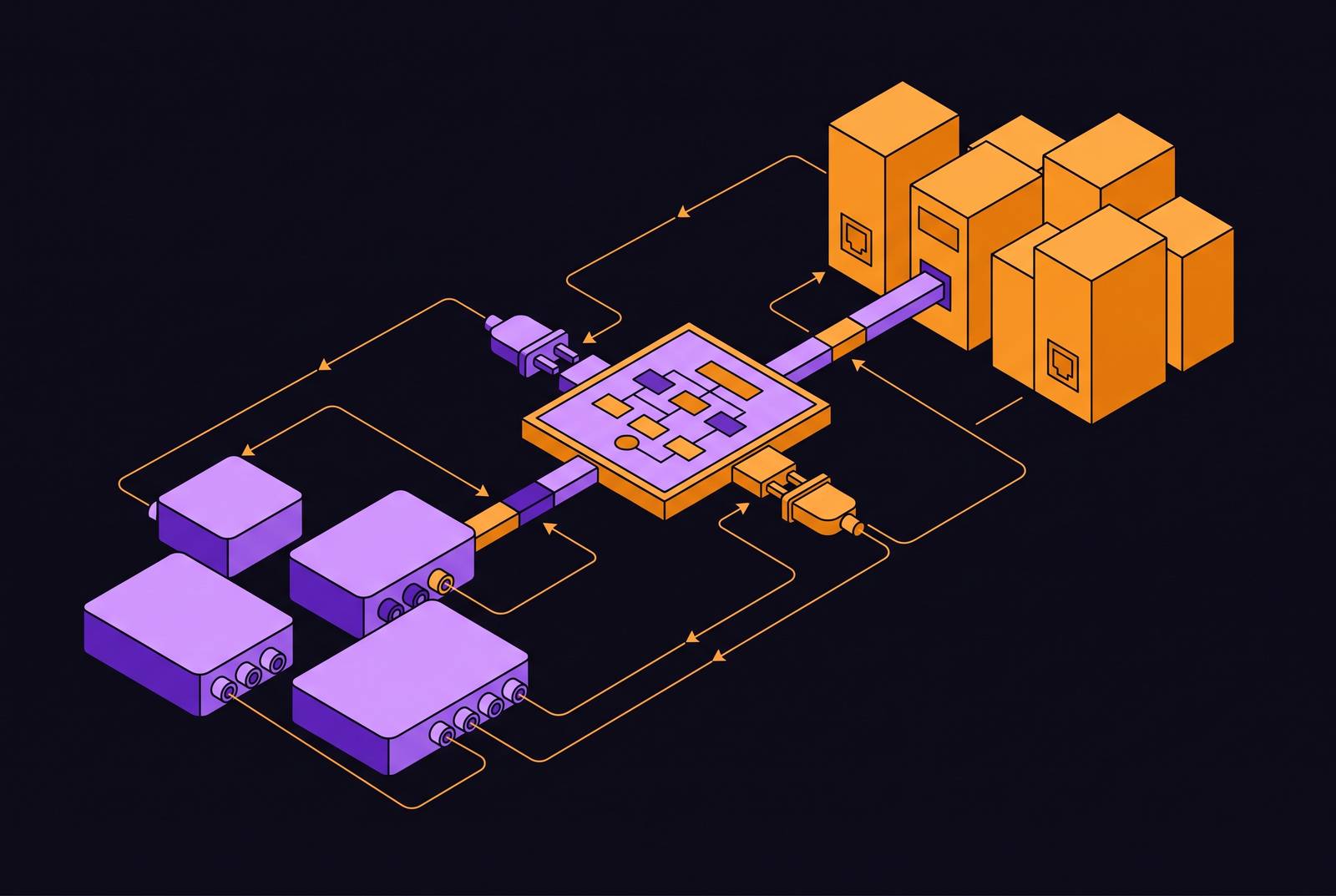
A web scraping API for AI agents and LLM pipelines should return clean Markdown for prose, caller-defined JSON for extraction, and explicit terms for freshness, scope, and artifact integrity. Registering that API as a tool is where those terms become a contract between the service and the agent. Reliable pipelines check that the contract holds at every handoff, so the model does not have to remember it.
Why tool registration is a contract negotiation, not a configuration step
Tool registration is often treated as plumbing. Add a URL, describe a function, and let the agent call it. That view leaves out the central design decision, which is what the caller may rely on and what it must preserve. Registration establishes those obligations before the first response enters the pipeline.
The agent loop makes this distinction concrete. An agent observes a tool result, decides what to do, and acts on that decision. The observation therefore determines more than the next answer’s content. Its structure and constraints set the terms for whether the next action can succeed.
ContractBench (2026) calls intermediate API outputs such as presigned URLs, session tokens, and OAuth state parameters “observation contracts.” The external system that makes each artifact sets rules for how it can be used later. A single violation between steps can invalidate the whole task flow, even when the agent chose the right tool and understood the task.
What the two sides of the contract actually are
The API commits to what it will return. That includes the output schema, with its fields, types, and structure, as well as whether the response is live, cached, or snapshot-based. It also includes constraints on returned artifacts, such as expiry windows, signing requirements, and byte-level integrity. Scope limits define what the service will and will not fetch, including robots.txt adherence and data minimisation rules.
The agent makes a different set of commitments. It must use time-bound artifacts within their validity windows, relay protected values without changing their bytes, and pass structured results onward in the specified shape. A summary is not a substitute for a required field. Nor is a semantically similar URL necessarily interchangeable with the original signed value.
ContractBench separates these obligations into two independent failure axes, validity and integrity, which it says existing benchmarks do not test. Validity checks whether an artifact can still be used when the agent acts. Integrity checks whether the artifact made it through without any change. Repairing one does not repair the other.
How the pipeline actively breaks the contract after registration
The path from an API response to the next tool call is not neutral. ContractBench’s taxonomy shows how the usual steps in a pipeline can damage artifacts even when the model makes the right decision. HTTP libraries can re-normalize percent-encoding in URLs, changing reserved characters and breaking signature-bound query strings. Middleware can reorder query parameters in the signing path, invalidating a signature. Rendered link text can also disagree with the underlying href, leading the agent to follow the wrong URL.
Delay creates a separate route to failure. Presigned S3 URLs, OAuth state parameters, and session tokens have expiry windows that a workflow can exhaust while waiting for LLM reasoning or retry logic. The bytes may stay exactly the same through that delay. The artifact is still unusable once its window closes.
Web data adds a related validity problem. A cached pricing page, competitor product listing, or brand contact record can look complete and well formed even when its data is out of date. Nothing about its clean formatting signals that loss of freshness. Tool descriptions alone cannot prevent these failures because the violation can occur in transit, in elapsed time, or in the choice of snapshot.
Why scaling the model does not reliably fix compliance
ContractBench describes observation contract compliance as an emergent and regression-prone capability, with performance that varies even among larger or newer models and independently of general tool-use ability.
That closes off an easy escape hatch. A model upgrade cannot be treated as a substitute for preserving bytes or checking whether an artifact has expired. The pipeline still contains the libraries, middleware, and delays that can break those conditions.
The lesson for teams is to put enforcement outside the model as well as instructions inside the tool definition. The schema should spell out the rules that must hold, while pipeline guardrails check them as the pipeline runs. This changes the purpose of registration documentation. It is not merely a description the LLM reads to choose a function, but a specification the surrounding infrastructure must enforce.
What should a web scraping API specify to return LLM-ready content, not raw HTML?
The definition of a web data tool used in production should call for clean Markdown for prose and structured JSON through a caller-defined schema for field extraction. Those outputs serve different jobs. Markdown is token-efficient and predictable to chunk for downstream retrieval, while typed JSON supplies values such as price, author, publish date, and product attributes without a separate parsing step. Raw HTML does not provide either contract by itself.
The input schema should make the requested work explicit. It includes a URL or query, filters, rendering mode, and the extraction schema that defines the desired fields and types. Crawl scope parameters belong there too, including crawl depth and robots.txt adherence. For work across more than one page, those parameters let the service follow links within the agreed scope, so the agent does not have to handle that logic.
The output definition must also describe handling constraints. Fields with expiry, signing, or byte-integrity requirements need explicit annotations, so their treatment is not confused with ordinary prose. The response must declare whether it reflects live content or a cached result, including the maximum staleness window for cached data. These are concrete criteria for judging whether an API’s output fits an LLM pipeline.
How freshness terms in the contract determine whether grounding actually works
Freshness is part of correctness. A pricing page, product specification, or company leadership page can change with no warning. An agent using the previous version can return a confident but wrong answer that still passes evaluations built around the old data. Without a freshness declaration, downstream steps have no signal that their grounding is out of date.
The trade-off is real and needs a name. Live extraction on every agent loop adds per-call latency and cost compared with vector store retrieval, while cached responses are faster but introduce a staleness window. The contract must state which approach applies. Otherwise, the agent has no way to tell how the age of each response should affect its use.
Instead of sending a notification for a person to triage, a monitoring service can expose a change as a machine-readable event. Semantic-diff mode uses natural-language instructions to judge which changes matter for the task, so competitive pricing monitoring can ignore rotating testimonials or minor layout updates. Through MCP integration, a hosted service can watch pages on a schedule and deliver judged changes directly to the agent. The schedule and freshness terms therefore belong in the registration design.
Compliance and legal obligations that now belong in the tool definition
Scope restrictions are also compliance decisions. Data minimisation, source exclusions, source-type filters, and output sanitization hooks belong in named, checkable tool parameters. The team writing the definition sets limits on later fetches as well as describing the technical interface.
The EDPB’s July 2026 guidelines, issued for public consultation, recommend data minimisation measures, including filters and source exclusions. That distinction limits what a schema can claim. Encoding those measures supports compliance work, but does not turn the tool definition into proof of legal compliance.
MCP also leaves implementation responsibilities with the host. Its consent requirement is not enforced at the protocol level, and mandatory credential revocation on session close and mandatory audit trails are absent. The MCP specification requires servers to sanitize tool outputs and recommends client validation before results reach the LLM. A production registration design must address those responsibilities.
Using formal contracts as runtime guardrails, not just design-time documentation
A complete schema still needs an execution check. ContrAgent (2026) proposes a research framework that represents agent behavior as a sequence of tool calls over checkable predicates. It uses assume-guarantee contracts in linear temporal logic over finite traces, or LTLf, to state how the agent must behave. In plain terms, the contract describes conditions that must hold as the sequence unfolds.
Each contract is compiled into a deterministic finite automaton, or DFA, that supports two uses. Online, it checks whether to let agent actions go ahead. Offline, it evaluates recorded traces against the same contract. The framework reports deterministic, reproducible verdicts with orders-of-magnitude lower per-call latency than LLM-judge baselines in online mode.
For web data pipelines, these roles connect the specification to its enforcement. Online checks can make sure the agent meets duties such as token validity and intact URL relay, while offline evaluation can check whether the pipeline’s recorded steps kept to the promised data shape and constraints. This is a research direction. Write tool definitions around checkable predicates now, with the schema serving as the specification and the compiled contract as a test harness. A contract library maintained separately from the model can then be reused across agents in the same task domain.
What agent-to-agent communication adds to the contract negotiation problem
A downstream agent needs more than the extracted data. It also needs the conditions under which that data remains usable. When an orchestrator calls a web data tool and passes the result to a sub-agent, the freshness window, artifact constraints, and schema shape must travel with the result.
A2A extends the negotiation to this second boundary. Whether the contract holds now depends on what both the API’s direct caller and the sub-agent do. A sub-agent receiving structured extraction without its freshness window may treat an old result as authoritative. A sub-agent that gets a signed URL without its integrity constraint may change a value that must stay exactly the same.
Both repeat the validity and integrity problems already present between an agent and an API, but farther from the original registration. The design implication is contract portability. Tool definitions should make their terms legible and forwardable through the agent graph, so downstream consumers receive the obligations as well as the output.
The registration-time checklist — what good contract negotiation looks like in practice
For teams registering a web data tool, the first decisions concern output shape and handling. Define extracted values as typed JSON fields through a developer-specified schema, and specify clean Markdown for prose content. Mark artifact expiry and byte-integrity requirements as checkable properties. Declare whether results are live or cached, with a maximum staleness window where caching applies.
Encode source exclusions, data minimisation filters, crawl limits, and output sanitization hooks as named parameters or typed constraints. Treat the EDPB guidance as guidance at its stated consultation stage. Assign the host-side responsibilities that MCP does not enforce.
Identify values that must be relayed byte-for-byte and document the segments that can corrupt them, including framework token limits, HTTP re-encoding, and middleware parameter sorting. Add integrity validation, such as SHA-256 verification for signed artifacts, at handoff points where values can be damaged. An unchanged value still needs a validity check before use.
Finally, write predicates for temporal validity, required field presence, and schema conformance that can support deterministic guardrails following the ContrAgent pattern. Keep that contract library independent of any specific model, and make its terms available to downstream agents. The acceptance test is whether the pipeline can detect a broken promise before acting on it.