Anti-Bot Evasion Patterns and Their Impact on Agent Web Access
Legitimate AI agents get flagged by anti-bot defenses built for actual threats.
Anti-bot systems were built for a specific enemy: credential stuffers, scrapers stealing competitive pricing data, DDoS-adjacent traffic floods. AI agents trying to ground a retrieval pipeline or run a research task were never the target. But detection systems don't check intent. They check behavior and environment, and an AI agent fetching a page often looks exactly like the bot the defense was built to stop.
The numbers explain why platforms treat this as a real threat category rather than noise. Imperva's Bad Bot Report put bad bots at 32% of all internet traffic Imperva 2025 Bad Bot Report. Cloudflare found that 38.7% of the top million websites received AI bot traffic in 2024, and by 2025 AI bots made up 8.7% of all HTML traffic Imperva 2025 Bad Bot Report. Gartner projected that 40% of enterprise apps would carry task-specific AI agents by the end of 2026, up from under 5% in 2025 Advanced Evasion Techniques and Architecture Analysis of Cloudflare B…. That trajectory means the collision between agents and defenses is a permanent structural feature of the web, not a temporary growing pain Advanced Evasion Techniques and Architecture Analysis of Cloudflare B….
For developers, this failure appears as a maddeningly specific pattern. A pipeline tests clean in a sandbox, then ships to production and starts returning empty JSON or a blocked page. The instinct is to blame the model or rewrite the prompt. Usually that's the wrong diagnosis. The retrieval layer is where it breaks, not the reasoning layer. Fixing that requires understanding what's actually checking the agent's credentials before a single token of content ever reaches it.
The evolution of anti-bot defenses from static rules to adaptive ML systems
Early anti-bot defense was blunt and brittle. IP blacklists, User-Agent string checks, rate limiting: all of it defeatable by rotating a proxy and spoofing a header. The second generation raised the bar with behavioral heuristics, JavaScript challenges, and CAPTCHA, but these were still fixed rule sets waiting to be reverse-engineered.
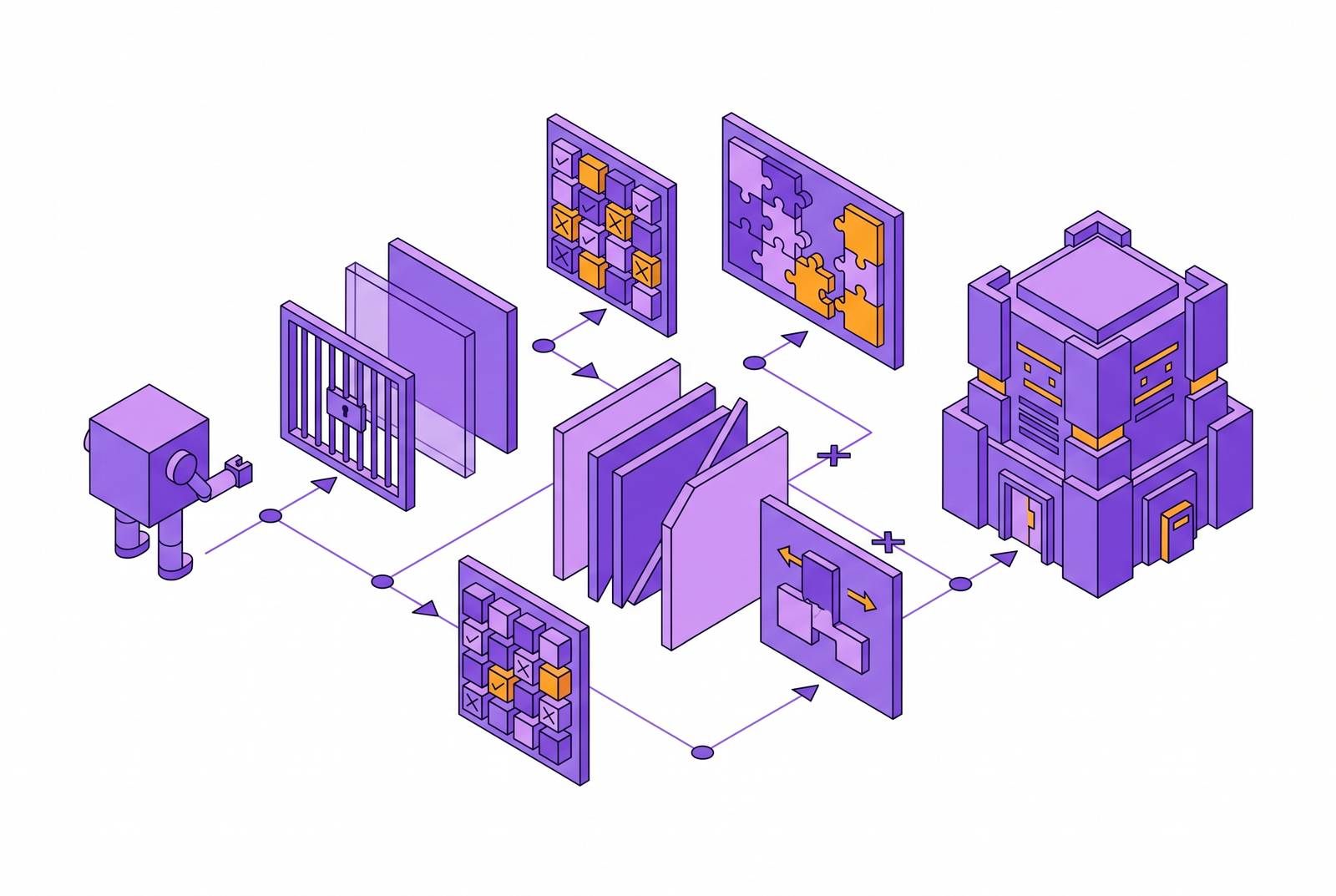
The current generation is different in kind, not just degree. Per the ScrapingBee analysis, anti-scraping systems stack multiple simultaneous layers at once, including login walls, IP reputation scoring, behavioral biometrics, and JavaScript fingerprinting. These aren't fixed rule engines anymore. They're adaptive machine learning models that retrain when new evasion patterns appear. Defensive platforms were mitigating something like 6% of all global web traffic, classifying it as potentially malicious or anomalous, according to the Medium/Aggarwal analysis. That's a huge share of the internet running through a classifier before it ever reaches its destination.
One structural problem forced this shift: nearly 40% of global bot traffic comes from major cloud infrastructure providers like AWS and GCP Advanced Evasion Techniques and Architecture Analysis of Cloudflare B…. Defenses had to move toward behavioral and cryptographic signals instead, since where a request comes from tells you far less than it used to.
None of these layers needs to be individually unbreakable. That's the real architectural insight producing all of this. The goal is to stack enough friction that the combined cost of evasion outweighs the value of whatever data sits behind it. Every layer covered from here forward, TLS fingerprinting, Cloudflare's specific toggles, login walls, behavioral biometrics, is one line item in that cost calculation. The first one starts before an HTTP request even exists.
TLS and JA4 fingerprinting: detection that happens before a single HTTP header is read
JA3 fingerprinting hashed the raw values of a TLS handshake's extensions to identify what client was connecting. It had an obvious hole: randomize the order of those extensions, and the hash changes, so evasion was almost trivial.
JA4, developed by FoxIO, closes that hole. It sorts the extensions before hashing them and folds in extra signals like ALPN values and TLS version. Randomizing extension order no longer moves the fingerprint at all. Cloudflare maintains fingerprint databases mapping known legitimate browser sessions against JA3 and JA4 values, so a Chrome session running on macOS has a specific, recorded JA4 signature.
That creates a very unforgiving mismatch problem. If a script announces itself as Chrome through its User-Agent header, but produces a different JA4 fingerprint, the discrepancy is immediate and definitive (no behavioral analysis needed). There's no need to watch how the "user" scrolls or clicks. The connection is flagged before a single cookie gets set.
This is where agent frameworks quietly sabotage themselves. Most HTTP client libraries used inside agent tooling, Python's requests, Node's axios, curl-based fetchers, produce TLS fingerprints that don't match any real browser on record. Even Playwright-based agents aren't automatically safe: if the underlying TLS stack isn't configured to precisely mirror the target browser, the mismatch is visible anyway. An agent can nail every application-layer behavior, polite headers, sensible request timing, a convincing User-Agent, and still get flagged before the server has processed anything at all. Fixing this means operating inside a real browser's network stack, or replicating it with real precision, not just imitating its HTTP manners.
Cloudflare's specific defense stack at 22.7% of the web
As of May 2026, W3Techs put Cloudflare's share of all websites at 22.7%, meaning roughly one in four URLs an agent fetches sits behind this single system.
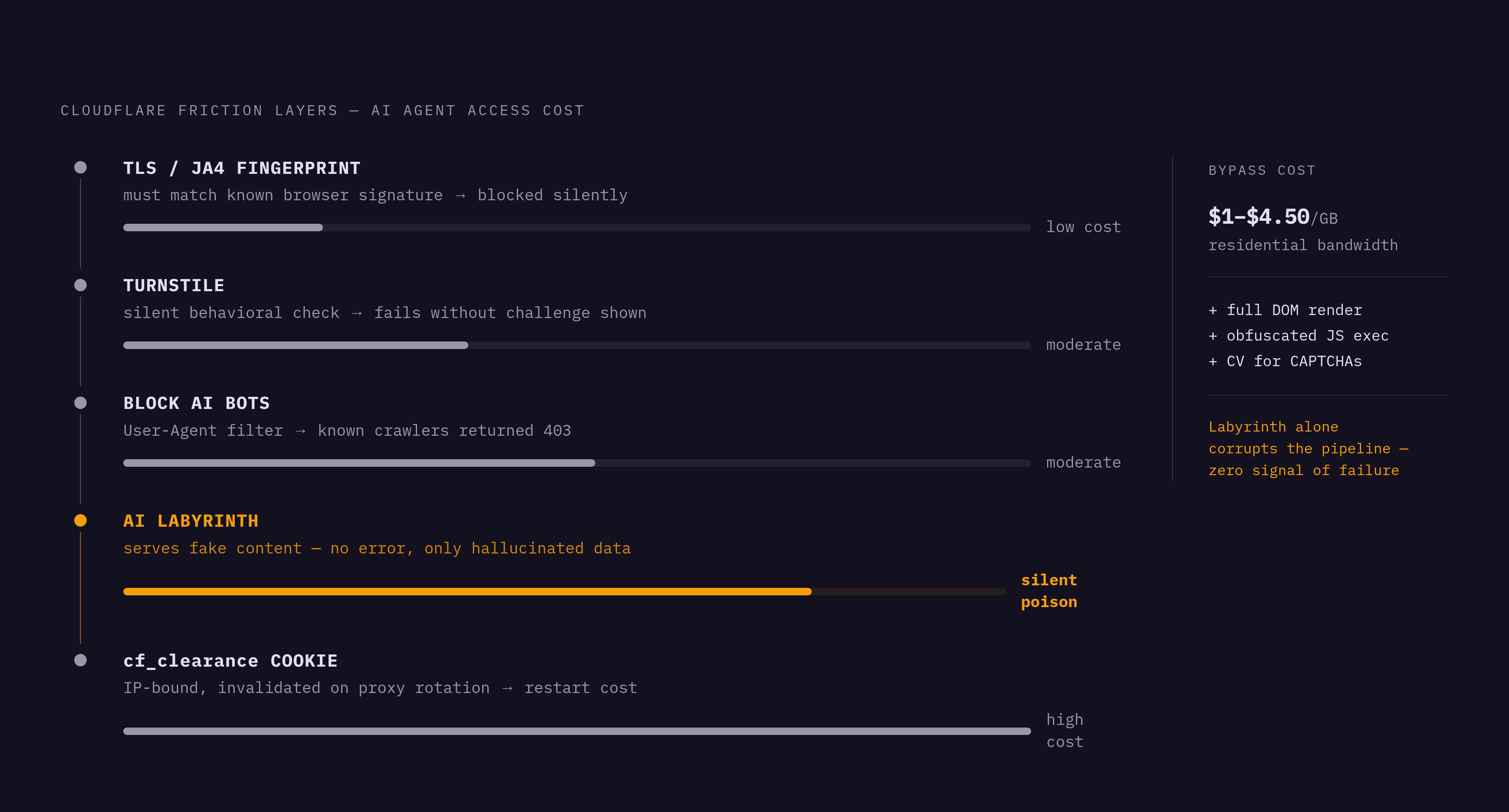
Turnstile is Cloudflare's silent replacement for CAPTCHA. It watches browser behavior, JavaScript execution, and device characteristics through fingerprinting, all without ever showing a visible challenge. An agent can pass the JavaScript execution test and still fail the environmental authenticity check running quietly behind it.
Separate from both of those sits "Block AI Bots," a toggle aimed specifically at known LLM-based crawlers used for AI training, naming ChatGPT, Claude, Perplexity, and Gemini agents directly.
The AI Labyrinth is the strangest piece of the stack, and arguably the most consequential for anyone building agent pipelines. Instead of blocking a suspected crawler outright, it serves convincing but entirely fake content, designed to waste compute cycles and fingerprint the crawler while it processes garbage. An agent that can't tell it's inside the Labyrinth won't get an error; it will process and return hallucinated data, a qualitatively different failure mode from a clean block.
Then there's the cf_clearance cookie, cryptographically bound to the IP address that earned it. It requires a sticky session: the same IP has to persist for the whole session to keep that clearance valid. Rotate a proxy mid-session, a common scraping habit, and the clearance already earned gets thrown out instantly. Add it up: bypassing Cloudflare in 2026 means rendering full DOMs, executing obfuscated JavaScript, running computer vision against CAPTCHAs, and buying residential bandwidth priced somewhere between $1.00 and $4.50 per gigabyte. None of that needs to be mathematically impossible to beat. It just needs to cost more than most operators are willing to pay.
Login walls and session management for authenticated content
Login walls turn a stateless fetch into a stateful obligation. Sessions have to be maintained, cookies handled, CSRF tokens navigated correctly, and each of those steps is a distinct point where an agent that wasn't built for persistent browsing can quietly fail. Modern authentication goes well past username and password. Multi-factor prompts, device fingerprinting, and session validation stack together to make unauthorized access economically unworkable for most scraping operations, according to the ScrapingBee analysis.
Headless browsers like Puppeteer and Playwright can simulate the whole login flow: filling forms, executing JavaScript, holding session state across page loads. But they carry their own tells. Missing browser plugins, navigator properties that don't match any real install, timing patterns in form completion that don't look like a human's. All of these bleed through even when the login itself technically succeeds.
The deeper problem is specific to agents running multi-step workflows: search, hit a login prompt, retrieve content, move to the next page. Every one of those steps has to carry the same consistent environmental signals, not just the first one. A fingerprint mismatch that occurs at step three doesn't just fail step three. It invalidates the work the agent already did at steps one and two, because the session that carried it there is no longer trusted. Clearing the network layer and the TLS layer and the login wall still isn't the finish line. Behavioral detection is waiting at the interaction layer, watching how the agent actually moves once it's inside.
Behavioral fingerprinting: how typing, scrolling, and mouse movement expose AI agents
Browser fingerprints by themselves don't discriminate that well anymore, especially once multiple AI browsing agents happen to share the same underlying browser fingerprint, according to the FP-Agent paper. Behavioral signals are where agents actually give themselves away, and the FP-Agent research catalogued the tells with real specificity.
Agents tend to paste entire strings into form fields instead of typing them character by character, the way a person does. They fill forms through change events rather than incremental keystrokes, and they show repeated delete-and-retype patterns that don't match how humans correct typos. Cursor movement jumps straight to the click target instead of drifting through the space in between, and scrolling comes in either instantaneous jumps or oddly discrete multi-burst patterns, both distinct from the smoother curve of human scrolling.
The FP-Agent classifier caught all seven AI browsing agents in its study. Cloudflare's deployed system, tested against the same seven, caught only one. That gap matters: it means today's live defenses are underperforming what behavioral data can already support in a research setting, a strong signal that deployed detection is going to get sharper, not that it's stuck. The multi-layer fingerprinting paper (arXiv 2606.30119) found that all six evaluated LLM-based web agents could be distinguished from humans and from one another using combined network-, HTTP-, and browser-level signals, with even agents with stealth mechanisms showing detectable signatures across at least one layer. Behavioral mimicry is a moving target that shifts as defenses adapt, and whatever slips past today's classifier becomes tomorrow's training data.
The environment authenticity problem: why clean browser environments fail non-interactive defenses
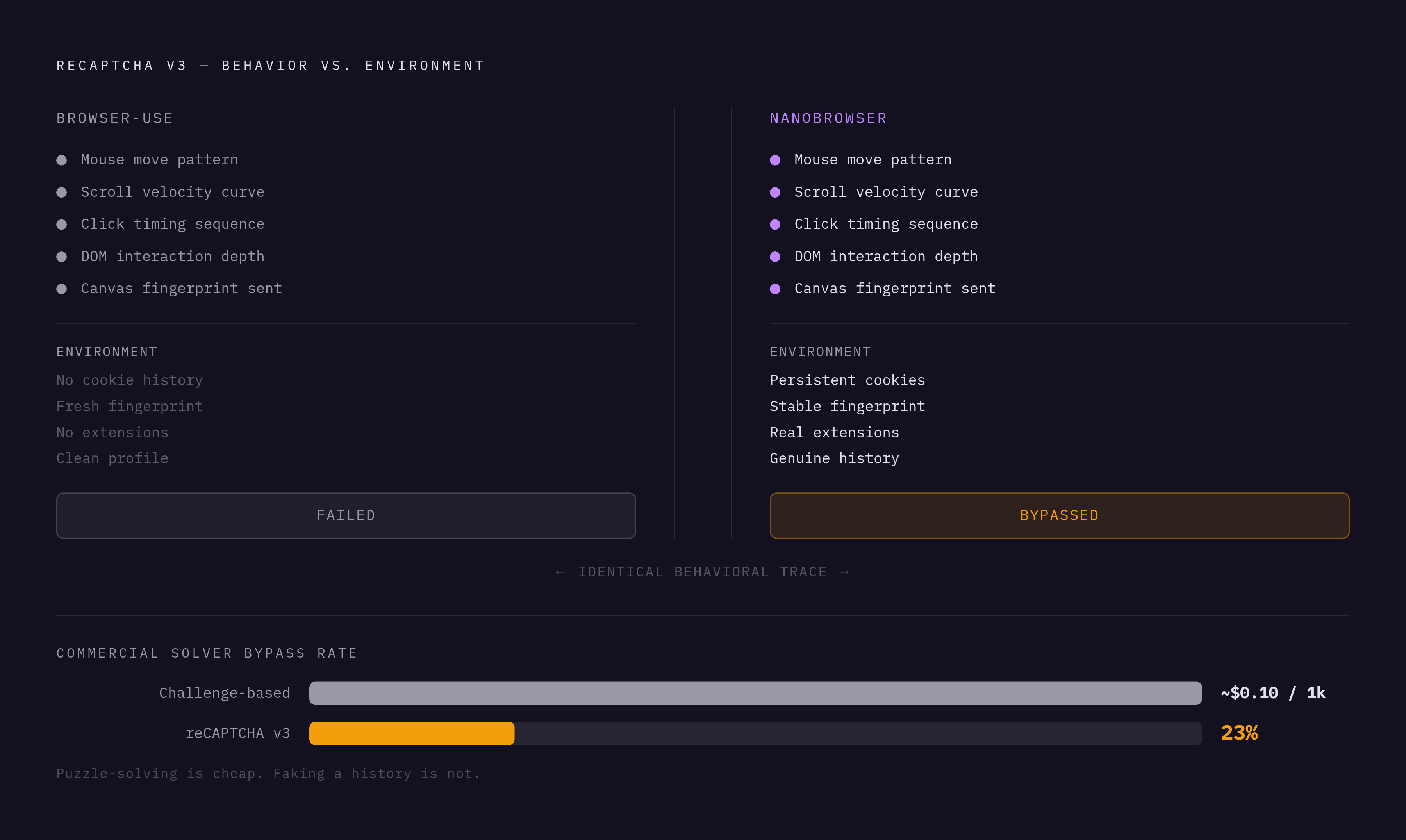
A July 2026 paper nicknamed "Broken Gates" ran a precise, almost surgical experiment on this question. The paper (arXiv 2607.18659) found that Browser-Use and NanoBrowser produced nearly indistinguishable behavioral event traces against reCaptcha v3, yet NanoBrowser consistently achieved bypass while Browser-Use failed. Same clicks, same timing, same scroll patterns, more or less.
The difference had nothing to do with behavior. The execution environment produced the difference. NanoBrowser ran inside a real browser profile, carrying persistent cookies, actual browsing history, installed extensions, and stable fingerprinting signals built up over time. Browser-Use ran in a clean, freshly instrumented environment with none of that accumulated history. The paper's conclusion is blunt: for non-interactive defenses like reCAPTCHA v3, the real security boundary is the environment layer. Long-term environmental legitimacy decides the outcome, not how convincingly the agent mimics a mouse.
What counts as environmental authenticity, concretely? A browser profile with cookies and cache built from genuine prior sessions. Fingerprints that stay stable across runs instead of being regenerated fresh every time. Browsing history that a real user would have accumulated simply by existing online. And the absence of instrumentation artifacts, things like CDP flags or automation-specific navigator properties that give away a controlled browser instantly.
The economics back this up sharply. Commercial CAPTCHA solvers achieve near-perfect bypass rates on challenge-based CAPTCHAs, at costs as low as $0.10 per 1,000 solves, according to "Broken Gates" Broken Gates: Re-evaluating Web Bot Defenses in the Age of LLM Agents. But against reCAPTCHA v3, where environmental authenticity is the deciding factor rather than challenge-solving skill, those same solvers average only 23% success Broken Gates: Re-evaluating Web Bot Defenses in the Age of LLM Agents. Solving a puzzle is cheap. Faking a history is not.
The detection asymmetry between simple HTTP agents and browser-based agents
General-purpose AI assistants that pull content through simplified HTTP requests, essentially cURL with extra steps, don't execute client-side scripts and don't perform any user-like interaction. According to the June 2026 arXiv paper, these are trivial to detect or block at the network layer. There's no ambiguity in that case. The request either matches a browser profile or it doesn't.
Even Playwright-based agents can expose mismatches if the TLS stack isn't configured to exactly replicate the target browser. They render JavaScript, they perform real interactions, they can even solve CAPTCHAs, so the entire detection burden shifts onto behavioral and environmental signals instead of the network layer. That asymmetry means the same website can behave in completely different ways depending on what kind of agent is knocking. A headless HTTP request might get blocked instantly at the edge. A browser session might sail through the same page and get served fabricated content instead, or pass through cleanly and never know the difference. Same target, three different outcomes, depending entirely on which tier of agent shows up.
The open-source ecosystem has already adapted to this split. But the same agents remained distinguishable by fingerprint the whole time. Bypassing a defense today says nothing about whether that same technique survives once classifiers catch up, and given how fast the FP-Agent and multi-layer research moved in a matter of months, catching up doesn't take long.
A second, quieter asymmetry exists in Cloudflare's own toggles, produced by how those toggles are configured Imperva 2025 Bad Bot Report. "Block AI Bots" targets known LLM training crawlers by their User-Agent string. A production agent that identifies itself honestly, with a legitimate, non-training User-Agent, can dodge that specific block entirely and still get caught by TLS fingerprinting or behavioral signals a few layers deeper. Passing one gate says nothing about the next.
The emerging governance layer: robot standards, HTTP signatures, and pay-per-crawl models
None of the technical evasion arms race solves the underlying coordination problem, which is that compliance right now is voluntary. Sites can publish robots.txt directives, keep allowlists of known AI traffic, or adopt emerging Web Bot Auth mechanisms. But nothing forces adoption. Malicious operators ignore these signals by default, and even well-intentioned agent builders sometimes skip them too, according to the FP-Agent paper.
Standards work is catching up, slowly and through the usual channels. The IETF's AI Preferences Working Group, tracked under draft-ietf-aipref, is building machine-readable consent signals so sites can state their preferences in a format software can actually parse. As of August 2026, draft-ietf-aipref-vocab-07 and draft-ietf-aipref-attach-05 were both still in progress. Alongside that, a draft filed September 1, 2026, draft-ietf-webbotauth-httpsig-protocol-00, lays out HTTP Message Signatures for automated traffic, a formal mechanism for agents to cryptographically authenticate their identity to servers.
Cloudflare has also introduced mechanisms aimed at turning AI bot traffic into a paid relationship rather than an adversarial one. Taken together, these efforts point toward a future where legitimate agents don't need to out-fingerprint every defense layer just to read a public page. They authenticate themselves honestly, and the site decides the terms up front. That future isn't built yet. Until it is, understanding TLS fingerprinting, Cloudflare's specific toggles, session persistence, and behavioral tells is the actual job for anyone building an agent that needs the live web.
Sources
- Advanced Evasion Techniques and Architecture Analysis of Cloudflare Bot Management Systems in 2026 | by Ayush Aggarwal | Medium
- Broken Gates: Re-evaluating Web Bot Defenses in the Age of LLM Agents
- FP-Agent: Fingerprinting AI Browsing Agents
- On the Internet, Nobody Knows You’re an LLM Bot:
- AI Bot Protection: Detect & Control Agentic AI Traffic | Imperva
- Usage Statistics and Market Share of Cloudflare, September 2026