Live Web Grounding to Overcome LLM Knowledge Cutoffs
Routing live information to models at query time is the only real fix for training data cutoffs.
Knowledge cutoffs get talked about like a bug that'll eventually get patched. That belief about cutoffs eventually getting patched is wrong. A cutoff is structural: the date training data stops, full stop, and no amount of waiting fixes it. The only real fix is routing around it, at query time, by feeding the model live information it never trained on. This piece covers how that works and what it takes to build.
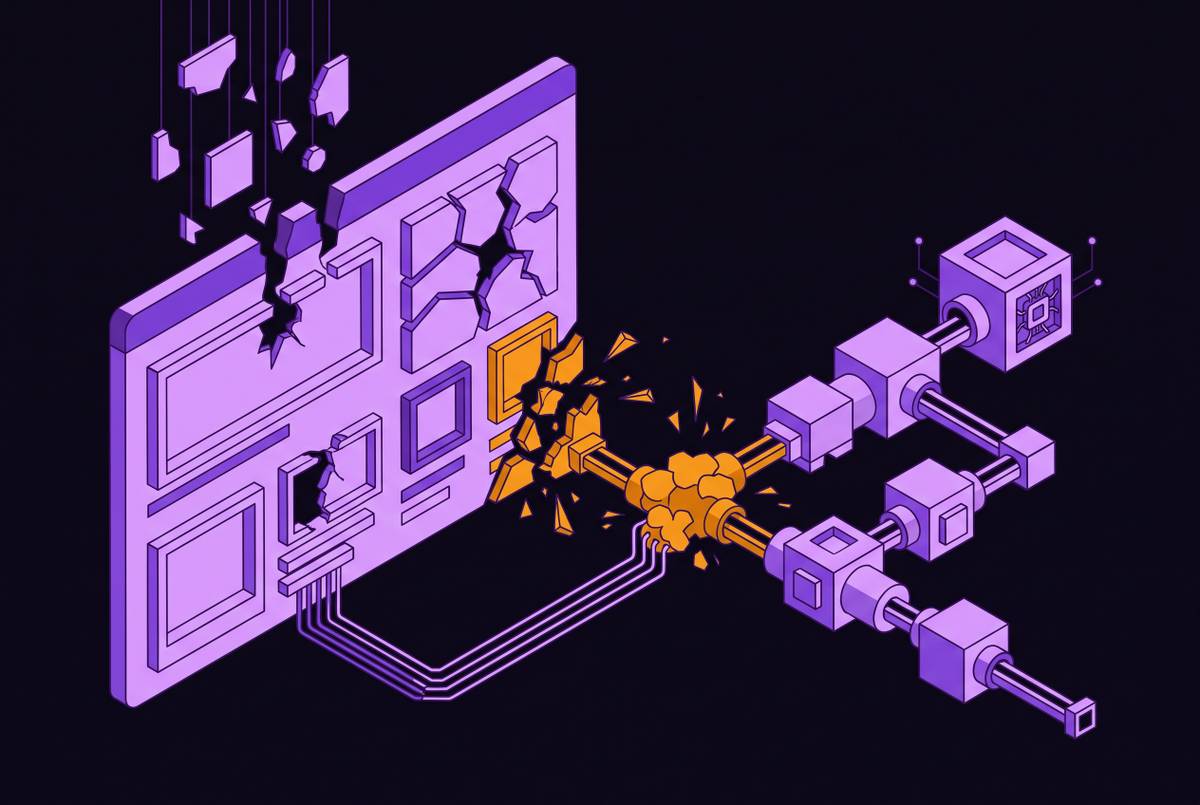
Start with the confidence issue: most people misdiagnose it. When a model answers a question about something that happened after its cutoff, it doesn't say "I don't know." It answers anyway, often with total confidence, and often wrong. That looks like hallucination. It doesn't know it's wrong. It's an information mismatch baked into how the architecture works: the model has no internal flag for "this is outside what I know," so it just predicts the most plausible-sounding continuation based on whatever it learned. Ask a support bot about a policy that changed last month and it'll cite the old one like it's gospel. Ask a sales copilot about a competitor's pricing and it'll quote a number that hasn't been accurate in a year. Ask a coding agent to call an API and it might generate a method that got deprecated eight months ago. Ask about a product that launched after the model's cutoff, and the model won't just get it wrong, it'll often name a competitor instead, because that's the closest match sitting in its weights.
The gap between training data and the present moment doesn't stay fixed either. A model with a December 2025 cutoff looks perfectly current in early 2026. Run that same deployment, unchanged, for three years, and the gap keeps widening every single day nobody touches it. Nothing about the model changes. The world just keeps moving without it.
Cutoffs are approximate. Providers publish a month, rarely a day, and data collection for training always wraps up well before the model actually ships. Even inside the stated cutoff window, coverage isn't even, some topics are thin in the training corpus regardless of date. And asking the model itself what its cutoff is? Don't. Metehan.ai notes that self-reported cutoffs are unreliable because models aren't trained to accurately identify themselves. Check the provider's API docs or model card instead. The provider's API docs or model card are the only source worth trusting.
Where the major models stand on training data freshness as of mid-2026
The figures below lean on metehan.ai, cross-checked against otterly.ai. Where the two disagree, the more recent source wins.
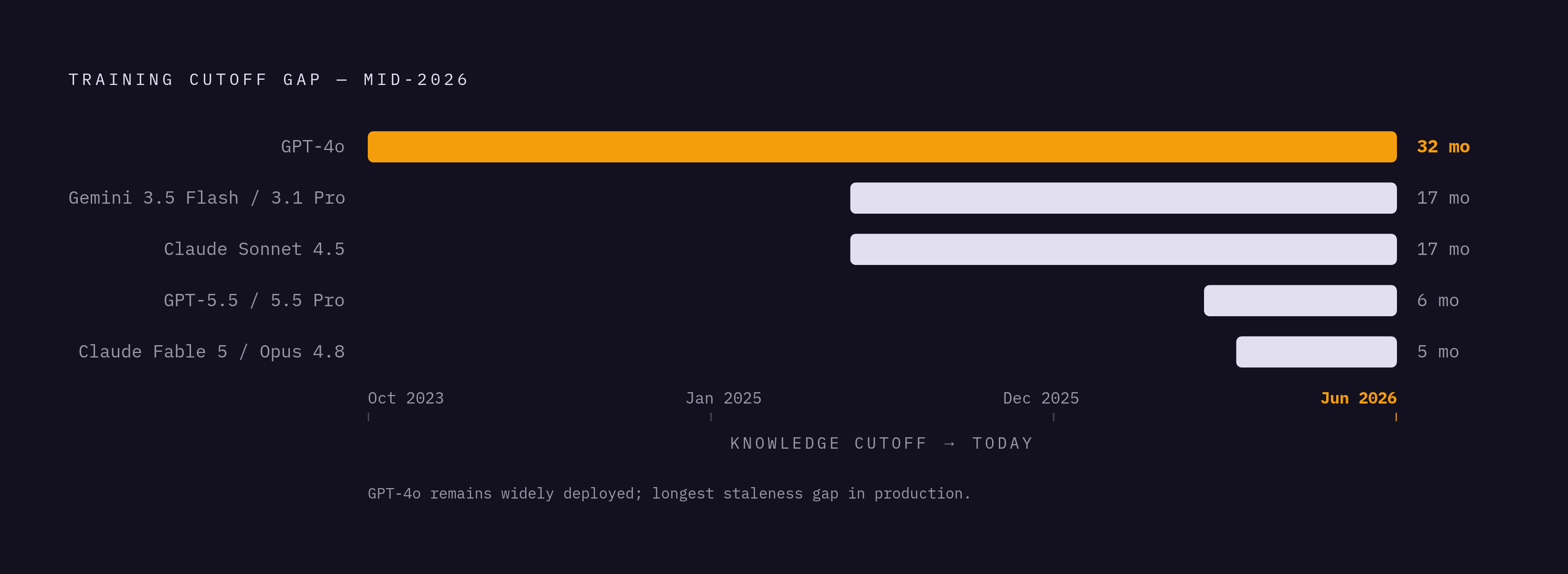
OpenAI's GPT-5.5 and GPT-5.5 Pro carry a December 1, 2025 cutoff, listed as Tier 1 according to metehan.ai. Meanwhile GPT-4o, still running inside plenty of production API integrations, is at an October 2023 cutoff. That's a gap now closing in on three years for anyone still calling that model.
The Anthropic Help Center, via metehan.ai, lists a shared January 2026 reliable knowledge cutoff for Claude Fable 5 and Claude Opus 4.8. Claude Sonnet 4.5 splits the difference oddly: a reliable knowledge cutoff of January 2025, but a later training data cutoff, per github.com's model card records. Two different dates carry two different meanings, so read the fine print on whichever Claude model gets deployed.
Google's Gemini line makes the point about release dates versus training freshness better than any other example. Gemini 3.5 Flash shipped in May 2026. Gemini 3.1 Pro shipped in February 2026. Both list a January 2025 cutoff in Google's own documentation. Metehan.ai's review finds that a newer release does not mean newer training data, and third-party blogs claiming Gemini 3.5 Flash carries a January 2026 cutoff are simply wrong.
Open-weight models don't get the benefit of the doubt at all. Llama 4 carries a substantial gap between its training cutoff and today, and because there's no web access layer built in, that cutoff is absolute. Every tool built on frozen open-weight Llama is running on frozen knowledge, permanently, unless someone builds a grounding layer on top of it.
Add it up and the pattern is obvious: even the freshest frontier model on the market today is carrying a gap measured in months, and the older models still doing real production work are carrying gaps measured in years. No model updates itself. That's not a criticism, it's just the mechanical reality of how these systems get trained and shipped.
Models with native browsing can partially override their own cutoff for factual lookups, but that's a distinct case from the one above. Models with native browsing, ChatGPT with browsing enabled, Gemini with Search Grounding, Grok pulling from X and the web, can partially override their own cutoff for factual lookups. But in the API, that browsing has to be explicitly turned on as a tool, and it usually comes with extra per-use cost. It is not automatic the way it feels in the consumer apps. Skip the tool configuration in an API call and the model falls straight back to frozen training data, no warning given. And open-weight models (Llama, Qwen, Gemma, open Mistral variants) don't have a search layer at all, under any configuration. For those, a developer-built grounding layer isn't an option, it's the only route to current information that exists.
What native browsing in cloud models does and does not solve
Native browsing works by having the model call a search tool mid-inference, pull back snippets from a handful of ranked URLs, and weave those snippets into its answer. That's retrieval bolted onto training, not a replacement for training, and the distinction matters for what it can and can't do.
It handles a specific kind of question well: something factual, with a short current answer, where a snippet is genuinely enough. "What's the current interest rate," that kind of thing.
Where it falls apart is control. Which pages actually get fetched, how the text gets cleaned up before the model sees it, what shape the final output takes, none of that sits in the developer's hands with native browsing. It's a black box wrapped around search. And that black box usually only exists as a consumer product feature. API callers who don't explicitly wire up browsing tools get frozen training data by default, silently. Open-weight deployments don't get the option at all.
There's also a structured-output problem. Native browsing hands back prose. If the pipeline needs JSON matching a specific schema, that prose has to get parsed and reshaped after the fact, which adds a fragile extra step. And retrieved information isn't automatically more reliable than what's baked into training. Retrieved content can actually be harder for a model to synthesize correctly than its core training knowledge, especially with no quality controls on what gets pulled in. Native retrieval is a tool, and like most tools, it's only as good as what feeds it. It's a tool, and like most tools, it's only as good as what feeds it.
So what does a serious pipeline actually need? Control. A developer who decides exactly what gets fetched, exactly how it gets cleaned, and exactly what structure it lands in before it ever reaches the model.
How live web grounding works: the search-scrape-inject pipeline
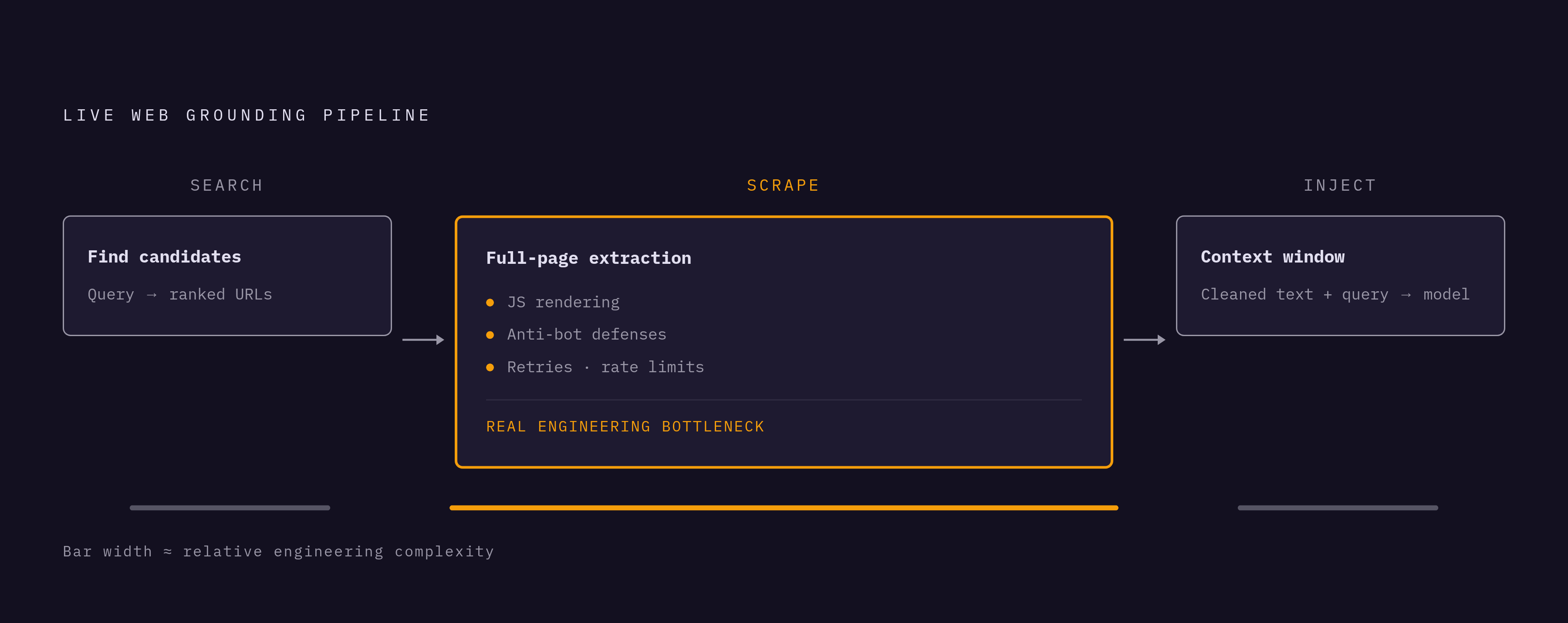
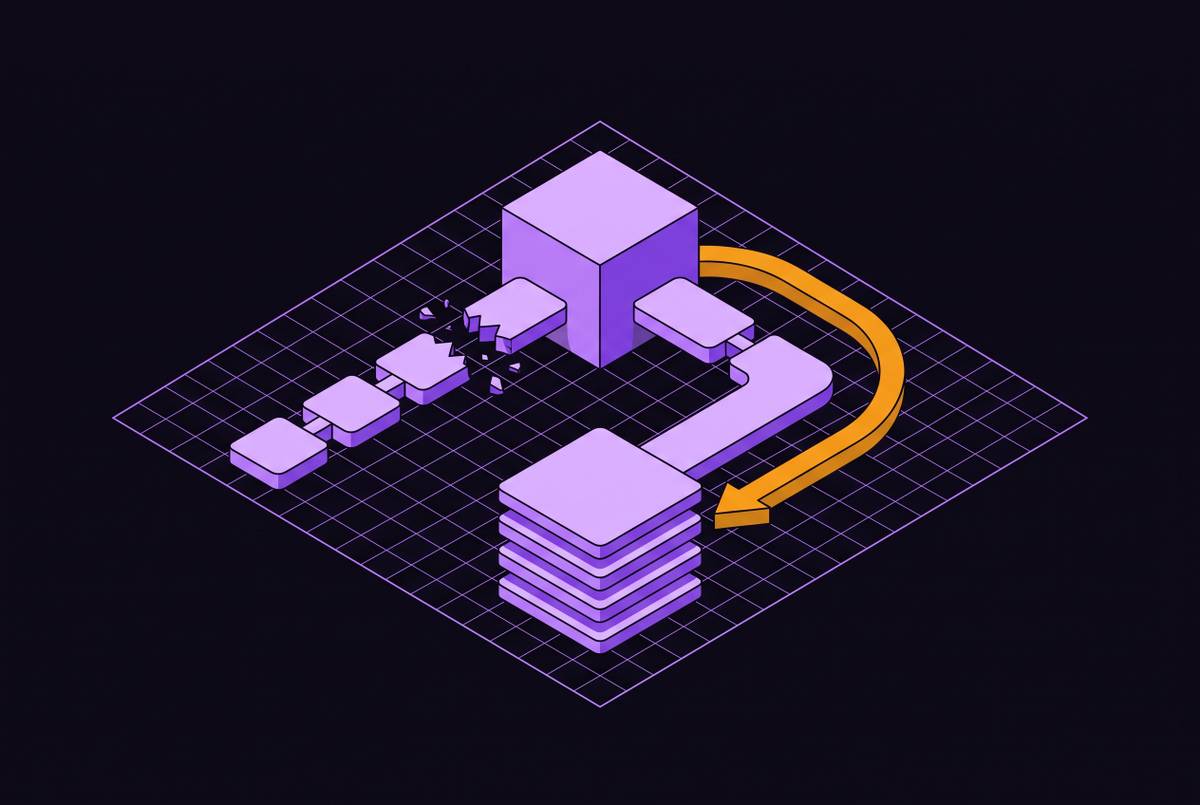
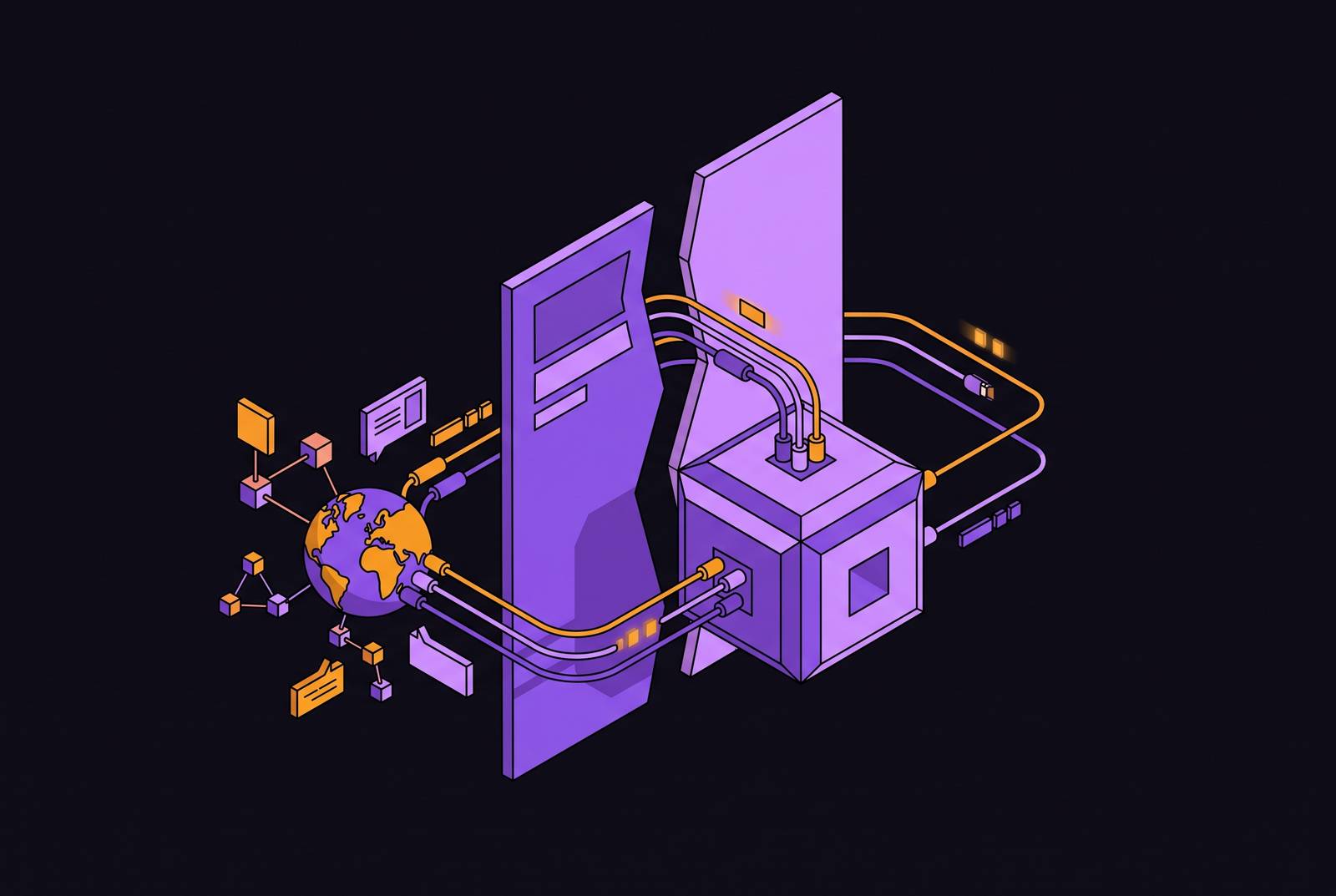
The pipeline has a shape, and the middle step is where most of the real engineering happens. Search finds candidate sources. Scrape pulls the actual content off those pages, full text, not a two-line snippet, because a short excerpt leaves gaps in the context the model needs to reason over. Inject drops that cleaned content into the context window alongside the query, so the model answers from real, current material instead of from memory.
Fine-tuning solves a different problem entirely: it changes how a model talks inside a domain, not what it knows. Fine-tuning changes how a model talks inside a domain, tone, format, style. It cannot teach a model what a court ruled last Thursday. No amount of retraining substitutes for retrieval when the need is "what just happened." That's a category error a lot of teams make early on, throwing fine-tuning at a freshness problem it was never built to solve.
Static RAG solves a version of the problem where information goes stale, but only a version. A vector store reflects the world exactly as it looked the last time someone ran an ingestion job. Live web grounding, done right, is current at the moment of every single query. There's no corpus sitting there waiting to go stale, because there's no corpus at all in the traditional sense.
That split maps cleanly onto two kinds of use case. Internal document Q&A, where the underlying material barely changes week to week, is a great fit for static RAG. Anything where the correct answer depends on what happened yesterday needs live web grounding instead.
Why static RAG alone is not enough when freshness is the requirement
RAG earned its place in production pipelines for a real reason: it constrains a model's output to retrieved sources rather than letting it guess from training-time patterns, and that constraint markedly cuts hallucination on fact-heavy tasks. The retrieved text gives the decoder something like ground truth to lean on instead of a probabilistic guess.
RAG also beats fine-tuning on cost and speed for keeping knowledge current. Update the retrieval database, and the model's answers update right along with it. No retraining run, no specialized processing hardware tied up for days, none of the expense that comes with fine-tuning a model every time something changes.
But RAG has a ceiling, and it's a hard one. A vector store is only as fresh as its last ingestion job. A regulation that changed last week sits completely outside the corpus until somebody manually re-ingests it, and that's not a settings problem to tweak, it's structural to how the architecture works. No amount of tuning the retrieval pipeline fixes a corpus that simply doesn't contain the new information yet.
Live web sources close that gap by giving the model a continuously updated view of reality instead of a fixed snapshot from three weeks ago. They also pick up long-tail information the vector store may never have held in the first place, pages too obscure or too new to have made it into any ingestion run.
The field's moving past plain vector search too. 2026's direction is adaptive retrieval, graph-based reasoning over documents, long-document memory, and agentic retrieval (often shortened to A-RAG), where the model itself decides when to retrieve and what to go fetch. Retrieval is turning into a reasoning and memory layer, not just a lookup step bolted onto generation.
Stacking a cross-encoder reranker on top of multi-query expansion adds real latency, and it adds up fast at scale. A two-stage approach, a smaller, cheaper rerank pass first, with the larger model reserved for just the top results, can reduce latency without giving up much accuracy.
None of this means static RAG is obsolete. For most production systems, the two approaches split the work: static RAG covers stable internal knowledge, live web grounding covers anything time-sensitive. They're not competitors. They're two tools solving two different halves of the same freshness problem.
The real obstacle in web grounding: getting the page, not understanding it
Extraction itself has quietly gotten easy. The old approach, brittle CSS selectors and parsing scripts that snap the moment a site redesigns its layout, is giving way to LLM-native extraction, where a developer just describes what they want and the model finds it across wildly different page structures. That part of the problem is basically solved.
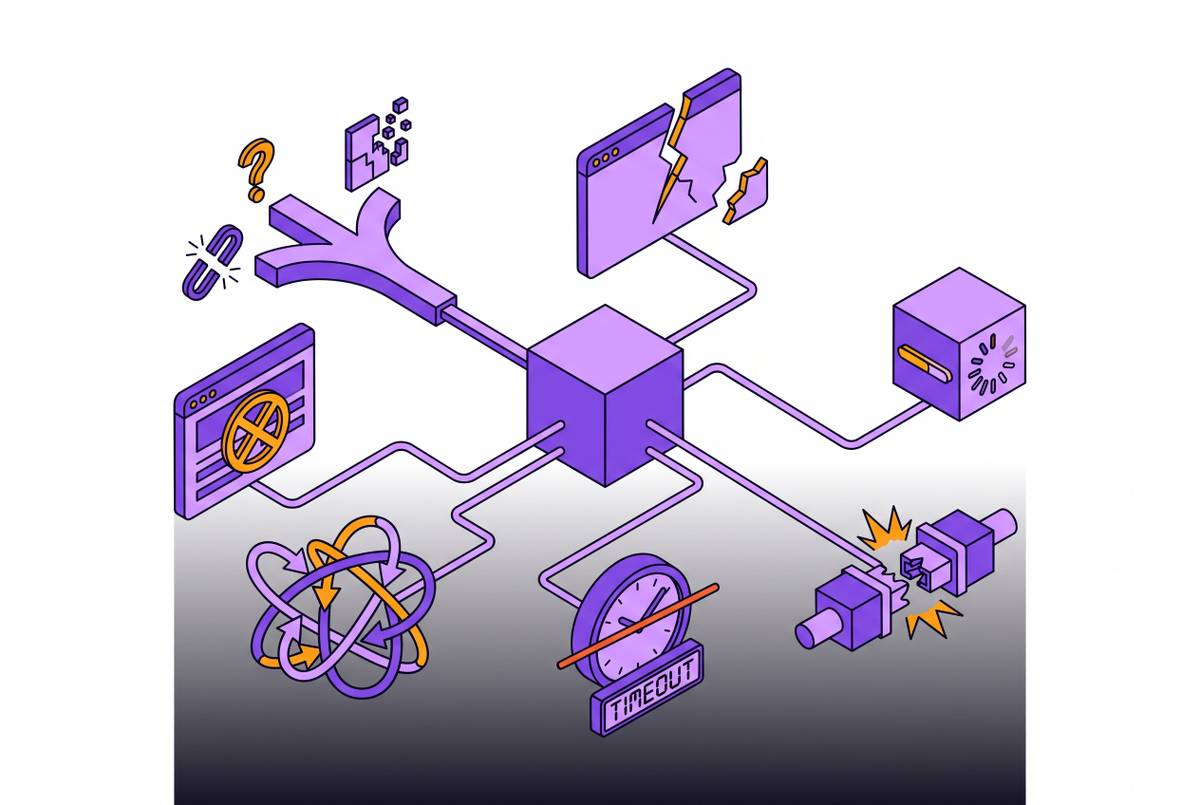
Fetching the page in the first place is where things actually break. Every tool that promises clean, LLM-ready output fails the same way when it hits a site running anti-bot defenses: silently. The extraction logic is fine. The page simply never arrives.
JavaScript rendering makes this concrete. W3Techs data, cited via browserless.io, puts React on 6.1% of all tracked websites, Vue.js on 0.7%, and Next.js on 2.7% as of mid-2026. A plain HTTP request against most of these returns an empty shell, no content, because the actual page gets built client-side after the initial load. Getting real content back out requires a headless browser or a rendering-capable API, no way around it.
That reshuffles the whole pipeline design. Dynamic rendering, anti-bot handling, retries, rate limiting, all of that has to be sorted out before any extraction logic even runs. Get the fetching layer wrong and it doesn't matter how good the extraction model is downstream.
Speed matters too, once volume climbs. Serppost.com reports that implementing asyncio for concurrent requests in an AI agent pipeline can cut total ingestion time by up to 40% when targets are high-latency. And scale is exactly where tools that work fine on a handful of test pages start falling apart, concurrency limits, request queuing, retry logic, and rate-limit handling become the actual failure points, not the extraction step everyone worried about at the start.
Tools and APIs for building the scrape layer in 2026
Crawl4AI is open-source and built specifically around feeding LLM pipelines, not adapted from a general crawler after the fact. It runs on Playwright for JavaScript rendering and outputs two versions of every page: raw_markdown, the full page, and fit_markdown, boilerplate stripped out, main content only. For anything feeding a model, fit_markdown is almost always the right call, no nav bars, no footers, no sidebar clutter competing for the model's attention. Best fit for teams who don't mind owning a Python dependency and running their own infrastructure underneath it.
Scrapfly takes a managed-infrastructure approach. Scrapfly's own blog states that its Crawler API handles site-wide RAG ingestion, competitor research, and ongoing content monitoring at scale, managing queues, retries, and throttling behind the scenes. It also ships a CLI mode that wraps scraping as a callable skill for LLM co-pilots like Claude Code or Gemini CLI: scrapfly scrape <url> --render-js --asp --format markdown covers rendering, anti-bot handling, and markdown output in one line. Fits teams that want the infrastructure managed and want scraping exposed as something an agent can call directly.
Browser Use is open-source and takes a different angle entirely: an LLM drives an actual browser toward a plain-language goal, clicking, navigating, and extracting on its own. It's built for agentic tasks where the path through a site isn't known ahead of time, where a fixed selector or a fixed URL pattern just doesn't apply.
Picking between these comes down to a few real questions. Is JavaScript rendering required, or is the content already in the raw HTML? Is the volume a few dozen pages a day or thousands? Does the task need a fixed scrape-and-extract flow, or does it need an agent that improvises across an unfamiliar site? Is there appetite to run and maintain the infrastructure, or is managed the better trade?
Whatever gets picked, the point doesn't change: a model's cutoff date is fixed the moment training ends, and the only way to answer a question the model wasn't trained on is to hand it real, current material at the moment it's asked, because the model itself has no mechanism for acquiring information after training stops. That's not a workaround. That's the whole architecture of getting an LLM to be right about anything that happened after it stopped learning.
Sources
- LLM Knowledge Cutoff Dates: Every Major AI Model’s Training Data Cutoff (2026)
- LLM Knowledge Cutoff Dates (Every Major Model Fact-Checked, June 2026) | metehan.ai
- Grounding LLMs with Fresh Web Data to Reduce Hallucinations | Towards Data Science
- joinmassive.com
- scrapfly.io
- dev.to
- confident-ai.com
- en.wikipedia.org