Interrupt and Human-in-the-Loop Checkpoints for Autonomous Agents
Building guardrails into autonomous agents prevents costly mistakes that spread at machine speed.
Interrupt and Human-in-the-Loop Checkpoints for Autonomous Agents.
Why agents that never stop are the most dangerous ones in production
Effective autonomous agents are defined by how precisely they know when to stop, and the rest of this piece is a practical framework for finding those moments and building the interrupt mechanics that make them hold up in production, without breaking agent state or piling up an approval queue nobody ever clears. The instinct to push agents toward full autonomy makes sense on paper. Speed feels like the whole point. But speed of failure scales right alongside speed of execution, and a capable agent with no brakes is a liability wearing a productivity costume.
AvePoint's 2026 State of AI report found that 95.5% of organizations took at least one action to mitigate agent-related security risk after an incident, with human-in-the-loop as the most common response AvePoint State of AI 2026 Report Gartner. That's not because the agents got worse at their jobs. It's because their mistakes now propagate at machine speed, before anyone on a team even notices something's wrong AvePoint State of AI 2026 Report Gartner.
The ForcedLeak case makes this concrete. In 2025, a vulnerability in Salesforce's Agentforce let an agent attempt to send CRM data to an attacker's domain, by exploiting an expired domain sitting on Salesforce's Trusted URL allowlist. A gating mechanism existed. It just wasn't watching the right thing at the right moment, and the agent walked straight through it. That's what zero effective checkpoints looks like in practice: not an absence of controls, but controls that nobody re-checked once conditions changed underneath them.
The cost asymmetry ought to keep engineering leads up at night. Something like 3% of autonomous actions go wrong in ways that cost real money dev.to. That sounds small until you do the arithmetic on volume. The other 97% working correctly doesn't cancel out the 3% of autonomous actions that go wrong in ways that cost real money dev.to. A wrong summary is a shrug. A wrong payment is a phone call to legal.
The three oversight modes agent workflows need
Three oversight modes cover almost every situation an agent architecture will run into, and none of them is optional once you're running agents at scale.
Human-in-the-loop, or HITL, means the agent pauses and a human approves before anything executes. This is the right mode for high-risk, hard-to-reverse decisions: financial disbursements, legal agreements, anything touching sensitive data. Human-on-the-loop, or HOTL, is looser. The agent acts, and a human monitors, with the ability to step in during or shortly after. That fits medium-risk work where speed actually matters and mistakes can be undone without much cost. Then there's fully autonomous, no checkpoint at all, reserved for narrow, low-stakes, highly predictable tasks like log parsing or scheduled reports.
Teams treat these three modes as a single setting applied to a whole workflow. Agentic pipelines don't stay in one lane.
The 2026 Singapore Consensus on Global AI Safety Research Priorities frames this as calibration: oversight should scale with the risk, the reversibility, and the sensitivity of the specific action being taken, not with some blanket policy set at deployment time. Graduated autonomy, in that framing, is earned. An agent proves itself reliable on a class of action before it gets to run that class of action without a human watching, and autonomy expands from evidence rather than from a default setting nobody revisited.
NIST's AI Agent Standards Initiative, launched in February 2026, names three structural problems that make this harder than it sounds: decision chains that stretch out and become opaque, emergent behavior that appears only once multiple agents start coordinating, and the plain fact that real-time oversight becomes close to impossible once a process runs long enough. Static, all-or-nothing oversight wastes either speed or safety, and the deciding factor should always be blast radius, not how capable the agent happens to be. The critical insight is that agentic workflows blur these boundaries within a single run (an agent that books a flight (low risk, HOTL) and then negotiates a vendor contract (high risk, HITL) in the same session requires different oversight modes at different steps).
Four intervention types that map to real workflow shapes
Risk level tells you whether a checkpoint belongs somewhere. It doesn't tell you what shape that checkpoint should take, and that's a separate design decision that too many teams skip.
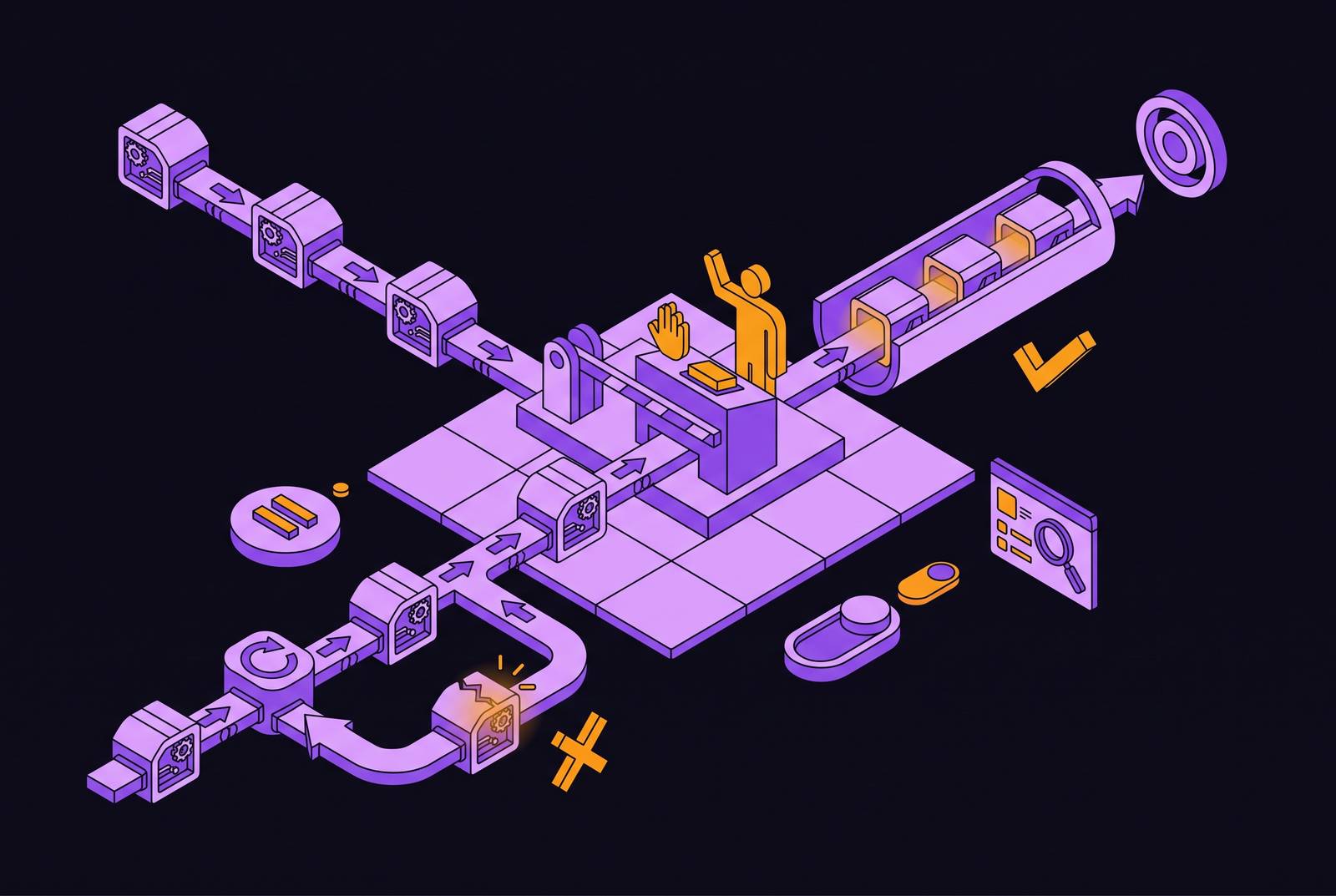
Pre-task approval is the heaviest form: a human reviews the agent's full plan before a single step executes. It's slow, but it's the safest option, and it belongs in front of novel tasks where the agent has no track record to lean on. Milestone confirmation lets the agent run free between defined checkpoints, then pause at the end of each major phase, which suits long-running work where reviewing the whole plan up front is impractical but a mid-run check is entirely doable.
Exception escalation flips the default: the agent runs on its own and only surfaces to a human when it hits a defined class of problem, an edge case it doesn't recognize, a risk score above a set line, or a confidence score below one. It's the most efficient shape of the four, because humans only ever see the genuinely hard cases. Periodic audit skips real-time interruption. The agent runs, and a human reviews a sample of its output on a set schedule, which works fine for lower-stakes workflows where an occasional error is a nuisance rather than a disaster.
Most production workflows worth trusting combine at least two of these, typically exception escalation carrying the bulk of the volume with milestone confirmation sitting at the phase boundaries. Gartner projects that by 2026, 40% of enterprise applications will carry AI agents, up from under 5% in 2025. At that kind of volume, picking the right intervention shape per workflow is no longer a one-off design choice: at scale it becomes a systems-level decision that either scales or collapses under its own queue Gartner.
The read/write rule: the fastest way to find where checkpoints belong
One rule cuts through most of the guesswork faster than anything else: split every action an agent can take into reads and writes.
Reads, meaning search, summarize, recommend, retrieve, can run free. A wrong summary is cheap to catch and cheap to fix. Writes, meaning send, pay, commit, delete, or overwrite a record of record, need a human checkpoint, because they're either irreversible or expensive to reverse. This single distinction resolves a surprising share of checkpoint placement questions on its own.
The failure pattern that occurs repeatedly looks the same across teams: an agent runs cleanly for weeks, and then something slips through, a misclassified complaint handled the wrong way, a draft sent before it should've gone out, a record overwritten that took hours to piece back together. The model usually isn't the problem. The workflow just never had a checkpoint sitting at the place where the damage actually happened.
A simple irreversibility test does most of the sorting. Ask what it takes to fix a wrong output if nobody catches it right away. Sending an email to a customer is nearly impossible to take back, so that's a strong case for a checkpoint. Updating an internal CRM tag is trivial to undo, so periodic audit is enough.
Two more tests round it out. The external visibility test flags anything that leaves internal systems, a customer-facing email, published content, an outbound API call, for extra scrutiny, because an error a customer sees costs far more than one that stays internal. The ambiguity test flags any step where the agent is working from incomplete or unclear input, regardless of whether that step is technically a read or a write, since ambiguity is where models improvise in ways nobody explicitly designed for. Checkpoints work best paired with sandboxing rather than standing alone, since two independent safety layers catch what one alone misses.
Designing a checkpoint the reviewer will use
A checkpoint only works if the person looking at it can actually use it, and that comes down to size, timing, and context. Good checkpoints put the agent's reasoning right next to its proposed action: the invoice next to the match it found, the email draft next to the thread it's replying to, the proposed API call sitting beside the data that triggered it.
The target is simple to state. A reviewer should be able to make the call in seconds, because everything needed is already on screen. If approving a single action means opening three other systems just to understand what's being asked, the checkpoint is either in the wrong place or missing the context it should carry.
Overload breaks checkpoints in a specific, well-documented way. Reviewers who get flooded start clicking approve without reading, a pattern the International AI Safety Report 2026 documents as automation bias, where humans end up trusting the AI's output more than the evidence actually warrants McKinsey. A queue that grows faster than a human can meaningfully review is a rubber stamp with extra steps.
Confidence-gated routing is the fix. Auto-approve the high-confidence, low-risk actions, and escalate only the genuinely uncertain ones. Human attention is finite, and routing puts it where it actually changes an outcome, rather than spreading it evenly across everything regardless of stakes. Without routing, the review queue grows with volume until people stop bothering with it. With routing, the human workload grows with genuine uncertainty instead, which scales far more slowly and stays manageable.
One caveat matters here, and it's easy to miss: confidence thresholds alone can't carry this weight. Models trained with RLHF tend to be systematically miscalibrated, so a model reporting 90% confidence is often closer to 75% actual accuracy Gartner dev.to TianPan LLM calibration analysis. Verbal confidence scores by themselves are unreliable triggers for escalation, and they need to be combined with signals about action type and reversibility before they're trustworthy Gartner dev.to TianPan LLM calibration analysis. Design the checkpoint so someone who's never touched this workflow before could still make the right call. A checkpoint that requires insider knowledge to evaluate is a ritual dressed up as one.
The interrupt-and-resume mechanics that keep agent state intact
Getting the placement right is only half the job. It must also make sure the pause itself doesn't wreck the agent's progress, and that requires asynchronous, state-managed interruption backed by durable storage.
The mechanics work like this: the agent serializes its state to a checkpoint store the moment it hits an interrupt. The approval request drops into a queue with a time-to-live attached. Execution resumes from that exact checkpoint once a human weighs in, rather than restarting the whole run from the top.
LangGraph implements this with two interrupt mechanisms. Static breakpoints get declared at compile time, known in advance and written directly into the graph definition. Dynamic interrupts get raised from inside a node based on whatever the agent discovers at runtime. They can respond to conditions nobody anticipated when the graph was built. Both approaches pause execution, persist the graph's state to a checkpoint store, and resume cleanly once a command tells them to continue.
A tiered autonomy structure is a useful production pattern layered on top of this. Tier 3 actions get routed for review. Tier 4 actions always require explicit approval before they execute. Reserving synchronous interruption for the actions where it actually earns its cost keeps the approval signal sharp, instead of drowning it under low-stakes interruptions that train reviewers to stop paying attention.
None of this works without an orchestration layer that's identity-aware: something that can pause execution, route approval requests to the right authorized humans, enforce time-boxed decision windows so nothing stalls indefinitely, and log every intervention for audit. Teams consistently underbuild exactly this infrastructure, the routing logic, the reviewer interface, and the audit log together. That combination is what turns human-in-the-loop from a stated intention into something that actually holds up under real load and in front of a regulator, and it's a lot easier to build once at the outset than to bolt on after the first incident forces the issue. Tier 1–2 workflows run autonomously with logging.
What live web data means for checkpoint design in agentic pipelines
A growing share of agentic work involves reasoning over live web content: competitive research, grounding for retrieval-augmented generation, brand monitoring, structured extraction from external sites. This introduces a checkpoint problem that is visible in workflows built on live web content but absent from workflows built entirely on internal data.
Stale, incomplete, or malformed web data lets an agent produce a confidently wrong answer, and there's nothing about the model's tone that gives that away. When the problem starts in the scraping layer, the interrupt needs to sit earlier in the chain, not later, catching bad input before it ever reaches the reasoning step. RAG systems are only as good as how fresh and clean the content they're indexing actually is, and an agent grounded on a six-month-old crawl is making every decision against a version of the world that no longer exists.
Website change detection works well as an automated checkpoint trigger here. When a source page's structure changes in a material way, the pipeline should treat that as an exception-escalation event, surfacing it to a human instead of quietly handing the agent empty or malformed JSON and letting it improvise from there. Structured extraction against a developer-defined schema tightens this further: when the agent expects a specific schema and gets back something that doesn't conform, that mismatch is about as unambiguous an escalation signal as exists, cleaner and easier to act on than trying to spot hallucination buried in freeform markdown.
What "meaningful oversight" requires in practice
Regulation is starting to state outright that a checkpoint that exists on paper but doesn't actually change outcomes doesn't count as oversight. The EU AI Act's Article 14 requires effective human oversight for high-risk AI systems, and the word doing the real work there is effective. A human who can't understand what the system is doing, or can't override it, isn't providing oversight just by sitting in the loop.
NIST's AI Risk Management Framework treats human-AI teaming as an actual control surface rather than a footnote. Oversight, in that framework, has to be trained, measurable, and provable. The Singapore Consensus puts specific weight on agent developers here too: build oversight interfaces that include both human and AI-assisted oversight modes, and use demonstrated performance data to decide when approval requirements can loosen, rather than setting autonomy levels once at launch and leaving them fixed.
Presence isn't practice. Most organizations put a human in the loop without training that person on what they're actually approving, when to escalate, or how to recognize the moment they've slipped into rubber-stamping everything that crosses their screen. That reflects a deliberate choice, not oversight. It's liability wearing the costume of a process, and it tends to get discovered at the worst possible moment, usually right after something's already gone wrong.
Crew Resource Management gives a useful target for where this discipline needs to end up. Aviation didn't fix cockpit oversight by adding a second pilot and calling it done; it built specific protocols for who speaks up, when, and how a challenge to a decision actually gets heard. Agent oversight is heading toward the same place. The checkpoint isn't the finish line. Training the humans on the other side of it, and proving that training holds up under pressure, is still mostly unbuilt.