Handling Paywalls and Login Walls in Agentic Web Retrieval
Paywalls block retrieval pipelines before models ever see the content.

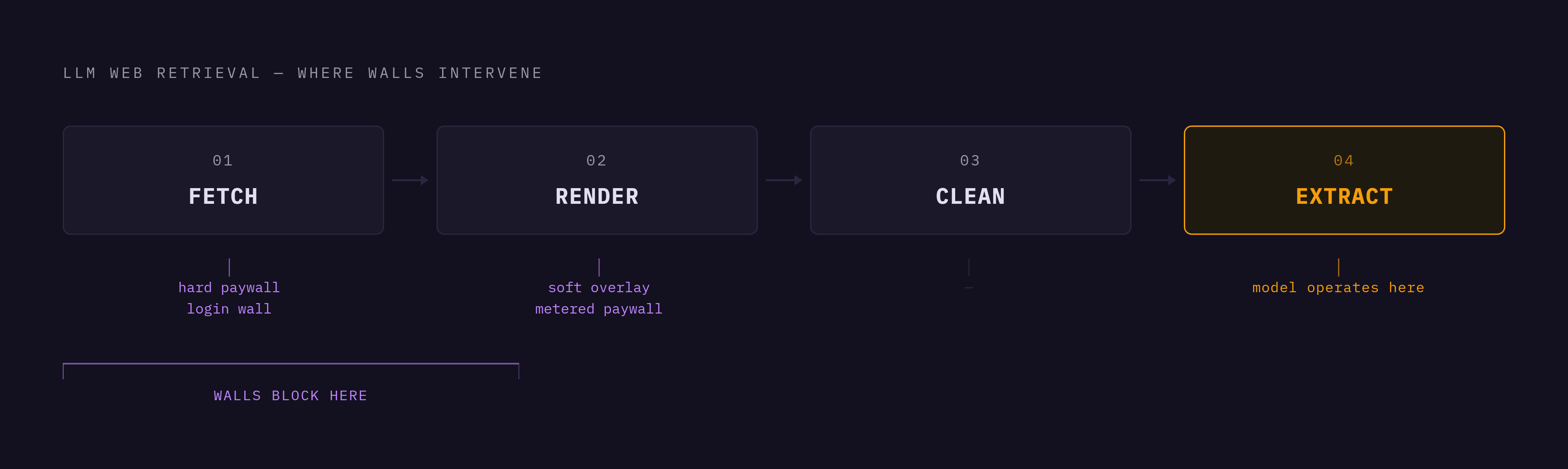
When a retrieval pipeline gives an agent wrong or outdated information, the instinct is to blame the model. That's usually the wrong diagnosis. LLM web retrieval runs as a four-stage pipeline, fetch, render, clean, extract, and the model only ever touches the last of those four stages. Everything upstream of that, the part where the content actually gets pulled off the web and turned into something readable, happens before the model ever sees a token.
Paywalls and login walls hit exactly at that upstream point. They attack the fetch and render stages, which is precisely where scraping projects fail most often, regardless of how good the underlying model is. It'll just be wrong, because there was never any real content to reason over.
That fetch problem is getting worse on a predictable schedule. It's getting worse on a predictable schedule. As language models get better at ingesting whatever is publicly available, publishers respond by moving their higher-quality material behind some kind of authentication. It's a direct feedback loop: better ingestion capability produces more aggressive gating, which produces a harder fetch problem, which no amount of model improvement fixes. Developers who keep upgrading their model while ignoring the retrieval layer are optimizing the one stage of the pipeline that was never broken.
A working taxonomy of wall types and the retrieval stage each one blocks
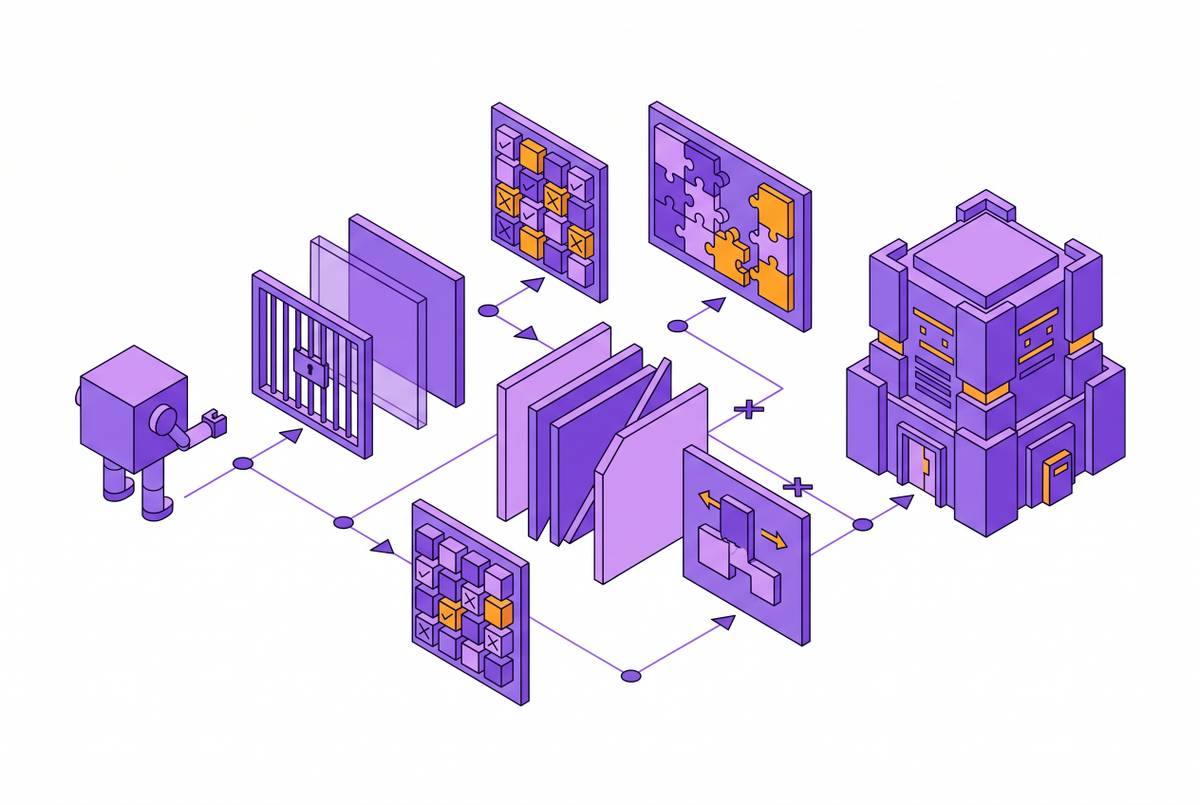
Not all walls work the same way, and treating them as one category is where most debugging goes wrong. Four distinct types appear in practice, each with its own failure mechanism, and each needing its own fix.
Hard server-side paywalls are the cleanest case. The server simply never sends the content, delivering only teaser text or a redirect regardless of who's asking. Standard crawlers like GPTBot, ClaudeBot, and PerplexityBot get exactly what the server decides to send them, so a hard wall genuinely blocks them at the fetch stage. There's no workaround hiding in the HTML here, because the article text was never transmitted in the first place. Even a crawler that respects robots.txt to the letter has nothing to retrieve.
Soft, client-side overlay paywalls behave completely differently, and this is the case most developers misunderstand. The server actually delivers the full HTML, article text included, and a JavaScript layer sits on top to visually hide it from a human reader. Most AI crawlers read raw HTML without executing scripts, so the text is effectively fully visible to the crawler despite being invisible to a human visitor. National Geographic and the Philadelphia Inquirer both run this kind of setup, and it amounts to a structural leak rather than real protection. A plain curl request or any non-rendering HTTP client pulls the whole article; adding a rendering-capable fetch on top gains nothing extra here, because the block was never in the markup to begin with.
Metered or freemium paywalls add a quota instead of a hard block: a handful of free articles before the login gate drops. A crawler that doesn't persist cookies or session state looks like a brand-new visitor on every request, which means it can keep landing inside that free quota indefinitely. The tricky part is that failure here is intermittent. Content that showed up cleanly in an early pipeline run can just vanish on a later one, with nothing in the logs to explain why.
Login walls are the strict case: a credential gate sits in front of a portal, a professional database, an internal tool, an investor relations page. No crawler gets past that without a valid session, full stop, because the wall is architectural rather than cosmetic. Robots.txt is a request, not a lock. Scrapers reaching protected content at scale even where robots.txt explicitly said not to is a documented pattern, which tells you the file is a norm, not a technical barrier.
A fifth pattern doesn't involve touching the original page. Reconstruction leaks happen when an engine assembles the substance of paywalled reporting from public fragments scattered elsewhere: syndicated copies, quoted excerpts, social reposts, archived versions. INMA testing confirmed chatbots replicating the substance of paywalled journalism by assembling paywalled facts from public fragments (syndicated copies, quoted excerpts, social reposts, archives), without ever touching the original page.
The infrastructure layer changes to the access landscape between 2025 and 2026
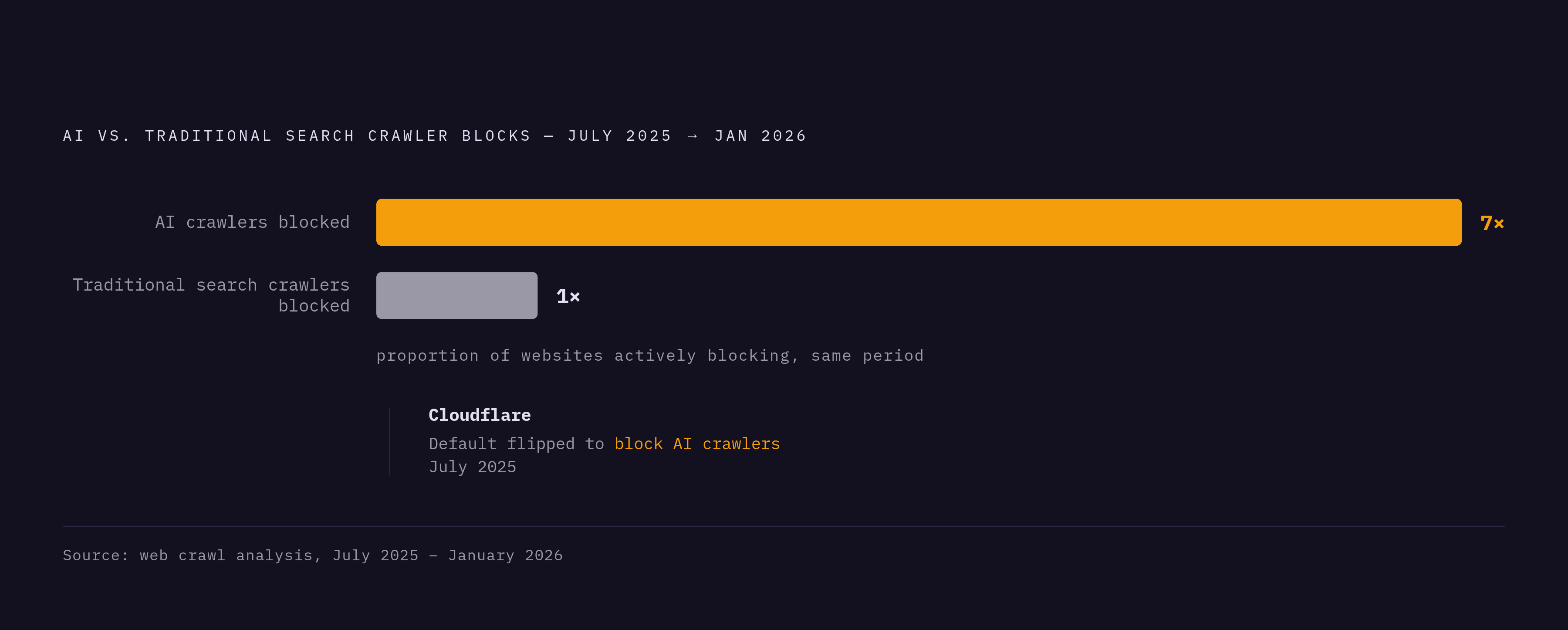
The single event that reshaped this landscape wasn't a publisher decision. It was an infrastructure decision. Cloudflare routes a large share of global internet traffic, which makes its policy choices functionally infrastructure-level rather than just one company's terms of service, and in July 2025 it moved to block AI crawlers by default, the first time a major infrastructure provider treated non-human access as something to opt into rather than a default right. That's a genuine inversion. For most of the web's history, a crawler could assume access unless explicitly told otherwise. After that shift, the assumption flipped.
The numbers explain why that flip happened when it did. Between July 2025 and January 2026, the count of websites actively blocking AI crawlers ran nearly seven times higher than the count blocking traditional search crawlers like Googlebot. Cloudflare's own data shows AI-driven crawl traffic also grew substantially as a share of total crawler requests over that same stretch. Publishers were reacting to volume: raw request counts for both GPTBot and Meta-External Agent grew dramatically between July 2024 and July 2025, with Meta-External Agent's growth curve especially steep. It's a substantial burden that runs well beyond single-digit percentages. It's an order-of-magnitude shift in how much of the web's traffic is non-human.
Press Gazette's reporting found that a large majority of news publishers now block at least one AI crawler. A lot of that blocking runs through broad robots.txt rules that end up wider than the publisher probably intended, catching more crawler traffic than the specific concern that prompted the rule. The blocking isn't uniform, and it isn't consistent site to site, which makes this landscape hard to build against. Paywalls and login walls attack stages one and two, where scraping projects most commonly fail regardless of model quality.
The silent failure mode developers lose sleep over: stale data with no error signal
The failure mode that actually costs people sleep is quieter than any of the wall types above. When a data source starts returning 403 errors to a scraper's IP address, the embeddings built from that source simply stop updating. The model doesn't know that, though. It keeps citing the stale data with full confidence, because nothing in its output layer knows the retrieval layer went dark.
A concrete case from the research makes this vivid. A pipeline had two sources silently start returning 403s. Embeddings stopped refreshing from either one, and the system kept citing pricing data that was three weeks old for another ten full days, until a human happened to notice a number looked off. Ten days is a long time to be confidently wrong in a production system, and the only reason it ended was a person's gut check, not an alert.
That's what makes a 403 more dangerous than a 500. A 403 that returns cached or partial content breaks nothing visibly. The pipeline keeps humming along, dashboards stay green, and the only symptom is data that's slowly drifting further from reality with each passing day.
The same blind spot occurs with login walls. A session expires, cookies go stale, and the pipeline keeps running against what is now a login redirect instead of the actual target page. Often it just ingests the login page's own HTML as if that were the content, generating summaries or citations from a page that says nothing but "please sign in". A RAG system is only as fresh as its fetch layer, and a model trained a year ago missing last week's policy update is bad enough. A RAG layer that's silently hitting a wall is no better than that stale model; it's just failing quietly instead of obviously.
Legitimate strategies for retrieving public-web content without hitting walls
Before reaching for anything aggressive, the right first question is simple: does the agent need the paywalled version specifically, or does it need the facts that version happens to contain? Those are different problems, and most of the time it's the second one.
Reconstruction is a legitimate strategy when approached deliberately rather than accidentally. Assembling facts from syndicated copies, public excerpts, social reposts, press releases, and open-access archives, before ever attempting authenticated access, covers a surprising amount of ground. Soft-paywall detection: a non-rendering fetch (plain HTTP client) often retrieves full text that a browser-rendered fetch would hide behind a JS overlay, so checking raw HTML before assuming content is unavailable is worthwhile. A non-rendering fetch (curl, basic HTTP client) retrieves the full article, while a rendering-aware fetch adds no extra access here.
Structured public data sources are underused as substitutes for paywalled intelligence. Regulatory filings, company investor-relations pages, government datasets, academic preprints, and official press releases frequently contain the open-access equivalent of whatever sits behind a subscriber wall elsewhere. For brand and company information specifically, structured extraction that pulls typed fields directly off a company's public web presence, logos, brand colors, founding dates, short descriptions, can replace the need to touch a paywalled database entirely.
IP-level blocking deserves attention too, because it's not limited to paywalled content. It appears on plenty of fully public pages as well. Recent industry survey data on web scraping practices found that a strong majority of professionals used more proxies in 2025 than the year before, and a similar majority increased their proxy budgets over the same period. IP diversity has become a primary access mechanism even where no paywall or login wall exists at all, purely because of rate-limiting and bot-detection systems.
And staying within a site's declared robots.txt policy on public content remains the cleanest path available. It's both the legally sound choice and the one least likely to trigger infrastructure-level blocking of the kind Cloudflare now applies by default.
Credential-based session management for content that genuinely requires authentication
Some content is behind a wall for good reason, and the agent's job there isn't to get around anything. An enterprise agent pulling documents from a portal, an investor platform, or an internal tool that its user already has legitimate access to is acting as a delegated authority, exercising access the user already holds, not bypassing a restriction that was meant to keep them out.
The mechanics of that delegation run through browser automation. Agent-controlled browsers, Selenium, Playwright, other Chromium-based tooling, can carry an authenticated cookie session forward from a user who already logged in, letting the agent retrieve exactly the content that user is entitled to see. Good credential handling here follows a few consistent patterns: secrets live in a secure vault rather than plain text or an environment file, multi-factor flows get handled by having the agent retrieve and enter one-time codes from email or an authenticator app, and sessions persist across requests instead of re-authenticating every single time, which cuts both latency and the odds of tripping a bot-detection flag.
Playwright leads adoption among practitioners building this kind of automation, with 45.1% adoption among QA professionals in recent research, and newer agent-powered tools like Stagehand layer an LLM reasoning step on top of that, handling the acting, extracting, and observing that a fixed script can't adapt to on its own. Browser Use, an open-source project in this same space, had climbed to roughly 98,000 GitHub stars by June 2026 running under an MIT license at version 0.13.1, which says something real about how much practitioner attention this approach has pulled in. Three things converged to make it viable by 2026 in the first place: models like GPT-4o, Claude 4, and Gemini 2.5 all became capable enough to interpret page structure, follow navigation patterns, and plan a multi-step login flow without hand-holding.
None of that should be mistaken for solved, though. The Online-Mind2Web study found that on a large benchmark of everyday web tasks, the strongest AI browser agent available completed only about 61% of them, and most competing agents scored considerably worse. A human working the same task list would clear nearly all of it. That gap, not the login-flow demos, is the real state of browser-agent reliability heading through 2026. In practice, that means these flows work well against predictable, structured portals with stable layouts, and they get fragile fast against dynamic login pages, CAPTCHAs, or any UI that changes shape between sessions.
The emerging paid-access layer: HTTP 402 in agent architecture
A new access model is forming and driving this shift, even though most agent pipelines haven't caught up to it yet. Cloudflare's Pay Per Crawl, already live, lets a website charge AI crawlers for the act of fetching its pages, and as of July 1, 2026, that's evolving into something broader called Pay Per Use, where publishers charge based on whether their content actually created value rather than just whether it got requested. Starting September 15, 2026, Cloudflare's default settings go further still, blocking "mixed-use" crawlers, ones that blend search, agent access, and model training, from any page carrying ads, unless the site owner specifically opts back in. That default applies to new customers, new sites under existing customers, and every existing free-tier customer.
The technical hinge holding this together is a decades-old, mostly unused HTTP status code. HTTP 402, Payment Required, gives an agent something to negotiate against: it hits a page, gets a 402 back, reads the price being asked, and decides programmatically whether paying is worth it. That's not theoretical anymore. Cloudflare reports its customers now send more than a billion of these 402 responses to AI crawlers every single day, which means the plumbing for this is already running at real scale.
Paywalls and login walls attack stages one and two, where scraping projects most commonly fail regardless of model quality. Ceramic.ai, founded and led by Anna Patterson, runs a pay-per-query model where publishers who opt in get paid when their content shows up inside search results, not simply whenever a crawler fetches the page. Elsewhere in this same emerging market, other players pay publishers on demand at the moment a specific piece of premium content actually gets accessed, a slightly different timing on the same basic idea.
What this means architecturally is that agents will need to start carrying something like a content budget: parsing 402 responses, weighing the price against the value of the content, and making that cost decision programmatically rather than either paying blindly or giving up at the first wall. Cloudflare's own stated vision points exactly there, an agent handed a budget for a research task, negotiating access across sources on its own rather than stalling out at the first paywall it meets. That vision is real and the infrastructure underneath it is live. What's not yet true is that agent-side tooling has caught up. Most pipelines running today have no logic at all for reading a 402 and making a purchase decision, which makes this one of the clearer gaps between where the infrastructure sits and where the software built on top of it currently stands.
The normative gap: why terms of service and access policies have not caught up to delegated agents
A legal and normative question that hasn't been settled yet shapes what's actually permissible far more than any scraping technique does. Existing terms of service, access law, and platform practice were all written before AI agents existed, and none of them draw a line between a malicious bot scraping content against a site's wishes and an agent acting with a user's express, delegated authority to retrieve something that user is already entitled to. Those are obviously different situations. Current policy frameworks mostly can't tell them apart.
Delegation holds that a user already entitled to access a service should ordinarily be able to exercise that same access through an agent acting on their behalf. Transparency holds that platforms should disclose how they treat agent traffic, and that agents in turn should identify themselves, their identity and their purpose, rather than disguising themselves as ordinary human browsing. Proportional restriction holds that platforms should only restrict access to address a real, specific harm, and should do it through the least restrictive means available rather than blanket bans that catch legitimate delegated access alongside genuine abuse.
None of that is settled law yet, and none of it should be mistaken for legal advice. But it gives developers a vocabulary for reasoning about where a given pipeline actually sits: whether it's exercising access a user already holds, or reaching for something no policy has agreed it's entitled to. That distinction is going to matter more, not less, as agent-mediated access becomes the ordinary way people interact with the web rather than the exception.