What a Web Scraping API Must Guarantee Before You Wire It Into an Agent
Clean, schema-based output keeps agents reasoning over data instead of raw HTML.
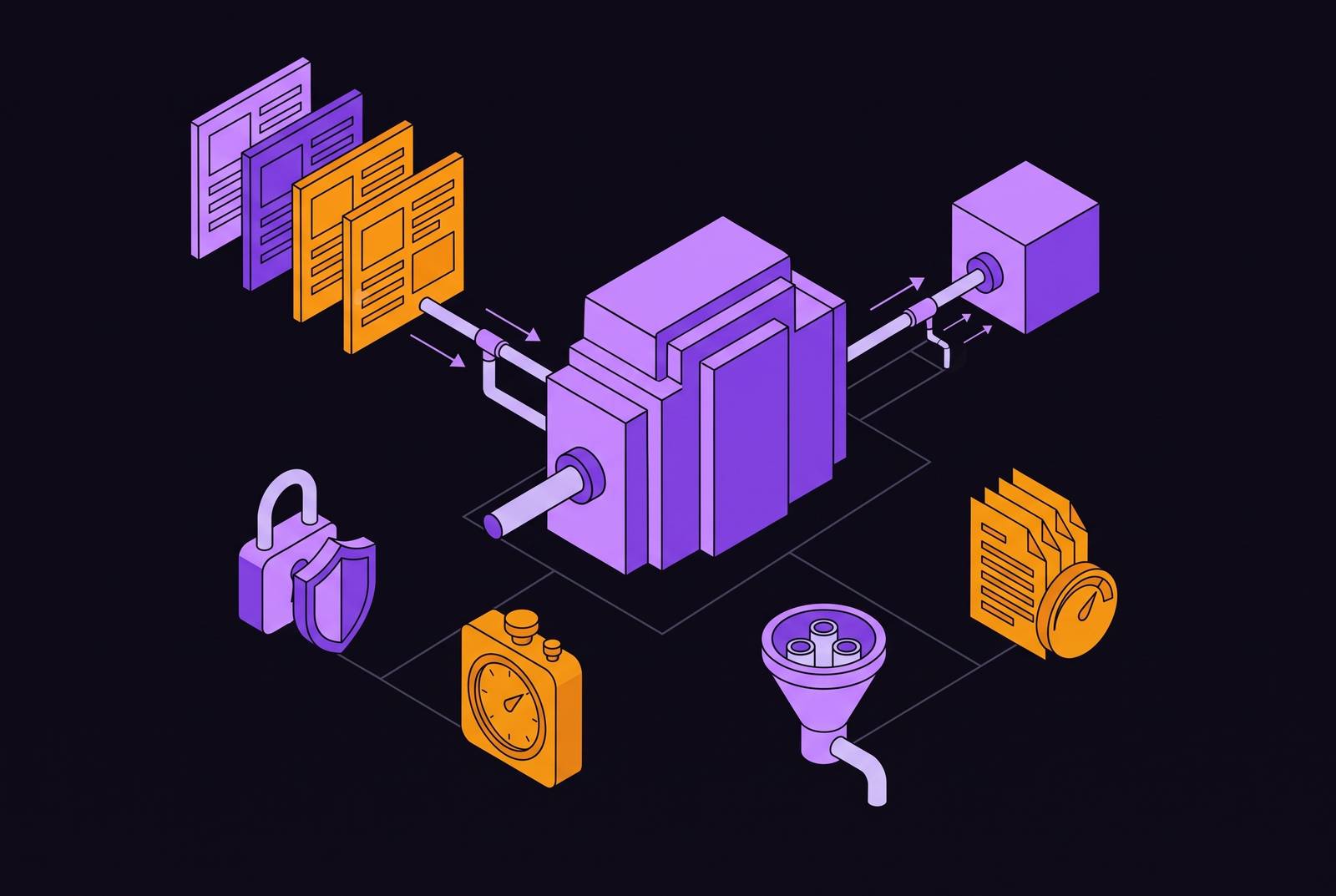
A web scraping API built for AI agents has to satisfy a different contract than one built for batch jobs: it must return clean, LLM-ready output, render JavaScript through a managed headless browser, respond fast enough to not stall the agent's loop, resist anti-bot blocks without silently corrupting the agent's reasoning, and expose structured, schema-based extraction over an MCP interface. The ones that hold up under real agentic load were designed around these constraints from the start.
Wiring a Scraping API Into an Agent: A Different Engineering Contract Than Batch Scraping
A team picking a scraping API for a batch job and a team wiring one into an agent are solving two different problems, even if they're staring at the same API docs. Batch scraping runs on its own schedule. It tolerates a slow response, a malformed page, even a failed job, because a person checks the output before it goes anywhere, and the next run fixes what the last one missed.
An agent doesn't get that grace period. The fetch call sits inside a synchronous loop: the agent observes, plans, and acts, and the output of that fetch goes straight into the model's context with nobody checking it first. When the fetch returns garbage, the model reasons over garbage immediately, with no review gate catching the mistake before it compounds.
That's why most agent failures that look like reasoning failures are actually fetch failures. Take a concrete case: an anti-bot interstitial returns a normal, successful HTTP status code, but the body is a CAPTCHA page instead of the product page the agent asked for. The agent hands that page to the model as if it were real content. The model, doing what it's supposed to do, tries to extract product data from a challenge screen and fails. Nobody wrote broken reasoning code. The agent failed at the web, not at logic.
This changes what "reliability" even means for a scraping API. In a batch pipeline, reliability means the data is right by the time someone reads it. In an agent, reliability means the data is right the instant the agent needs it, on that one call, with no second chance. Every guarantee that follows in this piece, clean output, JS rendering, low latency, anti-bot handling, structured extraction, exists to satisfy that one, narrower, much harder standard.
Why Raw HTML Disqualifies Itself as Agent Input
Raw HTML output should rule an API out before you evaluate anything else. None of that is information the agent's task requires. It's packaging, and the model has to pay for every byte of it.
That payment comes due in two places. Worse, if you flood the attention mechanism with layout noise, the model's reasoning gets less sharp on the content that actually matters.
The fix isn't complicated, which is part of why it's the floor rather than a feature. A scraping API built for agents parses the DOM, pulls out the primary content, and hands back semantic Markdown or schema-valid JSON. Markdown keeps headings, lists, and code blocks intact so the content's structure stays legible to the model, but it drops the visual scaffolding the page needed for a browser and the agent never needed.
A parameter called useMainContentOnly strips out navigation chrome and layout scaffolding, so the agent gets signal instead of the token bloat that raw HTML carries with it.
What gets lost in that conversion, dynamic charts, embedded video, interactive widgets, is almost never what the agent was after in the first place. Returns Markdown" isn't something a vendor should get to brag about; it's the baseline a scraping API has to clear before it's even in the conversation for agent use.
JavaScript Rendering and Managed Headless Browsers
Clean Markdown output solves nothing if the API never captured the right content first. A huge share of the modern web runs on frameworks like React, Vue, and Angular, where the page you get on first load is mostly empty, and the actual data arrives afterward through XHR calls the browser fires once the JavaScript runs. If a scraping API just grabs the initial HTTP response, it's grabbing a shell.
Without a headless browser that actually executes that JavaScript, the model works from incomplete information, and that hurts retrieval quality badly. The fetch succeeds, a success response comes back, and there's a page of HTML, but none of the data the agent was sent to find is actually in it.
Rendering a page correctly means managing a real runtime, not flipping a switch. The API has to spin up a browser instance, wait for network activity to settle down, capture the XHR responses that bring in the real data, and let the DOM stabilize before pulling anything out of it. That's a full execution environment, and scraping APIs that handle this well expose it as something closer to a single parameter, render_js=True on a managed call, rather than something the calling team has to run and babysit themselves.
Context handles browser lifecycle, network idle detection, and DOM stabilization as part of its managed infrastructure, so it renders JavaScript-dependent pages without the caller running anything. That matters because keeping a pool of headless browsers alive, fast, and current is expensive in a way that has nothing to do with building a better agent. It's infrastructure work that competes directly with the engineering time a team needs for the product itself, and teams that take it on in-house are paying an ongoing tax that a managed API absorbs instead.
Latency as a hard constraint, not a performance preference
An agent blocks on every fetch call, so the scraping API's response time becomes the floor for how fast the agent can respond to the person using it. So from the user's side, the whole agent just feels slow, and the model gets blamed for a problem that started somewhere else.
A scraping API built for agents has to shave time off the whole chain, not just the network hop, because the agent pays for every step in that sequence before it can move on.
Warm browser pools are how that time gets cut. Spinning up a fresh headless browser instance for every single request adds seconds the agent's loop has no room to absorb, so the API needs browsers already running and ready to take a request the moment it arrives.
Someone will point out that agents can run fetches in parallel, and that's true in some architectures. Latency guarantees and warm-pool infrastructure belong in the main evaluation criteria for picking an API, not buried in a footnote on a pricing page.
Anti-bot resilience as a correctness guarantee, not a success-rate statistic
Anti-bot systems don't usually fail loudly, and that's exactly the problem. When a block happens, the agent doesn't get an error. It gets a page, a challenge screen dressed up as content, and it has no way to tell the difference from the real thing.
The tool call still reports success, so the agent hands a bot-detection page to the model the same way it would hand over a product page. The model then tries to extract prices, specs, or whatever it was asked to find from a CAPTCHA screen. That's worse than an outright error. A CAPTCHA disguised as content produces confident, wrong answers instead, and confident wrong answers are the hardest kind of failure to catch anywhere downstream.
Handling this can't be the caller's job. Fingerprint normalization, IP rotation, and resolving challenges before they ever reach the agent all have to happen inside the API itself, because the agent has no way to pause mid-loop and solve a CAPTCHA interactively. The agent can reason its way through a challenge page instead of a real one with no human watching the loop to notice.
Structured extraction via developer-defined schema as the interface between the web and the agent's data model
Markdown solves the noise problem, but it doesn't solve the parsing issue, and that's work the model is doing on every single call, burning tokens and leaving room for hallucination each time it happens.
A developer-defined JSON schema moves that work earlier in the pipeline, before the model ever sees the data. Context's JSON extraction takes a jsonParams.schema object, pulls the matching fields out of the page, and returns typed data, so the agent reads json.data directly and validates it rather than parsing prose looking for the right sentence.
Amazon's PARSE research found that most approaches treat a JSON schema as a static contract written for a human developer to read once, not for a model to interpret repeatedly. The fix is treating the schema as something that can itself be improved for how a language model reads it, not just as a fixed spec handed down from the developer.
MCP support as the integration layer that determines whether agent frameworks can discover and invoke scraping tools autonomously
Once an API returns clean, structured data, the next question is how an agent actually finds and calls it. MCP support answers that question by letting the agent discover a tool, read its parameters, and invoke it on its own, without a developer writing custom glue code for every endpoint or every agent framework in use.
An MCP-native server that exposes a set of scraping tools this way lets any agent connected to it see the full toolset immediately, read what each tool expects, and call the correct one with no per-endpoint wrapper code and no manual JSON parsing standing in the way.
Providers that skip MCP push that integration work back onto the developer, who then has to write and keep up separate adapters for each framework the agent might run on, LangChain, LlamaIndex, or whatever comes next. That's precisely the kind of repetitive infrastructure work a scraping API is supposed to take off a team's plate, not hand back to them. MCP support has moved from a nice extra to a baseline expectation for any API that wants to work inside agent-first systems, and providers without it are starting from behind.
Treating Freshness as a Pipeline Primitive, Not a One-Time Load
An agent can clear every guarantee above, clean output, full JS rendering, low latency, solid anti-bot handling, structured schemas, and still reason from data that's wrong simply because it's old. Freshness isn't something an agent gets right once during setup. It has to be designed into the pipeline as an ongoing discipline.
A time-to-live value on each cached chunk is the right fix, but it only works if it's set per topic rather than applied globally. One global expiration setting can't capture that spread.
TTL alone still isn't enough, because staleness isn't only about the clock. A page the agent cited can 404 overnight. TTL handles the predictable decay of information over time, but event-driven invalidation handles the moments when something changes without warning.
None of this works without metadata captured at the very first fetch: the URL, the fetch timestamp, the canonical URL, a content hash, the language. Skip canonical URL handling, and tracking-tagged link variants or www versus non-www duplicates quietly get indexed as separate documents, corrupting retrieval until the answers start looking wrong.
The capability that actually closes this gap is change detection built into the pipeline itself: the API watches pages, sends structured JSON diffs through signed webhooks when something changes, and kicks off re-scraping, re-indexing, and enrichment automatically, with no person needed to notice the change first. That folds what used to be three separate vendors, a scraper, a monitoring tool, an alerting system, into one layer. Context's Crawl and Batches endpoints handle the initial site-wide ingestion, while its Monitors endpoint handles the scheduled re-fetching that keeps an index from drifting, without the team running its own browsers or proxy infrastructure to do it.
What a Well-Designed Single API Actually Consolidates
Every requirement covered so far, rendering, warm pools, fingerprint handling, schema extraction, MCP exposure, change detection, is a piece of infrastructure a team would otherwise have to build and keep running on its own. None of that work makes the agent smarter. It just keeps the agent from breaking on contact with the real web, and maintaining it, not the model's capability, is usually the actual bottleneck.
Context is built as a managed web scraping and data API that covers this ground directly: Scrape pulls individual pages, Map discovers URLs across a site, Crawl follows linked pages synchronously up to 500 pages per run, and Batches processes larger URL sets asynchronously, alongside Search, Monitors, Answers, and Parse. None of it requires a team to run its own browsers, manage proxies, or build site-specific retrieval logic. The same platform covers clean Markdown output, schema-based JSON extraction, brand intelligence lookups, and an MCP server, all through one API key instead of a half-dozen separate vendor relationships.
The honest cost comparison matters here. Keeping proxy networks running, handling CAPTCHA solving, and patching browser versions as sites change can turn into a full-time job for an engineer who could otherwise be shipping features. That's the real trade a team is making when it builds this in-house instead of buying it.
Data sovereignty and operational control remain a real objection worth taking seriously. Enterprises with strict compliance requirements, SOC 2 Type II certification, zero data retention, guarantees that queries aren't used for model training, can't adopt a managed API without confirming those properties hold. For teams in that position, evaluating a scraping API means checking its security posture with the same rigor as its feature list. That said, for most teams building AI-native products, those compliance questions have clear answers, and the managed API is the stronger choice. The teams where it isn't are a specific, identifiable segment, not the general rule.
Speed of integration matters on its own, separate from everything else. Going from an empty project to working API calls in minutes lets an engineer write agent logic on day one instead of spending the first two weeks standing up infrastructure the agent didn't need anyone to build by hand.