Push vs Pull Web Data Delivery and What Each Costs an Agent in Latency and State Complexity
Pull latency and push state complexity force agents to choose their architectural price.
Agents that have moved from demos into daily enterprise workflows impose a new requirement on data delivery: the timing and shape of incoming web data directly determines whether a reasoning cycle can complete usefully, at what cost, and with how much state the system must manage. This is not a configuration setting you flip during deployment. It is an architectural constraint that shapes everything downstream, from latency budgets to error handling to the durability of agent state.
Why the data delivery decision is an architectural constraint, not a configuration choice
The distinction matters because an agent is not a human dashboard user. An agent can query data in volumes and bursts orders of magnitude beyond human-driven workflows. It cannot interpret ambiguous responses. When a fetch returns something unexpected, there is no operator sitting at a screen to shrug and retype the query. The agent's next reasoning step is blocked until the current one has usable data, which makes delivery latency a first-class design variable rather than an afterthought you tune once the demo is working.
Two models sit on either side of this decision. Pull, or polling, means the consuming agent or pipeline requests data on demand, via API call, crawl, or database query, at the moment it is needed or on a schedule. Push means the source system emits data outward when a triggering event occurs, via webhook, event stream, message broker, or server-sent event. The agent receives the data without asking for it. Both models are legitimate and both are in widespread production use. The goal here is to characterize the concrete costs each model imposes so engineers can match model to workload rather than defaulting to whatever their demo happened to use.
What a synchronous pull actually costs a reasoning cycle
A synchronous web fetch inside an agent loop is dead time. The model cannot plan its next action until the page returns, so every millisecond of scrape latency is felt directly by the user or downstream system waiting on the agent's output. This is not hidden overhead absorbed by some background process. It sits on the critical path of every reasoning cycle that needs live data.
The latency floor for live web retrieval is built from layers that compound. Fetching a live page is not instantaneous. Render time, anti-bot challenge resolution, and structured extraction all stack up before the agent has usable data. Scrapeless's 2026 benchmarks identify login walls, anti-bot challenges, JavaScript rendering, geo-gating, and session handling as the layers that sit between an agent and a page. Each layer adds to the wall-clock cost of a single pull. The extraction step adds its own overhead on top of render time. Returning raw HTML fast but requiring a second parsing pass can be slower end-to-end than a tool that returns structured data in one call. A web scraping API designed specifically for LLM pipelines, one that converts any URL to LLM-ready Markdown and extracts structured data via JSON schema in a single call, eliminates that parsing penalty and lets the agent reason over usable data immediately.
Rate-limit arithmetic compounds the problem at scale. Agents do not make steady, evenly-spaced requests. They burst, processing a large batch, going idle, then bursting again. APIs with hard per-second caps force artificial throttling that lengthens total cycle time. If you poll a set of endpoints on a fixed interval, you can exceed API quotas before a single user-triggered action occurs. The system burns budget on calls that return no new information. This is the wasted-call problem. The agent pays the latency and quota cost regardless.
If you want web content in an agent pipeline, structured extraction via schema-defined output is the right abstraction. It eliminates the second parsing pass and returns data in a form the agent can reason over immediately. The pull tax is smallest when the fetch and extraction happen in a single, well-designed API call.
What a push delivery model costs in state machinery
Push delivers data faster but transfers the latency cost into state complexity. The receiving system must be built to handle events it did not ask for, in an order it cannot control, at a volume it cannot throttle. Teams that reach for push after feeling pull latency often discover they have swapped one problem for a stack of new ones.
The infrastructure a webhook receiver actually requires is substantial. A public HTTPS endpoint, signature verification, idempotency logic, retry handling, a queue, a worker, a dead-letter queue, a deduplication store, replay tooling, and monitoring. Each component is a surface that can fail silently. Lost webhooks are silent by nature. If the receiving endpoint was down when a provider stopped retrying, there is no signal that the event was missed. The agent's state drifts without knowing it.
Ordering is not guaranteed, and the consequences are non-trivial. A create event for a resource may arrive after the update event for the same resource. An agent that trusts arrival order will write incorrect state. Retried webhook payloads add another subtlety. They carry the original payload from trigger time, not a freshly fetched one. If the underlying data changed between the original attempt and the retry, the retry delivers stale data even in a push model.
Agent runtimes make webhook handling harder than traditional trigger design assumes. A conventional webhook handler is short and deterministic: receive event, process, return 200. An agent started from a push event may wait on human approval, block on an external API, call tools recursively, and need to survive across restarts. This is the durable-state problem, and it is the sharpest version of the push tax. Dey and Viradecha's 2026 Agentverse gap analysis identifies agent memory and state, including the absence of persistent semantic memory, shared memory spaces, and episodic memory, as critical missing infrastructure capabilities in current agent-native platforms. The gaps are catalogued across an eight-category taxonomy. Frameworks like LangGraph address the issue with checkpoint-based execution. The interrupt() function freezes the agent at a checkpoint, persists the thread, and resumes when a Command(resume=...) is sent by the caller. No compute is consumed while paused, but the infrastructure must hold that thread reliably. Debugging is structurally harder with push because payloads arrive asynchronously, often without good logs. Reproducing a failure requires replaying an event that may have been delivered once and discarded.
How content type and freshness requirements determine which cost is tolerable
The freshness window required by a workload determines which delivery model's tax is worth paying. Workloads where stale data produces wrong agent outputs need push or very-short-interval pull. Workloads where data changes slowly enough to cache can absorb pull's latency without consequence.
Freshness requirements vary sharply by content category. Live prices, availability, and security CVEs all sit at the most demanding end. A question answered from data that is hours old may be actively harmful to the agent's user or downstream system. Regulatory changes, product announcements, and competitor pricing moves can often tolerate a window of hours to a day, so hybrid models are viable. Reference content, documentation, standard library behavior, general how-to material, may accept a freshness window of weeks or months. A cached index with periodic pull fits that category well.
RAG systems make this tradeoff explicit. A pure embedding-based RAG system can only retrieve from documents already indexed. For any topic that changes faster than the indexing cadence, it returns answers that were already stale at the moment they were generated. Live fetch adds latency and per-query cost. A cached index is fast but goes stale. The same tradeoff applies inside the retrieval layer as it does at the agent's data boundary.
Structured change detection offers a third path between continuous push and periodic pull. Rather than pushing every event or polling on a fixed clock, a semantic-diff approach watches specific pages and distinguishes meaningful content changes from noise such as layout shifts, timestamps, and ads. It triggers a push only when watched content has actually moved. This pattern cuts push event volume, and the state machinery needed to handle it, while near-real-time delivery survives for changes that matter. For RAG pipelines specifically, the vector database is updated with only the changed content, and the ingestion layer can gate on change type rather than crawl success alone.
How agentic workload patterns stress both models in ways point-solution thinking misses
APIs and webhook systems built for human-driven workflows break under agentic load patterns. Agents burst at volumes humans do not. They operate continuously. They require machine-actionable error responses that human dashboard users never needed. The error-handling problem for push is a clear example. A webhook delivery failure that returns an HTML error page instead of a structured error object leaves the agent with no actionable path. Human operators can read an error page. Agents cannot.
At-least-once delivery, not exactly-once, means agents must be designed to tolerate duplicates from the start. Otherwise they will write duplicate records and reason from corrupted state. Long-running agentic tasks expose a gap that neither simple polling nor simple webhooks was designed to fill. Operations that take minutes or hours, deep research tasks, batch processing, multi-step pipelines with human-approval gates, cannot be served by a synchronous pull, which blocks too long, or by a fire-and-forget webhook, which carries no durable execution context. Major platforms have recognized this. The pattern of moving away from polling for long-running agentic tasks reflects the fact that polling burns quota and holds open connections for operations that take minutes or hours. Dey and Viradecha's Agentverse analysis frames the issue as one of the five critical evolution paths agent infrastructure must travel: from ephemeral key-value storage to a full Agent Memory Cloud.
Why most production teams land on a hybrid model, and what that model actually requires
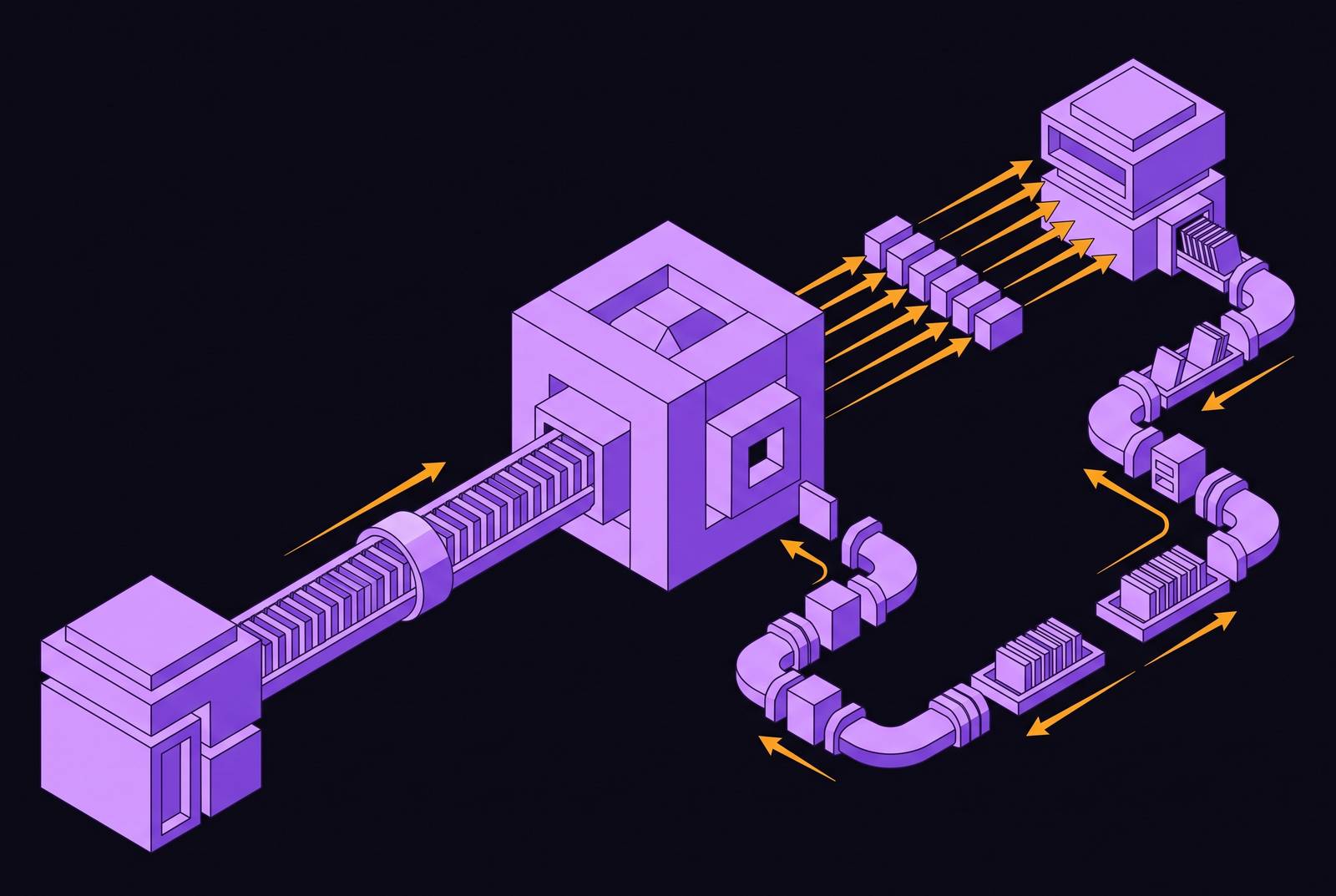
The production answer is not a choice between push and pull but a deliberate hybrid. Push serves as the primary signal for time-sensitive events. Pull serves as the reconciliation sweep that catches anything push missed. Deduplication keyed on message ID handles anything delivered twice. This pattern sounds simple in a diagram. It is not simple to build or maintain.
The push path needs an endpoint, queue, worker, dead-letter queue, deduplication store, replay tooling, and monitoring. For the pull path, you need burst-tolerant rate limits, schema-stable responses, and machine-readable errors, so the agent can self-correct without human help. The reconciliation logic needs a freshness TTL per content category, a way to detect structural changes in source pages before they silently degrade extraction quality, and a clear gate between crawl success and ingestion. The maintenance cost of building this stack in-house is real and ongoing. Source pages change structure. When they do, the retrieval layer can degrade without any obvious exception. Monitoring and change detection are not optional additions. They are load-bearing components of a hybrid pipeline.
Pull-based agents that have moved into production workflows face a fragmented data stack: one tool for crawling, another for rendering, a third for extraction. If you consolidate these operations into a single well-designed REST API instead of stitching together point solutions, you avoid compounding latency further and keep reasoning cycles as fast as possible. A single API that handles fetch, render, structured extraction, and change detection in one call collapses the largest sources of pull latency, the second parsing pass and the separate extraction step. It also reduces the state machinery required on the push side by delivering only meaningful changes rather than raw events. Context's web data API is built around this consolidation. It converts any URL into LLM-ready Markdown, crawls entire websites, and extracts structured data via developer-defined JSON schema. Teams can build the hybrid pattern without assembling a separate scraper, crawler, extraction layer, and change-detection service. For teams whose agents need to reason over the current web rather than a frozen snapshot, the data infrastructure layer is what determines whether the hybrid model is operationally viable or permanently under-resourced.
Matching delivery model to workload: a decision framework for engineers
The right delivery model for a given workload follows from three questions. How stale can the data be before the agent's output is wrong? How often does the source actually change? How much state machinery is the team prepared to own? The answers map cleanly onto three workload buckets.
Pull is the right primary model for on-demand research agents where the user query defines what to fetch. There are no events to listen for and no advance knowledge of what will be needed. Pull also fits overnight corpus builds, batch enrichment, and RAG index refreshes where freshness windows are measured in hours or days and per-query latency is not user-facing. Structured data extraction against known URLs belongs in this bucket too, when the agent needs the current state of a specific page rather than a stream of changes.
Push is the right primary model for competitive intelligence pipelines that monitor pricing, feature, or hiring changes. The signal is the change itself, not the current state. Push fits long-running agentic tasks that must complete asynchronously and notify downstream systems when done. If you poll for those operations, you burn quota and hold open connections for minutes or hours. Push also serves RAG freshness maintenance where the vector database should update only when source content actually changes. A semantic-diff push delivers the delta, not the full document on every crawl cycle.
The hybrid is required for any agent operating in a domain where source data changes unpredictably and the cost of a missed update is high. Push provides the primary signal, pull provides periodic reconciliation. Multi-agent systems fall into this bucket as well. One agent's output triggers another's input. The hand-off needs push for low latency, but the receiving agent may need a pull to verify current state before acting. The data delivery model is not a setting you configure after the agent is built. It is part of the architecture that determines which agent workload patterns are viable to ship at all.