Rate Limiting and Backoff Strategies for Web Tool Calls
Protect AI agents from rate limits with outbound shaping, server backoff, and circuit breaking.
Rate limiting and backoff strategies for web tool calls need three lines of defense that each do a different job: outbound rate shaping, server-aware backoff, and circuit breaking. For AI agents and LLM pipelines, retry logic alone cannot control bursty, multi-step traffic. The fix starts before the first request leaves.
Why agent call patterns break traditional rate limiting
The familiar retry pattern is simple. In this pattern, an error after a request triggers an immediate retry, with no delay and no distinction between errors. That pattern treats every failure as a temporary interruption. Under agent traffic, however, the interruption may be a direct result of sending too many requests. Repeating the request adds pressure to the condition that caused it to fail.
Traditional fixed-window limits were built for browser and app traffic that people send at a slower pace, spread over time. An agent instead chains file retrieval, chunking, several LLM calls, and storage into a single task. A 429 midway through that chain can fail the whole workflow, leaving results too incomplete to be useful. Legitimate bursts can therefore resemble a DDoS from the server’s perspective. Context’s web scraping API puts rate handling in the service layer, moving that part of the problem out of the agent’s orchestration code.
Concurrency compounds the mismatch. When many workers share an API key, each worker’s local retry state says nothing about the requests the others are sending. When each worker retries several times, far more traffic reaches a service that is already under strain. Even when each worker gets the backoff math right, the workers still compete for the same capacity.
The layered defense: three responsibilities that must stay separate
The architecture needs to do three jobs: keep traffic from exceeding limits, recover from failures that will pass, and stop attempts against a dependency that keeps failing. Client-side rate shaping does the first job before a request leaves. Server-signal-aware backoff handles the second when a request still hits a limit. A circuit breaker handles the third when continued attempts would make matters worse.
These mechanisms belong in the tool-call wrapper between the agent framework and the HTTP client. A limiter cannot make a failed request succeed, and a retry handler cannot decide when to stop sending traffic to an unhealthy service. In this design, the LLM sees success with data or a terminal failure with a clear message.
Layer one: shaping outbound rate before the first request leaves
The root cause is that the outbound request rate exceeded what the provider allows. Backoff can make the next attempt wait, but it cannot control the stream of work that first goes out. Client-side throttling addresses that stream directly. It makes requests wait before they consume provider capacity, preventing most 429s.
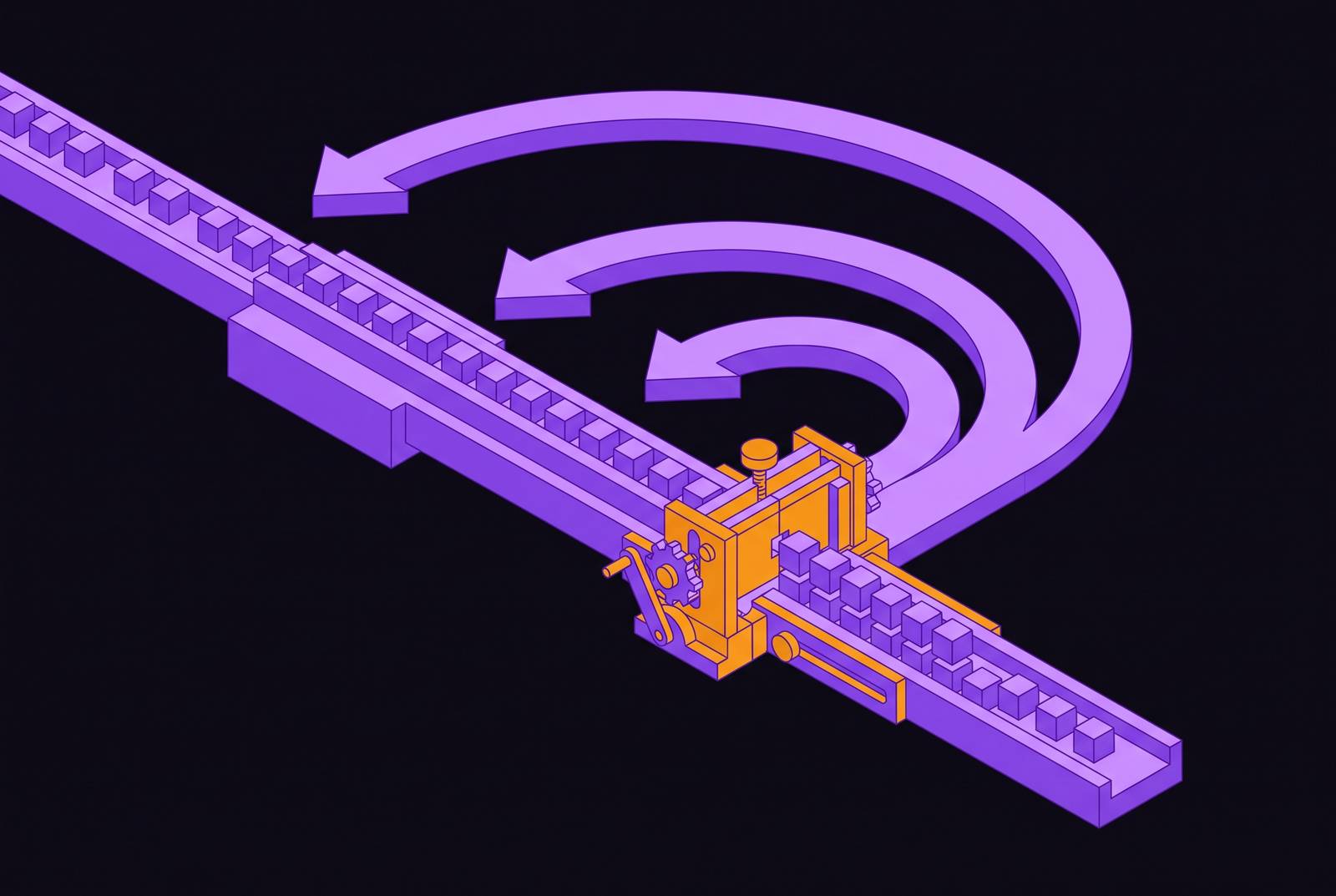
A token bucket is a useful model. The bucket fills at a fixed rate, each request consumes a token, and an empty bucket makes the next call wait. It starts full, allowing early calls through immediately while constraining the sustained rate. The library llm-rate-limit-bucket expresses this as RateLimitBucket(rate=50, per=60) for a 50 RPM tier, with bucket.acquire() waiting for capacity. Web data APIs such as Context use the same rate-shaping approach server-side when they handle crawl and extraction requests.
Requests per minute and tokens per minute each need their own bucket. A large prompt can exhaust TPM while plenty of RPM capacity remains. Passing an estimated token count to acquire(tokens=estimated_tokens) accounts for that separate constraint. Both buckets must be acquired before the request leaves.
The bucket must also match the scope of the provider’s quota. Five workers with separate 50 RPM buckets can send a combined 250 RPM. For shared limits, use a counter backed by a shared key-value store with the INCR + EXPIRE pattern or a distributed rate limiter. For a workflow that needs five API calls, check quota for all five before starting. That pre-flight check keeps a chain that cannot finish from using up capacity.
Response headers and queues make this layer responsive to changing demand. Watch X-RateLimit-Remaining and X-RateLimit-Reset. Add more delay when the capacity left falls below 10% of the limit. A local dispatch queue can spread simultaneous events across the allowed rate, while caching stable responses reduces demand altogether. The narrow exception is a single-threaded agent making well-spaced, single requests with spare RPM capacity. In that case, another limiter adds latency without addressing a real burst problem.
Layer two: reading server signals and backing off with discipline
When a 429 still arrives, the server’s instructions take precedence over a locally computed delay. Retry-After can contain either a number of seconds or an HTTP-date. The handler must distinguish those formats, turn the value into a wait, and honor it before another attempt. Ignoring the header discards the clearest signal the provider has supplied.
Without a server-specified wait, exponential backoff is the fallback for transient 5xx errors. Start with a short base delay, double it on each attempt, and cap it at a maximum. A 429 is a hard signal that quota has been exceeded, while a 5xx may indicate temporary overload. Those conditions need different waits in the retry loop. Errors that waiting cannot fix should stay out of that loop.
Jitter prevents concurrent agents from waking together and causing another burst. Random variation around a computed backoff spreads attempts across time. Where Retry-After applies, the retry must still respect the server’s wait. For background enrichment, scheduled crawls, and batch content generation, queueing is preferable to holding agent state through long inline delays. Inline retry belongs in user-facing, latency-sensitive flows.
There is a real design choice about which layer owns recovery. Truto takes the position that middleware should not silently absorb rate-limit errors when an LLM is involved. The wrapper approach instead keeps bounded recovery below the model and surfaces a clear terminal failure when it cannot recover. With either choice, ownership of recovery must be clear, since a library cannot be assumed to handle 429s on its own. Before retrying actions with side effects, separate generation from execution and use idempotency keys where supported, so a timeout does not turn into duplicate records, messages, or jobs.
Layer three: the circuit breaker and why agents need a DEGRADED state
A circuit breaker stops sending requests when failures show that a dependency is not recovering, using the classic states Closed for normal operation, Open for immediate failure without a request, and Half-Open for a recovery probe. A successful probe closes the circuit, while a failed probe opens it again. This protects dependent work from cascading failures and stops quota being spent on requests likely to fail.
Agents need a further distinction because HTTP success is not the same as useful output. An LLM-backed tool can return HTTP 200 with hallucinated or malformed content. A breaker that counts only transport errors stays closed through those failures. A DEGRADED state records partial capability, where the service responds but its output fails the expected schema or structural check. An empty body or malformed JSON should therefore contribute to the failure counter.
Recovery also needs more than one lucky response. More probe samples in Half-Open give better evidence that a tool that was unreliable can once again return results that work. That supports graduated re-enablement. For user-facing flows, an open circuit can trigger ungrounded generation with clear notice that the answer may not reflect current information. Log that fallback. Put background work in a dead-letter queue.
Worker limits still matter outside the breaker. HiveMind’s 2026 research reports 72–100% failure rates under contention in uncoordinated five-to-fifty-worker scenarios. Set a limit on global concurrency, with 5–20 workers for workloads that do a lot of crawling and 1–2 in-flight requests per host. These controls reduce the pressure that would otherwise keep reopening the circuit. A breaker without rate shaping and disciplined backoff merely produces a system that fails gracefully but often.
How the three layers interact in a working pipeline
At call time, the wrapper first acquires an RPM token and, where applicable, TPM capacity. It then checks the circuit state and returns a terminal failure without an HTTP call if the circuit is Open. Otherwise, it sends the request. This sequence keeps permission to send separate from the decision that a dependency is healthy enough to receive traffic.
On 429, the wrapper reads Retry-After, adds jitter while respecting the required wait, and decrements the retry budget. The next attempt returns through token acquisition. On 5xx without a specified wait, it follows the same bounded path using exponential backoff with jitter. On 200, it validates the response structure before returning data. A semantic failure increments the circuit failure counter and returns an error to orchestration, while retry-budget exhaustion parks the work in a dead-letter queue and surfaces the reason.
HiveMind illustrates how shared scheduling can start before the first response. Its sliding-window RPM and TPM counters are pre-seeded from a detected provider profile. Each call to wait_if_throttled() records a timestamp, and requests block once the RPM window is full until its oldest entry expires. This also covers providers that send no rate-limit headers. The finance agent benchmark documents another concrete part of the pattern, combining automatic rate-limit retries with exponential backoff, randomized jitter, and a maximum of 8 attempts.
The wrapper also needs a record of what happened at each boundary. Log failed attempts with the model, endpoint, prompt size, status code, latency, and delay before retry. Track retry rate, success-after-retry rate, circuit openings, and fallback frequency. High retry rates can point to oversized prompts, excessive concurrency, or a burst at the top of a minute. Recovery metrics should show why those retries keep happening and make clear that they are a sign of trouble.
For teams that would rather not own this wrapper, a managed web data API is an infrastructure alternative. With Context, crawling, rate compliance, and structured extraction sit behind a single REST endpoint that returns LLM-ready Markdown or validated JSON, removing the need for raw HTML processing. The tradeoff is less direct control in exchange for less maintenance of per-host backoff, proxies, and circuit thresholds. That moves web-fetching responsibilities into a service, but the agent’s other dependencies still need their own controls.
Operational tuning: TTLs, content hashing, and knowing when not to retry
Once the stack works, crawl schedules and cache lifetimes determine how much work it must absorb. News sources need short re-crawl cycles of hours, while documentation can often wait days to weeks. A single TTL across both either over-crawls stable material or serves stale information. Set the schedule around how quickly the source changes.
Re-embedding should depend on content changes. Raw HTML can change because of A/B tests, personalization, ads, and CDN variations even when the useful text stays the same. Hash the extracted content and re-embed only when that hash changes. This keeps unchanged pages from consuming embedding API budget. Before generation requests, also cache instructions that stay the same, keep output as short as it can be while still being useful, and split large jobs into smaller chunks to ease pressure on TPM.
A 400 Bad Request or 401 Unauthorized needs its underlying request or authentication problem fixed. Daily or monthly spend-cap exhaustion requires an alert and a stop. Repeated structurally invalid output points to extraction logic or the target site’s structure. Break the circuit and route that work to a dead-letter queue for human inspection.
Log the raw HTTP status, response structure, and schema validation result independently so a post-mortem can distinguish a changed site from a confused agent. That distinction connects failure handling to the real purpose of a RAG pipeline, which is retrieving current content for grounded answers. Stale caches and throttling that blocks timely re-crawls both undermine that purpose. TTLs and content-hash gating balance freshness against cost, while the three-layer stack keeps the work within the capacity available.