Agentic Scheduler Design for Continuous Web Extraction Into Structured Storage Targets
Scheduler design, not AI models, solves production web extraction at scale.
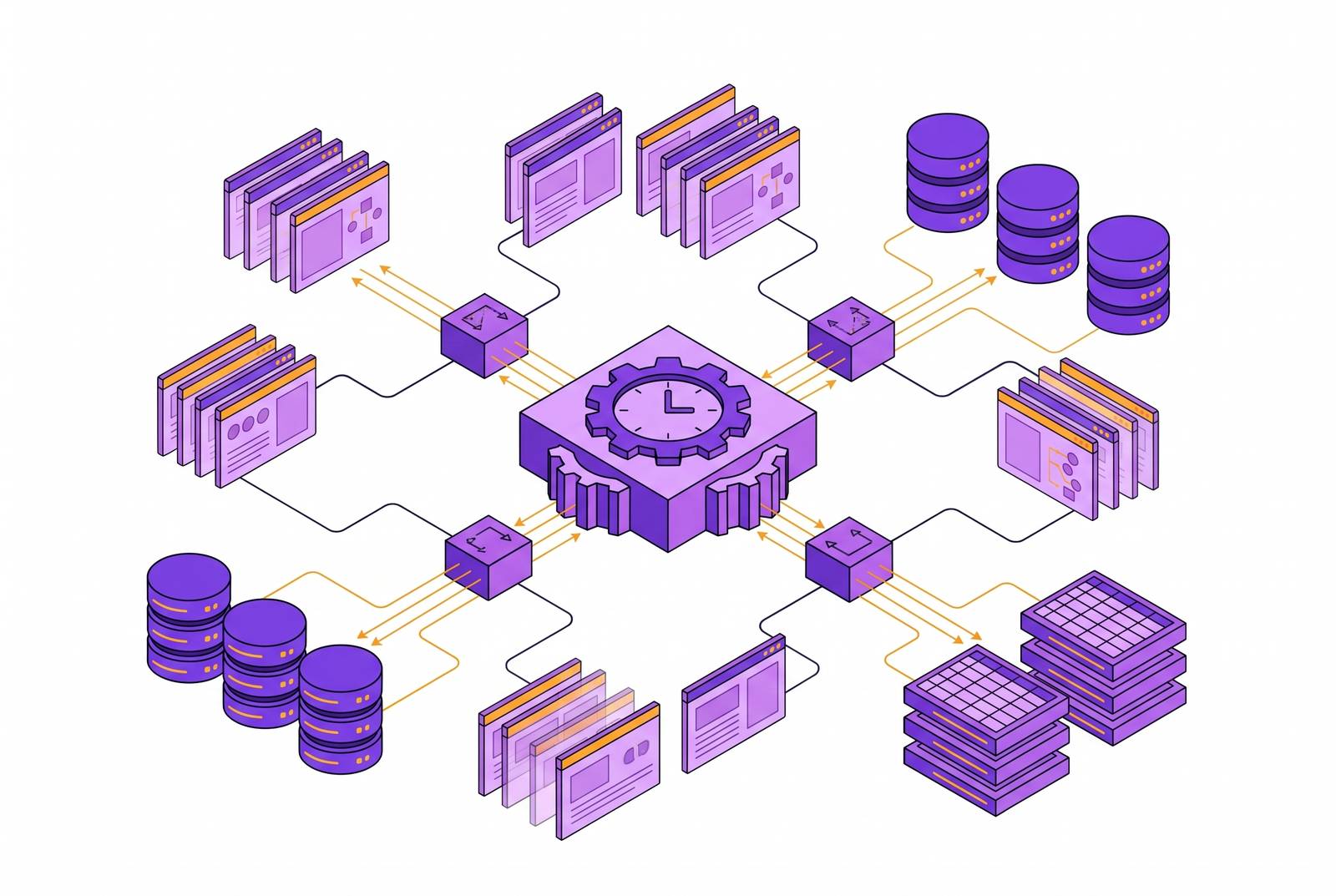
A continuous web scraping pipeline takes data from web pages as they change and turns it into fresh, structured records for storage and downstream AI. Build it around a scheduler that coordinates fetching, extraction, validation, and storage routing, with per-source freshness rules and step-level retries. Model quality helps extract the data, but the system depends on scheduler design to keep delivering it in production.
Why the prototype-to-production gap in web extraction is a scheduling problem, not an AI problem
Paste a URL, get structured data back quickly, and the hard part looks finished. Semantic extraction can interpret page content, follow a schema, and adapt to layouts that break fixed CSS selectors. At production throughput, however, those abilities do not decide which source needs another fetch, whether a browser session is being throttled, or where a validated record belongs.
Those decisions cross the whole pipeline. Static cron jobs pointed at fixed selectors cannot handle dynamic pages, JavaScript rendering, redesigns, and uneven freshness requirements as one coordination problem. The scheduler must own the transitions between those steps, including the choice between deterministic extraction and an agent-based fallback. Without that coordination, each component can seem to work even as the dataset grows stale or fills with errors.
The four production failure modes that a scheduler must prevent
Silent schema drift starts when a site changes its DOM or renames CSS classes. An adaptive agent may still return records, but put prices in the wrong field, omit fields, or infer relationships that do not exist. Row counts can stay stable throughout the damage. The scheduler must run validation after every extraction and stop downstream routing when it fails.
Browser sessions encounter slower responses, degraded content, or CAPTCHA interstitials, yet keep requesting pages and spending money. The scheduler must treat 429s, 503s, and degraded-content signals as rate-limit events, with exponential backoff and per-domain concurrency limits.
Raw HTML has navigation, ads, tracking scripts, and layout markup that must be cleaned up before an AI pipeline can use the content. Fetch success alone does not make that output storage-ready. The scheduler needs a validation gate between extraction and routing to check whether each returned page can be used as a record.
Stale data can pass every field-level check. A fixed global interval over-fetches stable pages while leaving volatile sources behind, so a RAG system can generate an answer from information already out of date. More accurate extraction cannot repair that timing error. The scheduler must assign freshness limits per source, calibrated to how quickly its data changes.
How do you build an automated web scraping pipeline at scale? Start with the scheduler architecture
A persistent job registry feeds a fetch orchestrator, which passes content through an extraction tier selector and a validation gate before a storage router accepts the result. Each stage has a distinct responsibility. The registry stores every target’s schedule, schema, destination, and state, including active, paused, backoff, or failed, so a restart does not erase progress or reset backoff counters.
The orchestrator applies each domain’s concurrency limits and session settings. Lightweight HTTP works for stable pages that do not need JavaScript, while a managed headless browser can handle rendered content. The tier selector then uses CSS or XPath for stable regions and invokes semantic extraction when selectors fail or return unexpected types. This means routine jobs can skip the more costly extraction.
The gate checks types, required fields, and other deterministic constraints before any record reaches storage. It also preserves the fetch timestamp through every layer. The router maps accepted records to the configured vector store, relational table, document store, or event stream. Separating routing from extraction lets one fetch feed both a RAG index and an analytics table without duplicating collection work.
Change detection as a first-class scheduling primitive, not a monitoring add-on
A detected change should trigger work. The practical pattern sends a structured webhook payload into conditional routing, which dispatches a re-fetch, re-extraction, re-chunking, or re-embedding step. The initial response needs no human in the loop. Escalation belongs to changes that are ambiguous or consequential enough to require judgment.
That automation needs a way to reject noise. Exact text comparison can flag rotating testimonials, timestamps, and minor layout changes as if they were new information. Semantic-diff mode instead applies natural-language instructions about which changes count. A competitor monitor, for example, can look for newly announced products while ignoring timestamps and rotating banner copy.
Prices, availability, and breaking news may need checks every minute or in near-real-time, while documentation and policy pages can be checked daily or weekly. With RRULE scheduling, checks can run at uneven intervals or on set dates for quarterly filings or product launch windows. Without that distinction, noisy pages can trigger expensive extraction while important updates wait.
Freshness TTL design and why a single global value breaks RAG pipelines
Embedding-based RAG retrieves from documents that are already indexed. It cannot recover a price, library version, regulation, or security CVE that the pipeline has not collected. Freshness is therefore an input policy. Scheduled live-web extraction must fetch, clean, chunk, and embed content at a pace matched to the source.
A freshness TTL defines how long data remains acceptable for use. Volatile data such as prices, sports scores, and breaking news needs seconds to minutes, while product specs, job listings, and competitor feature pages can use hours to days. Stable reference content can use days to weeks. One global value wastes quota on slow-changing sources and leaves fast-changing sources stale.
The fetch timestamp must reach every indexed document. That metadata lets retrieval enforce a freshness filter at query time, rather than trusting that scheduled indexing always completed. Without it, the indexing schedule becomes the only freshness control. A valid record can then remain eligible for retrieval long after its useful life has ended.
Schema-driven extraction as the contract between the scheduler and its storage targets
A schema sets the rules for what downstream systems can safely accept. Fields, types, and required values must be set before extraction runs, with JSON Schema-based structured outputs enforcing the interface at the model level. Loose rules can admit garbage, while overly strict rules reject pages where some fields are legitimately absent. The consuming pipeline’s minimum viable record should guide the design.
That contract also guides the extraction path. Template mode using CSS or XPath is fast and verifiable for stable, high-volume targets. LLM-prompt mode returns typed JSON from plain-language field descriptions, but costs more and belongs on the fallback path. Auto mode uses pre-built models for familiar page types such as products, reviews, and listings, so there is less to customize and less to maintain.
For operational data, the LLM can reason through deterministic tools. It classifies the document, applies the schema, extracts fields, and re-evaluates failures from arithmetic or cross-field checks. Storage must preserve more than the accepted record. Keeping raw fetched content with structured output allows a later schema change to trigger historical reprocessing without another source fetch.
Retry logic and backoff design at the step level, not the job level
A generic retry wrapper repeats work without diagnosing failure. If fetching succeeded but validation found an arithmetic mismatch, fetching the page again does not address the failed check. The scheduler should instead re-evaluate with a different extraction strategy. When output is empty or has a type mismatch, the scheduler should also try a fallback extraction tier before trying the same path again.
Fetch failures require their own response. Network errors and 503s warrant exponential backoff with jitter and reduced per-domain concurrency, while degraded bot-detection content calls for a session rotation, a fetch-infrastructure switch, or scheduled backoff. Each step needs durable input state and idempotent execution so a retry does not depend on lost in-memory continuity. Jobs that exhaust every path belong in a dead-letter queue for human review or an escalation webhook.
Multi-agent coordination and dynamic scheduling in agentic pipelines
At scale, specialized agents can handle DOM differences, sessions, or independent verification while the scheduler controls sequence and output routing. Multiple agents can check the same data using different tools, but that work has a cost. The scheduler must decide when cross-validation is worth paying for.
Dynamic scheduling extends this decision beyond fixed intervals. A scheduler can weigh the value of a fresh fetch against its cost and the usefulness of a cached snapshot. Agent JIT Compilation for Latency-Optimizing Web Agent Planning and Scheduling studies cost-aware plans and parallel execution, with source-freshness policy outside its scope. That distinction keeps research on planning from being mistaken for a complete extraction scheduler.
Infrastructure for the Agentic Web identifies durable memory, observability, and semantic agent discovery as gaps in agent-native platforms. These gaps matter to scheduling because state must survive restarts and jobs must reach agents that can do the work. The Agentverse paper also identifies the platform’s lack of native Agent2Agent support. Teams that design multi-agent scheduling should plan for A2A-compatible coordination interfaces, since they cannot assume agents can already share work through a shared protocol.
Brand and structured entity data as a specialized extraction target requiring its own scheduling policy
Logos, colors, fonts, social profiles, and firmographics are structured inputs for company profiles, lead scoring, and entity enrichment. A brand intelligence API can take a URL and return that information as JSON. These assets change infrequently, but a stale logo or social handle creates a visible quality failure when a change does happen.
An agent encountering an entity it has not seen recently can trigger a fresh fetch instead of waiting for a fixed sweep of every known company. This requires both event-triggered and time-triggered jobs. The schema and scheduling policy must follow the data’s use.
Replacing bespoke crawl infrastructure with an API layer: the build-versus-buy calculus for scheduler teams
Scheduler policy and fetch operations are different engineering commitments. The former decides freshness, validation, retries, and destinations, while the latter operates proxy rotation, headless browser fleets, and anti-bot fingerprinting. Building both adds operational work beneath the coordination layer. A managed API can take on fetch complexity while the team concentrates on the policies its pipeline needs.
The objections concern control as well as price. Depending on a vendor or fetching specialized or high-sensitivity targets can be reason enough to keep some fetch behavior self-hosted. A scheduler with an abstract fetch interface can route those job types to a self-hosted path and use a managed API for most targets. This hybrid setup can keep the pipeline’s scheduling rules in one system.
Designing for observability: how to know when the scheduler is failing before downstream pipelines do
A running scheduler is not necessarily a healthy scheduler. Per-job fetch success needs a history, because success after repeated soft-blocking differs from success on the first attempt. Schema validation pass rate must be tracked for each source, since a drop can be a sign of layout drift. Retry rate and tier distribution show whether primary selectors are forcing more jobs onto the agent fallback, while dead-letter queue depth exposes exhausted work awaiting resolution.
Freshness needs its own measurement at the destination. Fetch timestamp lag shows how much time has passed between the latest successful fetch and wall clock time for each source and storage target. Alert thresholds should follow downstream requirements, with tighter lag alerts for real-time pricing than for a weekly-refreshed documentation index. Every stored record also needs provenance, including its fetch timestamp, source URL, extraction tier, and schema version, so debugging can start from the data.
The design order is the practical conclusion. Teams should establish observability, per-source TTLs, step-level retries, schema-gated routing, and a dead-letter queue before selecting the fetch API beneath them. The AI component solves extraction. The scheduler makes continuous extraction a production system.