Replacing Brittle Selector-Based Extractors With Agentic Parsing Layers
Agentic parsing decouples extraction from page layout changes.
A reliable web scraping pipeline separates retrieval, parsing, validation, and storage. Replacing brittle selector-based extractors with agentic parsing layers makes the requested data shape the extraction contract. For most production systems, the practical answer is a hybrid that keeps fast selectors for stable sources and uses schema-driven parsing where layouts change.
Why selector-based extraction breaks at the architectural level, not the code level
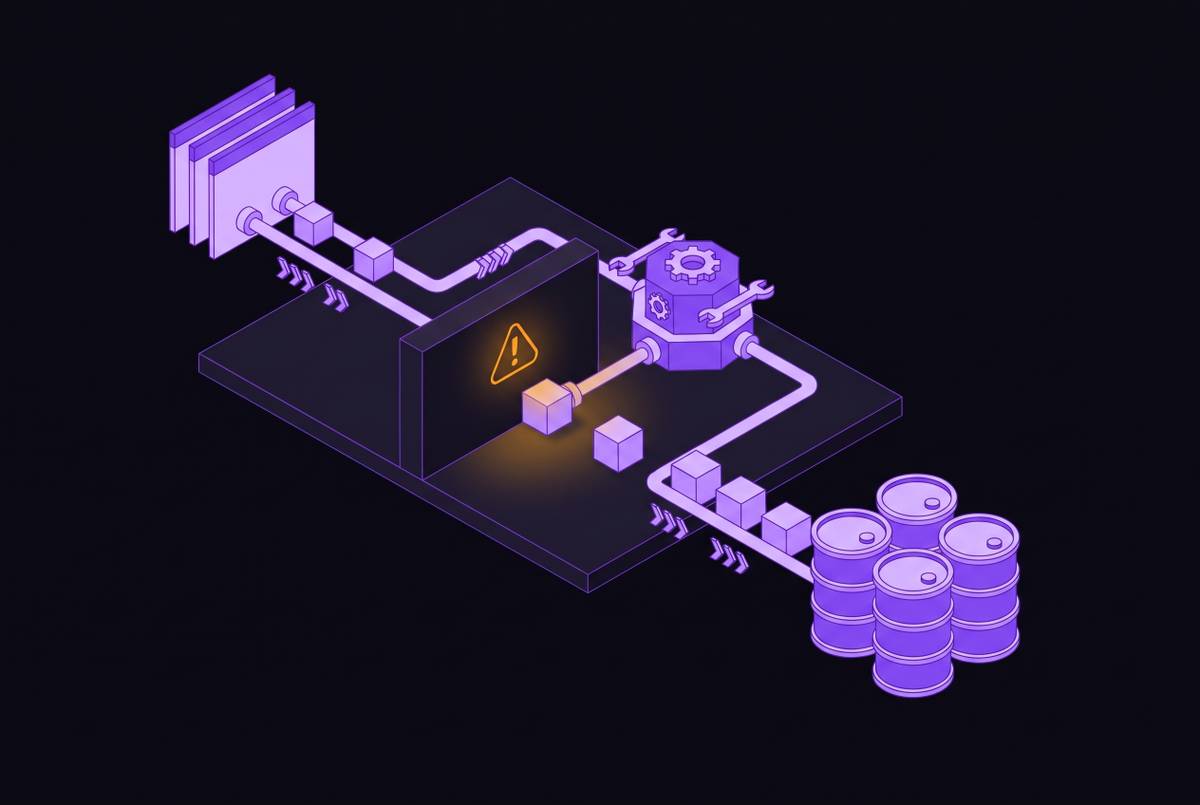
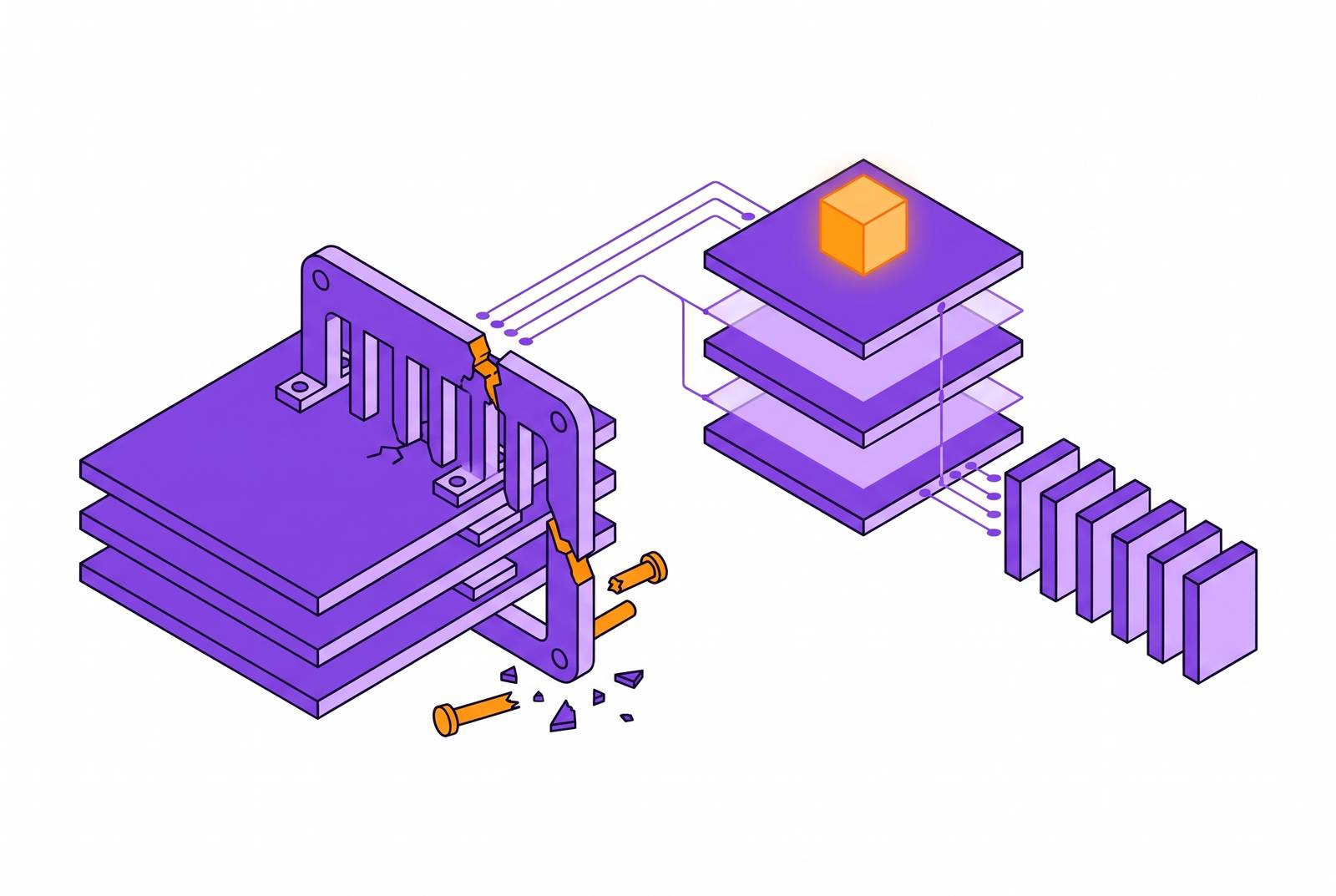
A selector works until the page changes underneath it. A Python pipeline built on BeautifulSoup or lxml may bind a field to a CSS class name or an absolute XPath path, then fail when a new React build replaces those classes. The extraction code has not changed at all. Yet the parser can return nothing, and code expecting an element can immediately throw a NoneType exception. The site changed its presentation, but the pipeline lost access to its data.
That dependency is the design flaw. Auto-generated class names make identifiers temporary, while long descendant chains turn layout depth into an extraction requirement. Positional selectors assume that element order stays fixed, and common class names can match unrelated elements after a redesign. These patterns fail for different immediate reasons, but each treats a choice made for displaying a page as a promise about where data will live. More careful selectors can lower the risk of failure, but they still depend on those choices.
XPath adds bidirectional traversal and text matching beyond what CSS selectors support, which can make some extraction rules more expressive. Both approaches still locate elements in a DOM tree, however, rather than define the meaning of the requested field. A rule for finding a particular node is not the same as a contract for returning the product price. That distinction explains why selector maintenance recurs even in well-written pipelines.
How schema drift turns selector failures into pipeline failures that look like success
An exception at least makes the failure visible. The more dangerous outcome is a selector that executes without error but returns an empty field or the wrong value. A small change to the page’s structure can let the extraction job succeed even though its output no longer has the expected data shape. This is schema drift at the extraction boundary. Downstream consumers get nulls, stale values, or unrelated content, but no failed job warns them.
Network access can succeed, rendering can finish, and the parsing code can run, yet the resulting record can still be unusable. Logs that record only those successful operations do not establish that the requested fields were found. A pipeline reporting success may therefore be reporting only that it has completed the process.
For RAG and LLM pipelines, that gap extends into the answer users receive. Stale extraction need not cause an inference-time error because the system can still generate a response from outdated material. The answer looks authoritative but is wrong. Managing this risk adds a separate detection burden, and that burden grows as the number of target sites grows. Faster detection makes failures less costly, but it does not remove the structural dependency that caused them.
What agentic parsing layers actually do differently
Agentic parsing changes what the extractor is asked to find. Instead of locating an element with a particular class, it receives an instruction to find a price in the supplied content. The LLM works from raw text or Markdown and a JSON schema, returning structured, typed fields. The parsing instruction no longer needs a DOM address. Extraction intent and page layout become separate concerns.
Markdown conversion makes this separation concrete. Headings, paragraphs, and lists provide content for the parsing layer without requiring it to follow the original page’s presentation markup. If a redesign moves a price between elements or renames its class, the extraction request stays the same because the price still means the same thing. This works only if the requested content reaches the parser. Decoupling the parsing step from the DOM does not make retrieval or content conversion irrelevant.
JSON Schema supplies the new contract between extraction and the rest of the pipeline. The developer defines the shape of the requested data, while the parsing layer returns fields that can be validated against that shape. The same contract can work across pages with different layouts, so each layout can use it without its own extraction rule. This is the architectural gain. A change in presentation no longer necessarily requires a change in the definition of the data.
The distinction also sets a limit on the promise. A correctly shaped result is not, by itself, proof that every value is correct or current. Source content can change, and the pipeline still needs validation appropriate to its fields.
The real cost trade-off between selector-based and agentic extraction
Agentic extraction costs more and takes more time for each job. It runs at a meaningful multiple of the cost of managed API-based extraction and adds LLM latency that a traditional selector parse does not incur. At large collection volumes, that premium is substantial. Replacing every stable selector with an LLM call can make a pipeline that already works as expected cost more without enough improvement to make up for it.
The fair comparison includes more than API charges. Selector-based systems require engineering time to maintain, version, and rewrite extraction rules when target pages change. They also need to detect drift with field validators, null-count monitoring, and DOM diff tests in CI. The per-page extraction price leaves out those costs, which can make selectors look cheaper than they are. Undetected failures add another cost through incorrect RAG answers, stale inputs to agents, and corrupted datasets.
Not all of that overhead disappears with agentic parsing. Selector-specific maintenance and DOM-change testing can fall away on the agentic path, but checking the output remains necessary. The useful distinction is between work required to keep locating data and work required to establish that the data is usable. Only the former is directly addressed by replacing selectors. Treating all validation as removable would overstate the savings.
The strongest case for selectors is high-volume collection from homogeneous, well-understood sources whose extraction rules rarely break. In that setting, maintenance costs stay low and the agentic premium is harder to justify. Unknown or frequently changing sources present the opposite economics because repeated repairs erode the advantage of cheap parsing. That contrast makes a hybrid architecture a cost decision.
How do you build a reliable web scraping pipeline with a hybrid architecture?
The practical recommendation is to keep a lightweight selector parse as the first path for known, stable sites. The pipeline should fall back to LLM-based extraction when selectors return nulls, field distributions diverge from historical norms, or a new source has no selector definition. Both paths should return output that fits the same schema. This preserves fast parsing where it works without making every unfamiliar layout a new engineering task.
A pipeline monitoring competitor pricing pages illustrates the division. Known pages with stable layouts can stay on the selector path, while changed pages and newly added sources use agentic parsing. The fallback is not triggered only by an exception. A price field that departs from its historical distribution can also signal that the apparent extraction success needs another path. Teams with highly specific, evolving schemas should lean more heavily on agentic extraction, while teams with a few stable sources can retain selectors as their primary method.
Refresh policy is a separate architectural decision. Prices, scores, and availability need short refresh cycles, but documentation and company descriptions can go longer between refreshes. The chosen parsing method should fit that cadence because repeated LLM calls affect both cost and latency. FreshStack, established at NeurIPS 2025, found that existing retrieval models significantly underperformed oracle approaches on challenging technical domains. That finding establishes room to improve retrieval quality.
Semantic change detection evaluates whether a change is relevant to the extraction goal, such as a newly announced competitor product rather than rotating testimonials or timestamp updates. DOM and hash comparisons can generate too much noise on active sites for automated pipelines to act on. The choice of API infrastructure then determines how much retrieval, fallback parsing, and normalization the team must build itself.
How API-first extraction infrastructure handles the parsing layer so teams don't build it twice
An extraction API makes the hybrid design practical when it handles more than the final parsing call. The relevant capabilities include JavaScript rendering, anti-bot handling, retries, JSON schema input, and clean Markdown or typed JSON output. If the service lacks those layers, the team still has to build them around it. Moving only the LLM call behind an API leaves much of the operational burden untouched.
The division of responsibility should be explicit. The developer gives the provider the URL and the data shape to return, and the provider handles rendering, retries, and format normalization. On the fallback path, schema-driven extraction becomes an API call rather than a separate inference pipeline maintained beside the selectors. The rest of the workflow can continue receiving the same data shape for validation and storage. This is how the parsing layer changes without requiring the team to rebuild every downstream consumer.
Buyers can compare services more usefully by what they do in those areas than by a claim of extraction intelligence alone. A service that parses text may still leave the work of getting that text from a JavaScript-rendered page to the team. Similarly, anti-bot handling and retry support address access problems, while schema-driven parsing addresses extraction problems. They are different failure layers. For a large-scale workflow to be reliable, someone must clearly own each layer, even when parsing succeeds.
Agent integration adds another selection criterion. An extraction API offered as an MCP tool can fit straight into an agent runtime, so teams have less custom integration work to do. Agent2Agent (A2A) v1.0 shipped on March 12, 2026, and the Linux Foundation announced 150+ supporting organizations on April 9, 2026. That adoption does not itself establish MCP support for an extraction API. The useful buying question remains whether the service exposes the interface the intended runtime needs.
What a migration from selectors to a schema-driven parsing layer looks like in practice
The migration should begin at the extraction boundary. The first action is to audit existing selectors by stability, recording how often they break and whether they target class names, positions, or text nodes. The audit should also find sources whose front-end frameworks often change DOM depth. This shows which selectors are cheap and dependable and which rules look cheap only because no one counts the work of fixing them.
The second action is to define a JSON schema for every data shape the pipeline currently extracts. That schema should describe the output downstream consumers already expect, independent of any source page’s markup. The contract moves from location to data. Preserving the output shape allows pipeline logic, storage, and consumers to remain unchanged while the extraction method changes underneath them.
The third action is to replace the extraction call for unstable sources with an API call that accepts the URL and schema and returns typed JSON. BeautifulSoup, lxml, or custom XPath no longer defines the parsing path for those sources. Stable, high-volume sources can retain selectors where the agentic cost is impractical. Teams can then use selectors where they improve performance without making them the default for every new source.
Range and type assertions, null-count logging, and field distribution tracking can detect unusable output regardless of the parsing method. On the agentic path, the concern shifts from broken node paths to changes in what the source actually publishes. The practical sign of progress is that unstable sources eliminate the queue of selector repairs, and adding a source means defining its required data. The schema becomes the contract, changing the task from “find the element” to “define what you need.”