Designing Self-Healing Web Scraping Pipelines That Adapt Block Signals Into Storage-Ready Agent Outputs
Autonomous web scrapers need classified failures before they can adapt recovery strategies.
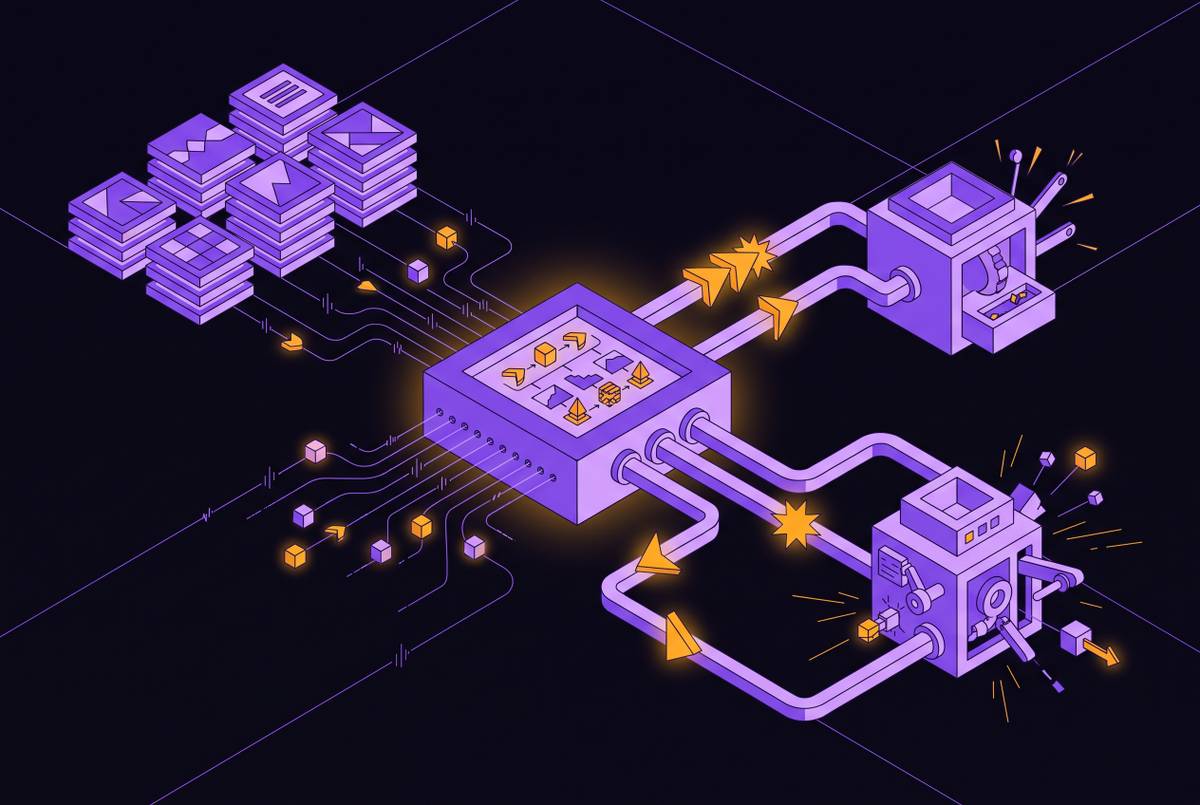
A self-healing web scraping pipeline turns block signals into recovery decisions through four layers, which are detection, adaptation, validation, and normalization. Reliable large-scale collection depends on classifying failures before choosing a fix, then delivering clean Markdown or structured JSON with validated fields and freshness metadata. Better fetching alone cannot provide that guarantee.
Why scraping pipelines keep breaking despite better tooling
At 2 AM, a pipeline breaks because a target page has changed. The immediate response is familiar, involving debugging, re-mapping selectors, and applying a hotfix. Yet the repair leaves the underlying design untouched. A conventional scraper assumes that page structure stays the same, that responses have the content it asked for, and that retries work when failures are temporary. Modern web infrastructure breaks all three assumptions.
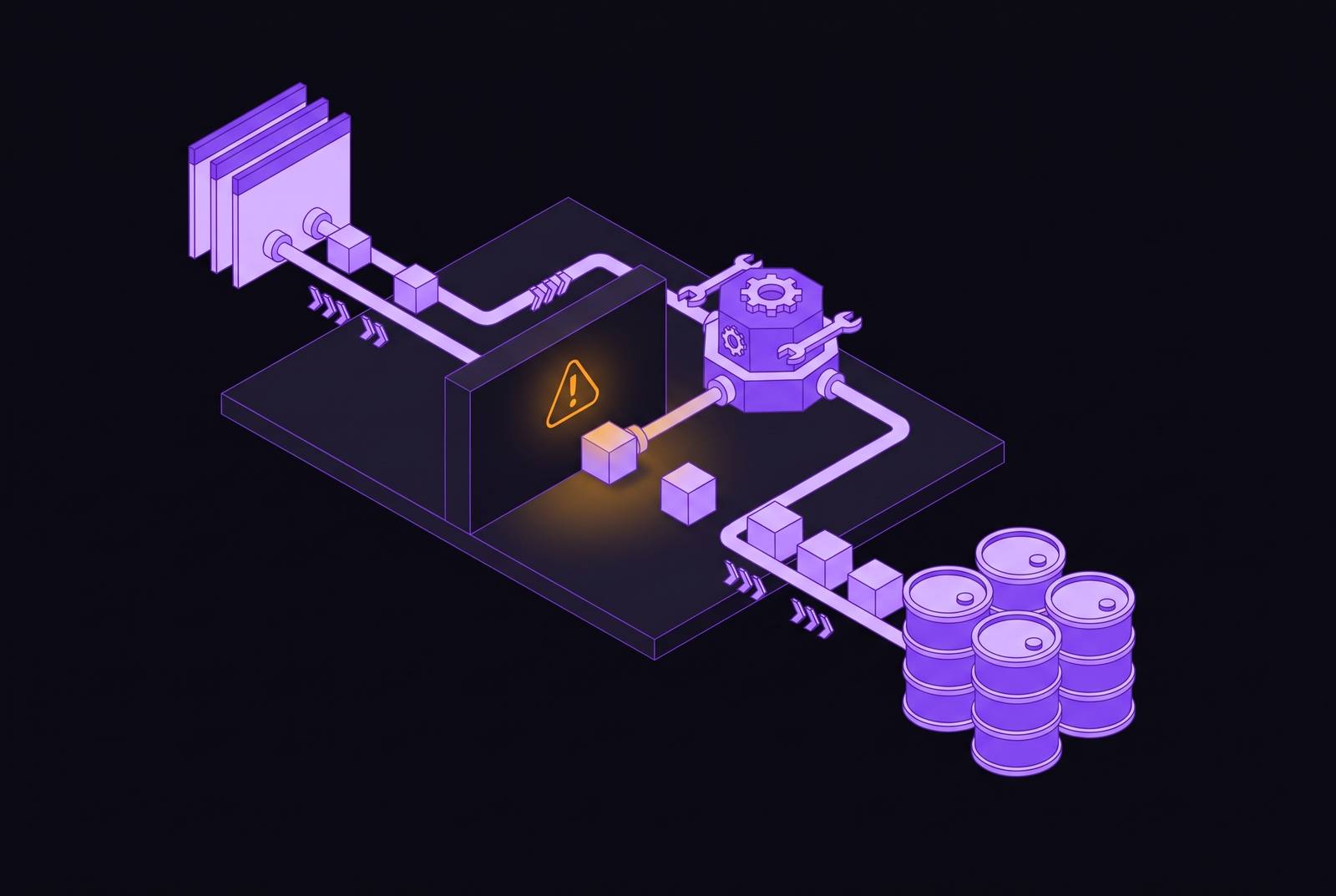
Some failures never raise an error at all. A plain HTTP client can receive valid HTML that omits the target data and contains an access challenge or an empty shell. If the pipeline treats a successful response as successful extraction, that content moves downstream. Retrying the same request does not correct the mistake because the system has no way to identify what went wrong.
Across many target domains, this means making repairs over and over. Better tooling can make each fix easier while leaving people with just as much work to do. A scraper fetches and parses, while an agent observes, classifies, decides, and adapts. That distinction calls for separate responsibilities within the pipeline.
Block signals are not uniform errors — they require classification before recovery
“The pipeline got blocked” is too vague to guide recovery. A CAPTCHA challenge requires a different execution path or a human handoff, while a consent or cookie wall requires an overlay-dismissal action before extraction. A login redirect calls for a choice between authentication, another authorized route, and marking the content as out of scope. These are not interchangeable failures. Each changes what the pipeline can do next.
An empty shell points to missing browser rendering, so re-parsing the blank HTML is pointless. A rate-limit response or IP ban instead calls for recovery through transport and session identity, within the access policy. A soft block is harder to spot because its plausible-looking HTML omits the requested fields and contains an access challenge or sanitized content. It can reach a model without raising an alert, consuming tokens and producing noise.
A field that moved within the page needs new targeting. Conversely, rotating a proxy does not solve detection tied to a session’s browser fingerprint, and changing a user-agent does not repair a blocked IP range. Classification prevents these mismatched fixes. Without it, autonomous recovery just repeats the wrong action faster.
How do you build a reliable web scraping pipeline with a four-layer control loop?
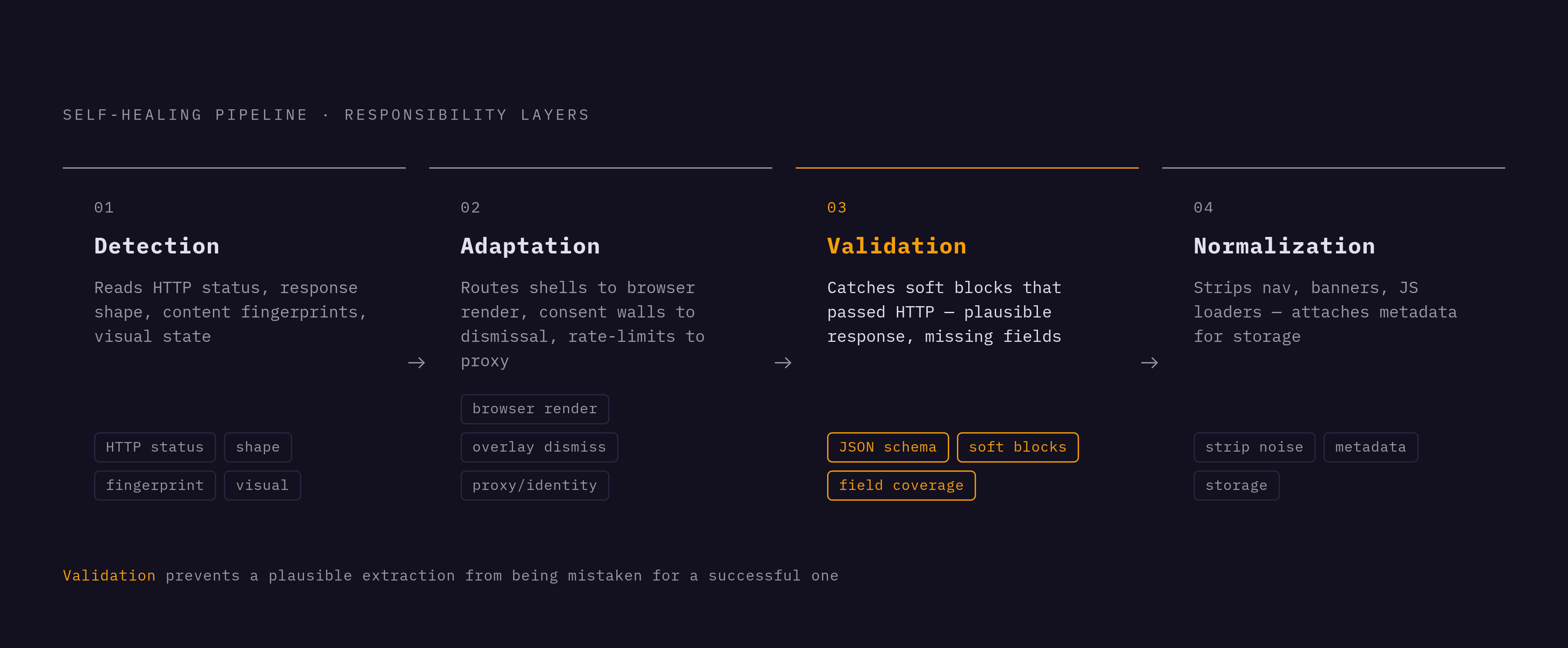
Detection and classification form the first responsibility boundary. This layer inspects HTTP status, response shape, content fingerprints, and the visual state of rendered pages before content moves downstream. Status codes cannot reveal every failure. A modal overlay, login form, or empty viewport may expose a problem that transport checks miss. Eshun et al., 2026 frame detection as combining monitoring signals, pipeline metadata, and incident history to classify failures before remediation begins.
Adaptation routes empty shells to browser rendering, consent walls to overlay dismissal, and rate-limit signals to the proxy and identity layer. The routing depends on the diagnosis. Transport, rendering, parsing, and recovery therefore need separate boundaries so that one can change without requiring a rebuild of the others.
Validation decides whether the recovery actually worked. It compares extracted fields with the defined JSON schema and uses prior-run data to spot changes in field coverage or value distribution. A mismatch can trigger modified extraction instructions or another extraction strategy within the run. This also catches soft blocks that passed HTTP checks but failed to produce the required fields.
Normalization turns accepted content into usable output. It strips out navigation, cookie banners, nested containers, and JavaScript loaders that add tokens but no target data. It also attaches the metadata needed for storage and later retrieval. These layers define responsibilities. Their value lies in preventing a successful fetch, a plausible extraction, and a usable record from being treated as the same thing.
Structural resilience at the extraction layer: from rigid selectors to semantic and visual targeting
A hardcoded selector ties the identity of a field to its current location or label in the document. When a platform recompiles client assets, a class such as div.product-price-large can become an obfuscated hash-based equivalent. The price may still be visible to a reader. But the selector fails, so it needs a fix that has to be repeated across target domains.
CSS and document-path templates still suit predictable sites with stable schemas. They offer the lowest cost but the greatest fragility among the extraction modes described here. LLM prompt-based extraction recognizes what a price or title means, so it depends less on the markup around it. For unknown sites, an agent that explores the page and returns a reasonable schema from plain-English requirements removes the need to pre-code every new domain.
Relational targeting offers another way to loosen that dependence. A relationship-based model tracks how elements relate to each other. It evaluates proximity to stable anchors such as company headers, product title positions, and corporate footers. Even when a field moves, its relationship to an anchor the model can recognize can still help the model find it.
When structural confidence falls below a threshold, vision-language extraction provides a fallback. It renders the document, locates fields through object recognition, and maps their coordinates back to the changed node. This does not make validation optional.
Why recovery logic must include a human-approval path, not just autonomous remediation
Autonomous remediation works for known failures that have established responses. Deterministic policy checks can handle most of those cases cheaply before an LLM agent is consulted, leaving novel failures to the agent layer. But an unfamiliar signal is not permission to improvise. When confidence is low, the block type is new, or the data feeds a high-stakes decision, the pipeline should pause and surface the incident.
Eshun et al. describe a fuller loop in which detection leads to diagnosis, a proposed fix, automated or human approval, remediation, verification, and learning. Approval is a routing decision within recovery. It requires the system to distinguish an established response from an untested action whose consequences need judgment.
Authorization creates another boundary for that routing. The ability to bypass a block does not establish permission to do so. Where a site signals that it does not want automated access, recovery should point toward an official API, licensed feed, or direct partnership. Technical success alone is not the acceptance criterion.
Persisting the signal type, attempted remediation, and outcome lets the policy layer improve without repeating the same manual diagnosis. The same paper identifies fragmentation across vendor platforms, observability tools, and open-source components as an architectural gap. Human approval and incident history help connect those components into a controlled system.
Delivering storage-ready output: metadata, freshness, and chunk integrity
Storage-ready output is a contract. Clean Markdown or structured JSON must include validated fields and enough metadata for downstream agents to identify, filter, and assess the content. Otherwise, successful recovery can still end in unreliable retrieval. Normalization is the final delivery stage of the control loop.
The minimum record includes url for the fetched address and canonical for deduplication. It also includes fetch_timestamp, recording retrieval time rather than processing time, and content_hash for detecting unchanged content on re-crawl. Title, language, and content type support routing and filtering. Blocked records need a normalized block reason too. A null field alone cannot tell a downstream system whether data was absent or access failed.
Freshness requires its own policy. A time to live, or TTL, should vary by topic, with volatile prices, scores, and breaking news needing minutes, while stable reference content can use hours to weeks. The query layer should be able to shorten or bypass that TTL when recency intent is detected. Cached content served without a freshness check can mislead the receiving model while hiding how old the content is from the agent.
Normalization must happen before chunking, and structural boundaries should serve as chunk delimiters. Splitting a table row or list item can leave fragments unusable or misleading to a retrieval model. Together, intact chunks and freshness metadata make the recovered content fit for downstream agents and retrieval-augmented generation systems.
How website monitoring feeds the pipeline as a change-detection trigger
Website monitoring watches a URL or content scope and sends structured change events through webhooks or polling to trigger the pipeline from outside. Those events enter the same recovery architecture. A detected change, rather than a failed request, starts the work.
An event can route to re-crawling, re-extraction, re-embedding, or human review. A webhook-driven change can also chain re-scraping, re-validation, re-indexing, and notification without a person coordinating each step. Validation remains in that sequence because changed content is not automatically valid content. Monitoring tells the pipeline when to act, while the existing layers determine what to accept.
Building that trigger internally can become a substantial project. Headless-browser monitoring brings requirements for asynchronous-content waits, proxies, retries, snapshot storage, document normalization, comparison logic, webhook delivery, and dashboards. The work extends well beyond comparing two pages. A team pursuing that route is maintaining a monitoring product as well as its extraction workflow.
Change events also need to work with freshness policy. A content-hash mismatch on a record with a long TTL should reset the TTL and trigger re-indexing. A mismatch on already-volatile content may be expected and handled through its normal refresh cadence. This distinction keeps monitoring connected to the output contract, so detected changes affect the version that downstream systems actually retrieve.
What a consolidated API layer gives teams that a bespoke stack cannot
Each responsibility in this architecture creates an infrastructure requirement. Transport needs proxy and session management, extraction may need browser fallback, and delivery needs formatting, metadata, schema validation, and change events. A bespoke stack can assemble those capabilities. What it cannot avoid is ownership of the integration points between them, each of which becomes another place where records can fail.
A well-designed consolidated API layer reduces that integration burden through a shared contract. Its capabilities can include a single REST endpoint that turns a URL into clean, LLM-ready Markdown, developer-defined schema extraction into JSON, full-site crawling, and brand or entity intelligence. Rendering, proxies, and normalization then stop being separate systems for the team to manage. Consolidation does not replace domain-specific validation or approval policy.
Integration speed is part of the design criteria. When teams spend days wiring services together, they have to wait to test extraction quality, while API calls that work in minutes let them start testing sooner. Debugging benefits from the same consolidation. When fetching, normalization, and schema extraction share a contract, teams can trace a failed record within one system instead of having to match up logs from three vendors.
Rebuilding common transport and formatting infrastructure consumes time that could go toward adaptation rules, field validation, and escalation thresholds specific to the domain. The API layer handles common plumbing so the team can concentrate on whether the data is correct, current, authorized, and ready for an agent to use.