Why Agentic Extraction Pipelines Outperform Scheduled Scrapers for Daily Multi-Site Product Data
Agents adapt to page changes; scheduled scrapers break when sites redesign.
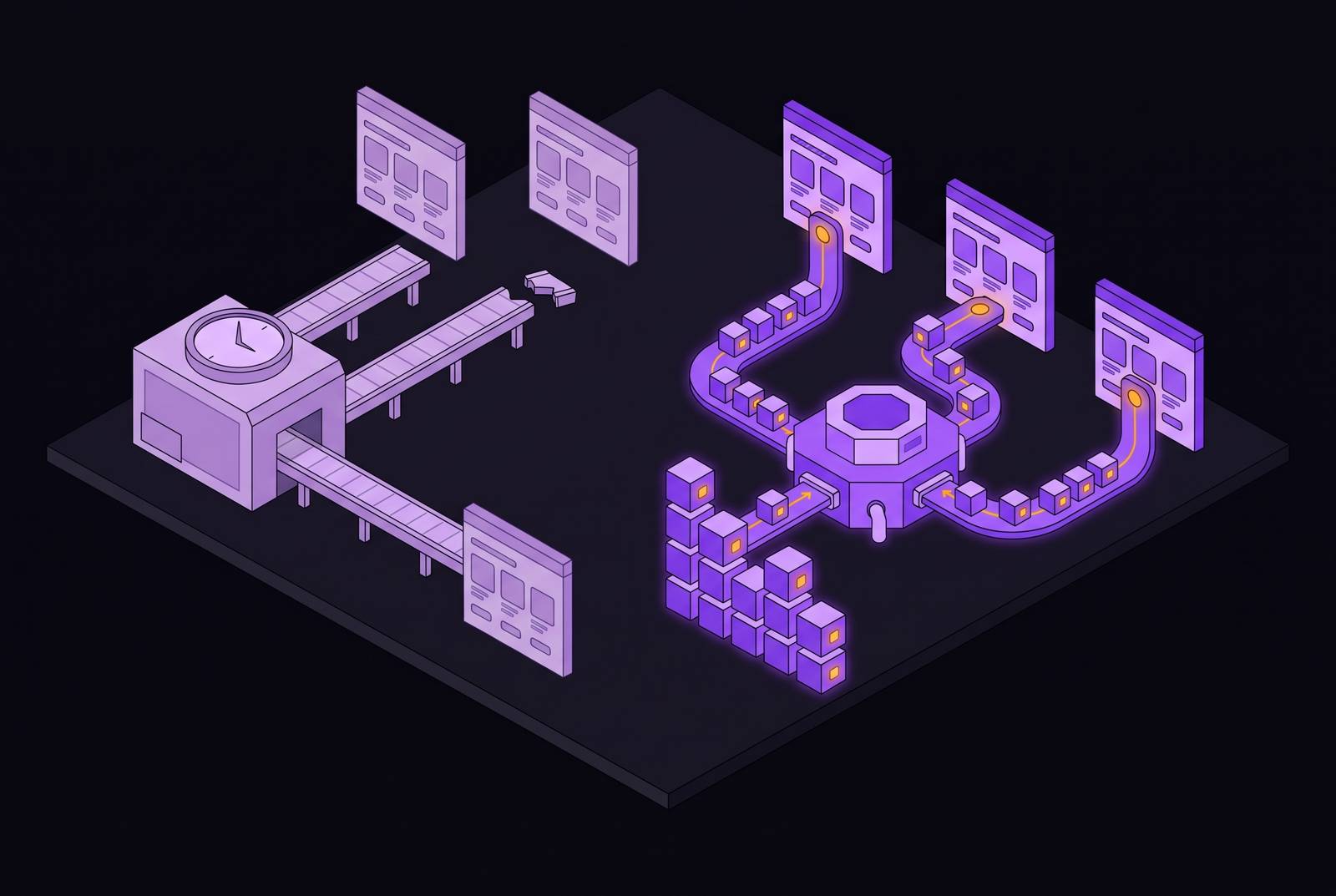
A web scraping pipeline fetches pages, extracts data, validates it, and passes it downstream. For daily product data across many changing sites, agentic pipelines outperform scheduled scrapers because they decide how to extract from the page as it exists now. A reliable architecture pairs that reasoning loop with schema validation, change-triggered extraction, and managed fetching infrastructure, freeing engineers from having to repair static selectors.
Why scheduled scrapers carry a structural maintenance ceiling
A developer rewrites a broken CSS selector because a retailer changed its product page layout. The next scheduled run works again. But nothing about that repair protects the pipeline from the retailer’s next redesign, or from another source changing tomorrow. The developer has restored an assumption.
A scheduled scraper makes a static assertion that the price lives in a particular CSS class or at a particular XPath. Its correctness depends on that assertion staying true. When the page changes, extraction can fail outright or quietly return bad data. The second outcome is harder to spot because the pipeline may still produce a value.
Each retailer has its own redesign and A/B testing calendar, so adding sources raises the chance that at least one extraction path will be broken on a given day. This is the mechanism behind the 80/20 maintenance trap, where fixing selectors consumes the effort that should go into building features. A daily schedule repeats the work, but it cannot make the underlying instructions more durable.
Why this is an architecture problem, not a tooling problem
Traditional scrapers decide how to extract at author time, when an engineer can see where the desired data sits. Every later run executes that decision against a page that may no longer match it. The page can change without the instructions changing. That mismatch is the architectural fault.
A faster proxy layer can make pages easier to reach, but it cannot tell whether the selected price is for the intended product variant. A smarter selector can tolerate some layout changes, but it still encodes an extraction rule in advance. Failure alerts shorten the time before someone notices a problem. None of these improvements moves the extraction decision to the moment when the scraper sees the current page.
The distinction is between executing an instruction and judging whether that instruction still fits. A script told to find .product-price has no built-in basis for deciding that the current price now appears somewhere else. The extraction architecture itself still depends on a human updating the rule.
What an agentic extraction pipeline actually does differently
An agentic extraction pipeline receives a goal, such as extracting the current price and availability of a product. It observes the page, chooses an extraction path, and adapts that path when the page changes. Extraction logic becomes a runtime output.
That distinction becomes concrete when a price is not immediately visible. An agent can reason through cookie consent, an AJAX tab, or a product configurator that requires size, colour, and configuration choices before showing a price. It can also interpret specifications embedded in descriptions. These tasks require deciding where to look and what to do next.
The same flexibility helps when onboarding an unfamiliar source. An agent can explore the page and propose a reasonable schema without source-specific extraction code written in advance. When a familiar site changes layout, it can instead remap the path to the requested information. McGill University’s 2025 study found that AI methods kept their accuracy at 98.4% even when page structures changed completely. That finding supports adaptability, but it does not make every agent or every extracted field reliable.
Where agentic pipelines do not automatically win
Runtime reasoning has a cost on every page. For large catalogs, LLM inference can take up most of the budget, while pages that stay the same may need only cheap rule-based extraction. Replacing those rules wholesale can make a working pipeline more expensive without solving a meaningful maintenance problem.
Direct navigation to target elements, irregular timing, and missing scroll events can expose automated browsing to bot detection. An agent does not become harder to detect simply because it reasons. Unassisted agents can perform substantially worse on targets protected by bot detection services than managed infrastructure using appropriate fingerprinting and residential proxies.
An agent may pick the wrong price tier, mix up variants, or make up a field from the text around it. Schema enforcement and content validation are therefore required. The practical architecture layers rule-based automation, ML and NLP, generative AI, and agentic reasoning where each fits. Agentic extraction is most useful for product data gathered daily from many sites whose pages change and keep breaking fixed rules.
How schema-driven extraction connects the reasoning loop to a usable pipeline output
Flexible reasoning is useful only if downstream systems receive predictable data. A pricing engine, RAG index, or dashboard cannot depend on an agent choosing the same response format on every run. A JSON Schema defines that output contract. The agent may change how it finds a price while the next pipeline step continues reading the same field.
Schema-driven extraction accepts that contract and returns an object shaped to match it. This removes the need for downstream steps to reinterpret free-form text after every extraction. It also gives validation a clear boundary, making missing fields or structural mismatches visible before they propagate. The extraction path can vary without forcing the rest of the pipeline to vary with it.
OpenAI’s Structured Outputs feature guarantees adherence to the supplied JSON Schema when strict is set to true. A correctly shaped response can still contain the wrong price or a misidentified variant. Schema enforcement makes the output usable, while accuracy validation checks whether the data in it can be trusted.
Change detection as the event trigger, not a monitoring dashboard
A notification in a dashboard still needs someone to act on it. A webhook can instead fire a re-fetch and start an automated chain of extraction, validation, and downstream updates. That is the useful distinction for an automated pipeline.
A global daily schedule assumes that data from every source needs to be refreshed at the same rate. A fast-moving retail page and a slow-moving manufacturer specification sheet do not change at the same rate. Change detection replaces that blanket assumption with checks tailored to each source and runs extraction when content changes in ways that matter. Monitoring still needs a cadence, but full extraction no longer has to run on every source every 24 hours.
The event also needs a machine-readable form. A structured JSON diff can trigger a RAG pipeline to re-index only changed content, whereas a screenshot or dashboard notice requires interpretation. Semantic-diff mode uses natural-language instructions to filter for the changes that count. It can ignore timestamps, rotating testimonials, and minor layout updates that would otherwise flood the notification feed. Per-source cadence, structured diffs, and semantic filtering turn monitoring into part of the pipeline’s control flow.
How do you build an automated web scraping pipeline end to end?
The end-to-end pattern joins change detection, fetching, agentic extraction, schema validation, and downstream delivery. A meaningful source change triggers a fetch, the agent interprets the current page, and validation checks the resulting object before it proceeds. Failures enter a repair loop. That repair loop needs explicit limits and a way to verify its work.
ishango.ai’s paper “Agentic Self-Healing for Data and AI Pipelines” describes a vendor-agnostic architecture for that loop. Monitoring detects a failure, an LLM agent diagnoses its cause using pipeline metadata and incident history, and a proposed remediation runs within policy bounds. The next run verifies the fix. Each step is explicit and auditable, so automatic repair does not mean unaccountable repair.
In web extraction, a layout change may make the output fail schema validation. The pipeline can rerun extraction with the agent reasoning over the new layout, validate the new output, and log the incident. The paper identifies the main gap as architectural rather than technological because the required ingredients already exist but are fragmented across platforms and components. Human oversight therefore shifts toward reviewing edge cases, accuracy metrics, and remediations outside policy bounds.
How API-first infrastructure handles what the agentic layer cannot
The reasoning loop still needs access to the page. Extraction relies on proxy rotation, browser rendering, and anti-bot handling, and when those fail, the agent has nothing useful to read. More reasoning cannot substitute for managed fingerprinting or residential proxy infrastructure. Access and interpretation are different jobs.
Building a proxy layer, rendering cluster, parsing pipeline, and monitoring stack can simply exchange selector maintenance for infrastructure upkeep. A single REST API can accept a URL and return LLM-ready Markdown or schema-bound JSON while handling proxies, rendering, and anti-bot measures. For structured product feeds, the JSON output connects that infrastructure directly to the downstream contract.
MCP compatibility makes the same infrastructure available as an agent tool. An agent can decide to fetch a page, extract structured data, or look up brand information without custom integration code for each capability. That connection lets the agent request the operation its reasoning calls for. It does not remove the need for output validation or make protected pages universally accessible.
Freshness is another decision that belongs in the request. A parameter such as maxAgeMs lets a team distinguish a source that must be live from one where yesterday’s data is acceptable. This provides a per-source cost and freshness tradeoff rather than forcing every request through the same schedule. Together, managed access, structured output, tool compatibility, and freshness controls provide the substrate the reasoning layer needs.
When to migrate an existing scheduled scraper pipeline and where to start
The first migration candidates are the sources that repeatedly consume engineering time. A source requiring weekly extraction fixes deserves attention before one with a stable layout and predictable output. Failure cost changes that priority too. A broken feed used for pricing decisions or RAG-grounded responses is riskier than one used for a low-stakes dashboard, because stale data can lead to confident wrong answers.
The decision should therefore weigh break frequency, downstream consequences, and structural stability. Those checks help show where runtime reasoning is likely to be worth the extra inference cost. Sources that stay the same and handle high volumes should come later in the migration and may stay rule-based.
Migration can start by replacing the extraction layer for sources that change often with an API call that returns schema-bound JSON. The downstream pipeline can stay as it is if the output contract stays the same. Before retiring the old scraper, the team should validate that the replacement meets that contract.
Change detection is another way to start with little risk. Using structured diffs to trigger extraction events cuts out scheduled runs that are not needed and shows which sources need attention. It can be adopted before the agentic extraction layer, so the trigger and extraction decisions do not have to change together.
The end state gives engineers a supervisory role. They define schemas, review accuracy, and approve out-of-policy repairs while the pipeline handles layout drift, change-triggered extraction, and schema validation in steady operation. The concrete goal is to invert the maintenance ratio so engineers spend most of their time building features.