Closing the Gap Between Raw HTML and Agent-Ready Structured Data With Semantic Normalization Layers
Turn raw HTML into reliable structured data for AI agents through validation and semantic layering.

A reliable web scraping pipeline fetches pages, removes rendering noise, preserves content structure, and validates extracted fields before storing them for agent use. Semantic normalization must turn raw HTML into structured data that is ready for the agent. Without it, an agent can produce plausible answers from broken, ambiguous, or stale input.
Why raw HTML is structurally incompatible with agent reasoning
HTML is built to render pages. Navigation, cookie banners, ad slots, scripts, and CSS share the same byte stream as the text an agent needs. The model must separate them before it can reason from the text it needs. That filtering consumes tokens and creates more opportunities for hallucinations and faulty field extraction. Raw HTML is therefore not merely structured data that needs tidying up, but a different artifact with a different purpose.
A model can fail silently by misreading a table boundary, attaching a value to the wrong field, or inventing a missing value while still producing a fluent answer. Later decisions then rely on an error that looks like a fact. This problem extends beyond web pages because much enterprise data arrives in documents and emails that downstream systems cannot natively consume. The shared weakness is the gap between how content is presented and what its relationships actually mean.
What semantic normalization actually does, broken into its three jobs
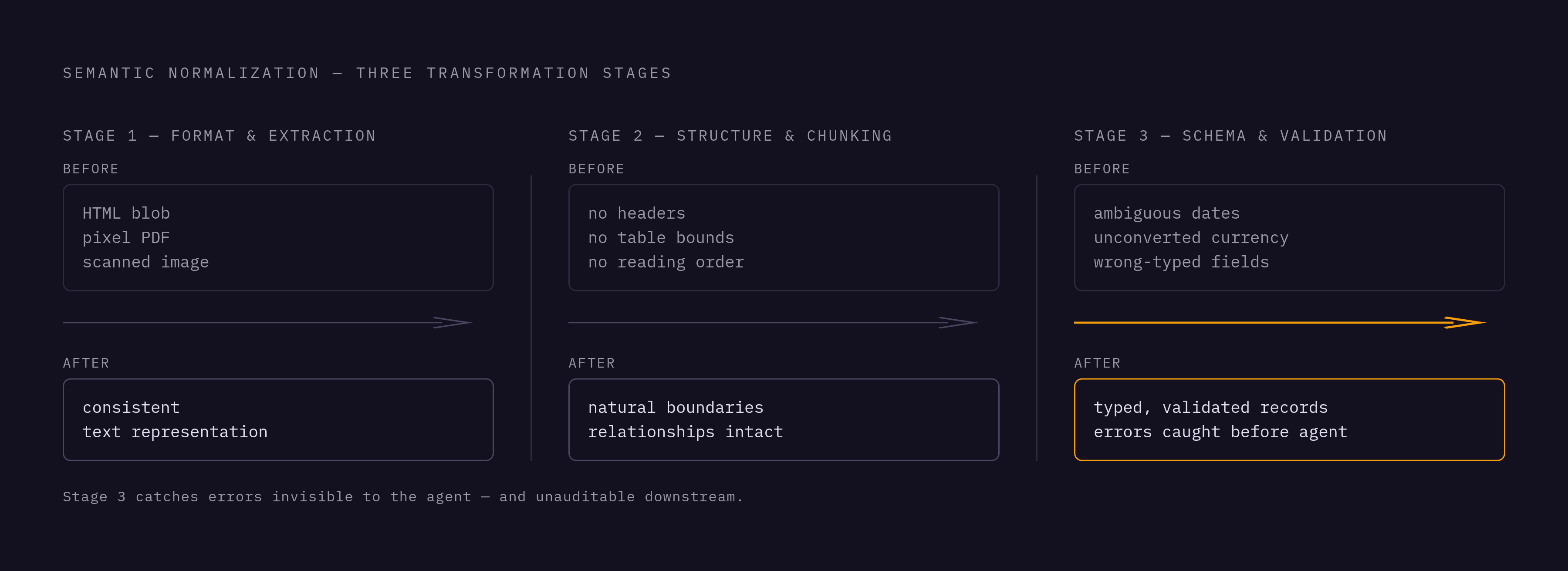
The first job is format normalization and text extraction. Before this stage, the input might be an HTML blob, a pixel-based PDF, or a scanned image. After it, the pipeline has a consistent text representation that later stages can process without separate logic for every format. For HTML, that means removing scripts, navigation, ads, and layout chrome while retaining informational content. For images and scanned documents, OCR supplies the text, so errors caused by skewed scans, handwriting, multiple columns, or embedded image text enter the pipeline here.
The second job is structural understanding and semantic chunking. Before this stage, readable words may still lack clear headers, table boundaries, form-field relationships, or reading order. After it, the content is in groups that keep those relationships intact. Fixed-size chunking cannot make that promise because it cuts at a token count, even when the cut severs a sentence, table row, or clause. Natural boundaries keep related evidence together instead of leaving the model to infer the missing connections.
The third job is schema alignment and validation. Before this stage, a date can be ambiguous, a currency figure can remain unconverted, and a field can contain the wrong kind of value. After it, extracted records must match the fields, types, and value rules that have been set before they reach the agent. Quality checks belong inside normalization because an error that passes through without validation is invisible to the agent and leaves downstream users without an adequate basis for auditing it.
How schema enforcement through LLMs replaces the old NLP extraction stack
The architectural shift is to define the output before extraction. Earlier systems relied on rule-based toolkits, sequence-labeling models, and transformer-based discriminative pipelines that needed training data or per-format rules. Yang et al. 2026 identifies their brittleness when documents vary in layout, terminology, and reporting style. Each change could mean the extraction stack needs to be changed too. Schema-constrained LLMs change that arrangement by making the required record structure part of the extraction call itself.
The LLM-based ETL architecture paper demonstrates this approach with off-the-shelf OCR and a schema-constrained LLM guided by type-checked Pydantic outputs. It also uses a one-pass swap heuristic for efficient few-shot prompting to transform heterogeneous documents into a unified JSON schema without fine-tuning. A shared output contract can replace a collection of layout-specific extraction paths.
Daniel Kang’s 2025 “Analytical Queries for Unstructured Data” describes ways to express queries through user-defined functions, standard structured schemas, and examples. This makes the requested data shape an interface rather than a custom parser buried inside the application. The practical sequence is to define a Pydantic or JSON schema before processing source data, enforce it through function calling or structured output mode, and then validate the result. Types are only the first test. Value constraints and business logic still have to check whether the returned record makes sense.
Where LLM-based normalization still fails and why reliability requires layered defenses
A valid JSON object can still be wrong. Semantic drift can change how a term is read, aliases can lead to a mix-up between entities, and evidence spread across text and images can be missed or put together the wrong way. These failures do not necessarily violate a schema. A pipeline can therefore look sound in testing while losing accuracy as its inputs vary in production. A mature design anticipates those conditions instead of treating a successful structured response as proof of correct extraction.
Reliability requires several defenses with distinct jobs. Source grounding connects extracted claims to a source URL or document location, while ontology constraints use controlled vocabularies to reduce ambiguity. Physical or logical verification flags values that break known constraints, such as a total that does not equal its line items or a date outside a valid range. Confidence checks send outputs that may be wrong to human review. Kang’s work also describes outlier detection and drift detection as responses to errors in analytical queries over unstructured data, making them relevant checks for normalization pipelines.
Those semantic defenses cannot fix fetch failures. Fingerprinting and anti-bot systems are infrastructure constraints that must be handled before normalization receives the page content. This distinction prevents teams from treating every extraction failure as a prompting problem. Schema enforcement checks the shape of the output, grounding and validation check whether the values are right, and fetch infrastructure gets access to the source, so each has its own job.
How the normalization layer fits into a live-web RAG pipeline and why freshness changes the design
Static retrieval-augmented generation can retrieve only what has already been indexed. That works for a stable knowledge base, but a well-structured record can become wrong when its source changes after the last crawl. A live-web pipeline must decide when an indexed answer is sufficient and when the query needs a new fetch. Otherwise, normalization produces precise representations of information that no longer answers the question.
In a hybrid architecture, vector search retrieves owned content that is indexed on a schedule, while live web retrieval handles questions that need current information or fall outside that collection. Both paths still need to follow the same normalization contract. The live path still needs to process text before giving it to the agent, even when it was just fetched, and the indexed path still needs to check that correctly structured data is up to date. Retrieval chooses the evidence, while normalization makes that evidence usable.
Freshness time-to-live settings should follow the topic. Prices, scores, availability, and breaking news need near-real-time re-fetching, while stable reference material can tolerate longer gaps. This choice also affects latency and answer quality. After a live retrieval call, the content still needs cleaning, structural interpretation, extraction, and validation before it can be used. Deciding when to repeat that work is part of the data pipeline.
Schema-driven extraction as the correct abstraction for getting web content into agent tool calls
At the agent boundary, the useful abstraction is a developer-defined JSON schema enforced by the extraction API at fetch time. The agent receives typed, validated objects instead of text it must parse again during inference. That removes a hidden second extraction step. With raw or lightly cleaned text, every call asks the model to reconstruct field boundaries and interpret values anew, increasing token use and inconsistency. Externalizing that work makes the output contract testable and auditable, even though the extracted values still require the defenses described above.
Function calling and structured output mode implement this pattern at the model layer. An extraction API that accepts the same schema extends it to web retrieval, so the requested fields and types remain explicit from the agent’s intent through extraction. The schema becomes a shared contract between stages. This is more useful than asking an agent to read a page and hoping its internal interpretation matches the downstream API. It separates the question of what data is required from the question of how a particular page presents it.
A competitive intelligence agent provides a concrete example. A search API discovers new competitor pages, and an extract API pulls content from each page according to the defined schema. A storage step then saves normalized JSON records with their source URLs. No custom page parser is maintained in that pattern. The stored record is both usable by later tool calls and traceable to the page that supplied it, rather than being an unsupported summary detached from its evidence.
Website change detection as a first-class input to the normalization pipeline, not a monitoring add-on
A source change should start work in the pipeline as well as send a dashboard alert. Traditional website monitoring often relies on CSS selectors and scripts that break when a site redesigns, then sends notifications for a human to interpret. That is a poor boundary for an automated data layer. If the event never starts a re-fetch and re-normalization, the agent can keep getting stale records whose fields still pass every schema check.
Change detection therefore belongs in the pipeline design. Its role is to turn changes in relevant source content into events that fire a webhook and trigger retrieval again. The choice of which pages need continuous watching follows the freshness policy established for RAG. Sources that change often need to be checked often, while stable reference pages can use periodic re-crawls.
That distinction also clarifies what an alert is for. A notification helps a person know that something changed, whereas a pipeline trigger starts the work needed to make the change usable by an agent. The latter includes normalization: new content must pass through the same structural and value checks as the original content. Change detection is thus an input to data processing rather than a separate system that reports problems after stale answers appear.
How do you build a production-grade web scraping pipeline end to end?
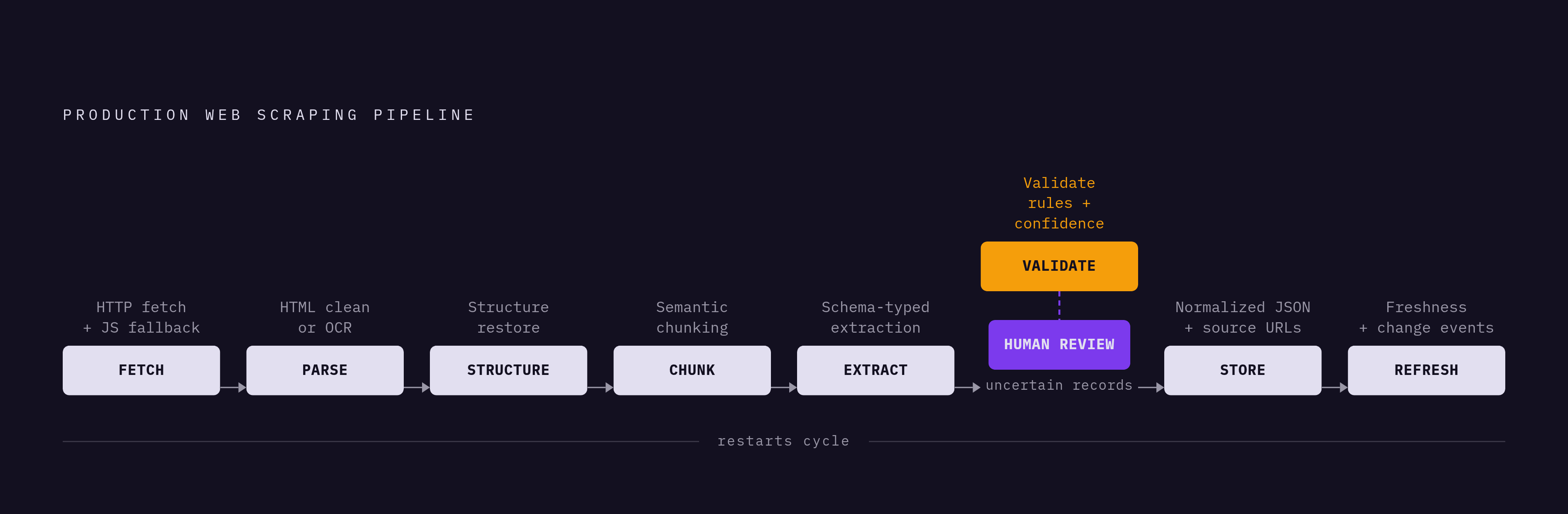
A production pipeline starts with HTTP-first fetching and uses browser rendering as a fallback for JavaScript-heavy pages. Headless rendering adds latency, so it should not be the default for content a static fetch can retrieve. The infrastructure layer should handle proxy rotation and anti-bot handling so application code does not have to. An extraction model cannot compensate for a fetch layer that fails to obtain the source.
The fetched bytes then become format-agnostic text through HTML cleanup or OCR for image-based content. Structural understanding restores headers, tables, fields, and reading order before semantic chunking divides the content at natural boundaries. The extraction call takes the developer-defined schema and returns typed output through function calling or structured output mode. Validation checks business rules and confidence thresholds before uncertain records go to human review. Accepted records can then be stored automatically as normalized JSON with source URLs, while freshness rules and change events determine when the cycle runs again.
HTTP clients and browser rendering handle access, OCR handles image-based text, structural processing preserves relationships, and Pydantic or JSON schemas define the extraction contract. Storage and change detection keep the workflow going. A third-party extraction API introduces dependency and latency, but keeping everything in-house means maintaining fetch infrastructure, proxy pools, OCR, chunking logic, and change-detection scripts. The decision is whether that upkeep deserves engineering time that could otherwise ship features.